Clinical Trial
. 2021 May;29(5):745-759.
doi: 10.1038/s41431-020-00793-7. Epub 2021 Jan 17.

Employing a systematic approach to biobanking and analyzing clinical and genetic data for advancing COVID-19 research

Collaborators, Affiliations
Clinical Trial

Employing a systematic approach to biobanking and analyzing clinical and genetic data for advancing COVID-19 research

Sergio Daga et al. Eur J Hum Genet. 2021 May.

Abstract

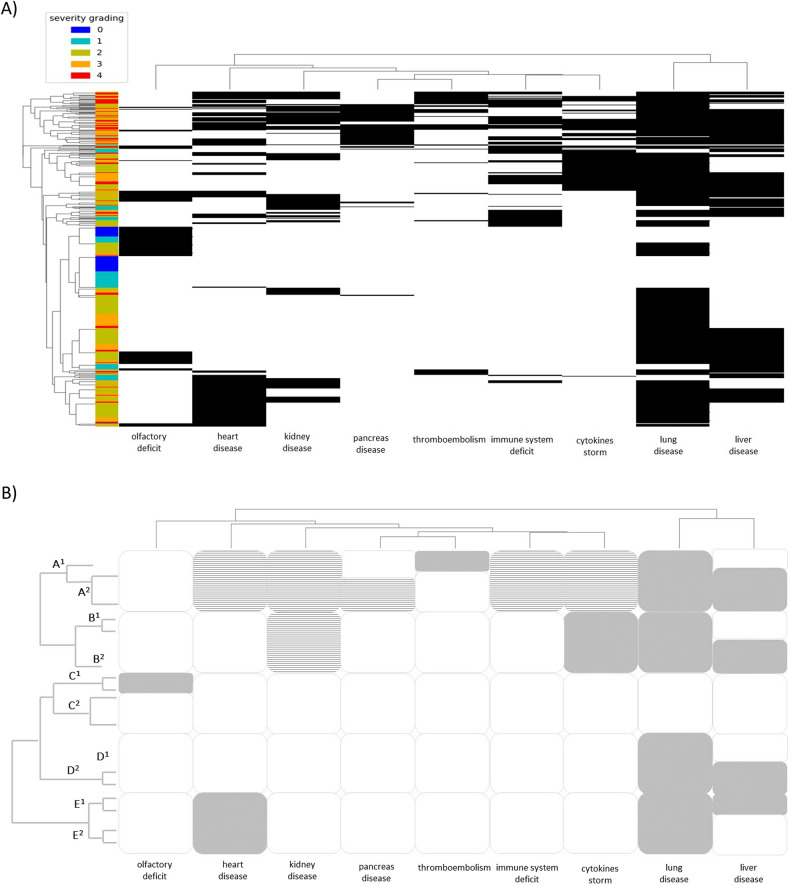
Within the GEN-COVID Multicenter Study, biospecimens from more than 1000 SARS-CoV-2 positive individuals have thus far been collected in the GEN-COVID Biobank (GCB). Sample types include whole blood, plasma, serum, leukocytes, and DNA. The GCB links samples to detailed clinical data available in the GEN-COVID Patient Registry (GCPR). It includes hospitalized patients (74.25%), broken down into intubated, treated by CPAP-biPAP, treated with O2 supplementation, and without respiratory support (9.5%, 18.4%, 31.55% and 14.8, respectively); and non-hospitalized subjects (25.75%), either pauci- or asymptomatic. More than 150 clinical patient-level data fields have been collected and binarized for further statistics according to the organs/systems primarily affected by COVID-19: heart, liver, pancreas, kidney, chemosensors, innate or adaptive immunity, and clotting system. Hierarchical clustering analysis identified five main clinical categories: (1) severe multisystemic failure with either thromboembolic or pancreatic variant; (2) cytokine storm type, either severe with liver involvement or moderate; (3) moderate heart type, either with or without liver damage; (4) moderate multisystemic involvement, either with or without liver damage; (5) mild, either with or without hyposmia. GCB and GCPR are further linked to the GCGDR, which includes data from whole-exome sequencing and high-density SNP genotyping. The data are available for sharing through the Network for Italian Genomes, found within the COVID-19 dedicated section. The study objective is to systematize this comprehensive data collection and begin identifying multi-organ involvement in COVID-19, defining genetic parameters for infection susceptibility within the population, and mapping genetically COVID-19 severity and clinical complexity among patients.


Conflict of interest statement

The authors declare that they have no conflict of interest.

Figures
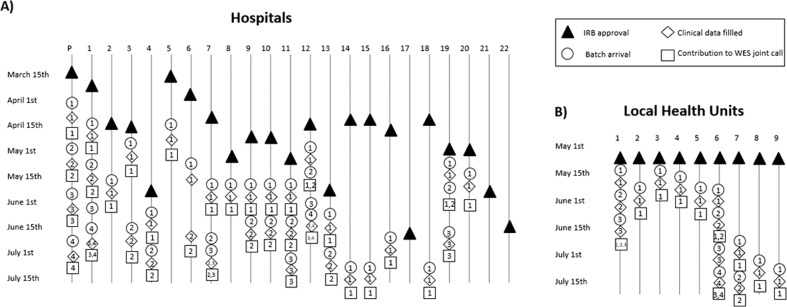
Fig. 1
Fig. 1. Timeline of GEN-COVID Multicenter study.
A Main milestones of the study with the timeline for the 22 Italian hospitals (P: Promoter, Policlinico Santa Maria Alle Scotte, Azienda Ospedaliera Universitaria Senese, Siena; 1: San Matteo Hospital Fondazione IRCCS, Pavia; 2:ASST Santi Paolo e Carlo, University of Milan, Italy; 3: Ospedale Maggiore di Crema, Italy; 4: ASST Valtellina e Alto Lario, Sondrio; 5: University Hospital of Modena and Reggio Emilia, Modena; 6: IRCCS, Lazzaro Spallanzani, Rome; 7: ASST-FBF-Sacco, Milan; 8: Santa Maria Hospital, Azienda Ospedaliera di Perugia, Perugia; 9: Treviso Hospital, Local Health Unit (ULSS) 2 Marca Trevigiana, Treviso; 10: Ospedale dell’Angelo, ULSS 3 Serenissima, Mestre; 11: Belluno Hospital, ULSS 1 Dolomiti, Belluno; 12: ASST Spedali Civili Hospital, Brescia; 13: Policlinico San Martino Hospital, IRCCS, Genova; 14: AORN dei Colli, Monaldi Hospital, Naples; 15: A.O.R.N. “Antonio Cardarelli”, Naples; 16: Fondazione IRCCS Casa Sollievo della Sofferenza Hospital, San Giovanni Rotondo; 17: IRCCS Istituto G. Gaslini, Genoa; 18: CEINGE Biotecnologie Avanzate, Naples; 19: San Donato Hospital, Arezzo; 20: Misericordia Hospital, Grosseto; 21: Fondazione Policlinico Universitario Agostino Gemelli IRCCS; 22: Luigi Curto Hospital, Polla (SA)). B Main milestones of the study with the timeline for local health units (Continuity Assistance Special Units, USCA) and departments of preventive medicine (1. USCA, Chianciano; 2: USCA Sansepolcro; 3: USCA Siena; 4: USCA Orbetello; 5: USCA Arezzo; 6: Department of preventive medicine Senese, Siena; 7: Department of preventive medicine Aretino-Casentino-Valtiberina, Arezzo; 8: Department of preventive medicine Alta Val d’Elsa, Poggibonsi; 9: Department of preventive medicine Amiata Senese e Val d’Orcia - Valdichiana Senese, Montepulciano). Other 11 USCA and 4 departments of preventive medicine have obtained IRB approval and they are going to start sample collection.
Fig. 2
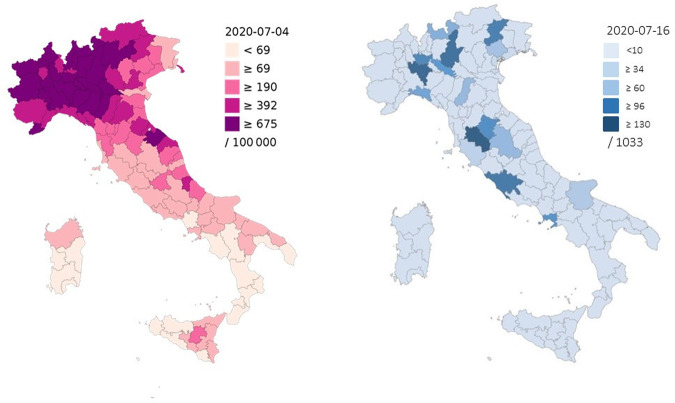
Fig. 2. Geographical coverage.
Comparison of GEN-COVID geographical coverage (right) and the incidence of SARS-CoV-2 infection per 100,000 inhabitants by Italian provinces (left).
Fig. 3
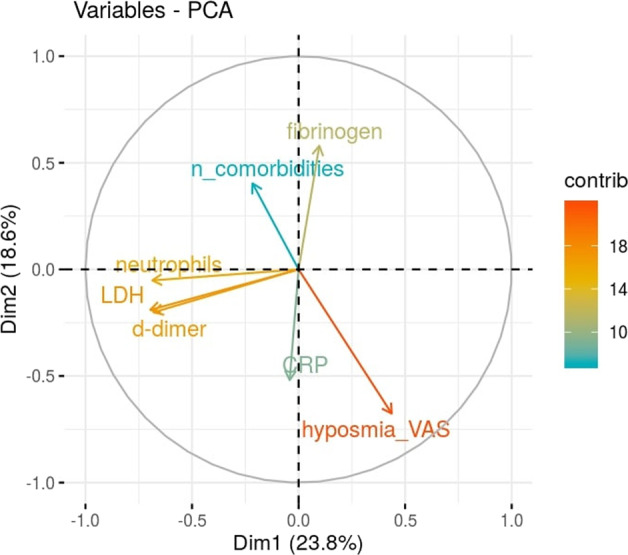
Fig. 3. PCA variables plot.
Eigenvector-based coordinates of the original variables in the two-dimensional space defined by the first two principal components. The relative position of the clinical variables reflect their relationship (positive correlated variables point to the same side of the plot; negative correlated variables point to opposite sides of the plot), while the length of the arrow is proportional to their contribution to the principal components.
Fig. 4
Fig. 4. Phenotypic clustering of COVID-19 patients.
A Dendrogram of COVID-19 patients’ clinical phenotypes by hierarchical clustering of organ/system involvement. B Drawing of the above reported graph helping interpretation and simplification in the main branch of the tree. A1 severe multisystemic with either thromboembolic; A2 severe multisystemic with pancreatic variant; B1 cytokine storm with moderate liver involvement; B2 cytokine storm with severe liver involvement; C1 mild with hyposmia; C2 mild without hyposmia; D1 moderate without liver damage; D2 moderate with liver damage; E1 heart with liver damage; E2 heart without liver damage.

References

    1. Wilkinson M, Dumontier M, Aalbersberg I, Appleton G, Axton M, Baal A, et al. The FAIR Guiding Principles for scientific data management and stewardship. Sci Data. 2019;6:6. - PMC - PubMed
    1. Zhu N, Zhang D, Wang W, Li X, Yang B, Song J, et al. A novel coronavirus from patients with pneumonia in China, 2019. N Engl J Med. 2020;382:727–33. - PMC - PubMed
    1. Italian Civil Protection Department—COVID-19 case update. http://opendatadpc.maps.arcgis.com/apps/opsdashboard/index.html#/b0c68bc.... - PMC - PubMed
    1. Wu Z, McGoogan JM. Characteristics of and important lessons from the coronavirus disease 2019 (COVID-19) outbreak in China: summary of a report of 72 314 cases from the Chinese Center for Disease Control and Prevention. JAMA. 2020. 10.1001/jama.2020.2648. - PubMed
    1. Benetti E, Tita R, Spiga O, Ciolfi A, Birolo G, Bruselles A, et al. ACE2 gene variants may underlie interindividual variability and susceptibility to COVID-19 in the Italian population. Eur J Hum Genet. 2020;28:1602–14. - PMC - PubMed