


Review
doi: 10.1016/j.bjae.2019.04.002.
Epub 2019 Jun 14.
Emergency front of neck access in airway management
Affiliations
- PMID: 33456898
- PMCID: PMC7807984
- DOI: 10.1016/j.bjae.2019.04.002
Item in Clipboard
Review
Emergency front of neck access in airway management
BJA Educ.
2019 Aug.
No abstract available
Figures

DAS Difficult intubation guidelines—overview. Difficult Airway Society 2015. With permission from the Difficult Airway Society

Transverse thyroid cartilage-airline-cricoid cartilage-airline (‘TACA’) method for ultrasound identification of the CTM. Step 1— ‘T’: A linear high frequency array probe is placed transverse on the anterior neck at the estimated level of the thyroid cartilage. The transducer is moved until the thyroid cartilage is identified as a triangular structure. Step 2— ‘A’: The probe is moved caudally until the CTM is identified as a hyperechoic white line resulting from the air-tissue border of the mucosal lining, the airline. Reverberation artefacts will often be visible below as parallel white lines. Step 3— ‘C’: The probe is moved caudally again until the cricoid cartilage is identified as a ‘black lying C’ with a white lining. Step 4— ‘A’: The probe is repositioned cephalad until the centre of the CTM can be identified again as the airline. Step 5—The midpoint of the CTM can then be marked with a pen by placing a dot at the midpoint of the transducer on all four sides and subsequently connecting the dots. With permission from Michael S. Kristensen, The Scandinavian Airway management course, www.airwaymanagement.dk , illustration from Br J Anaesth..
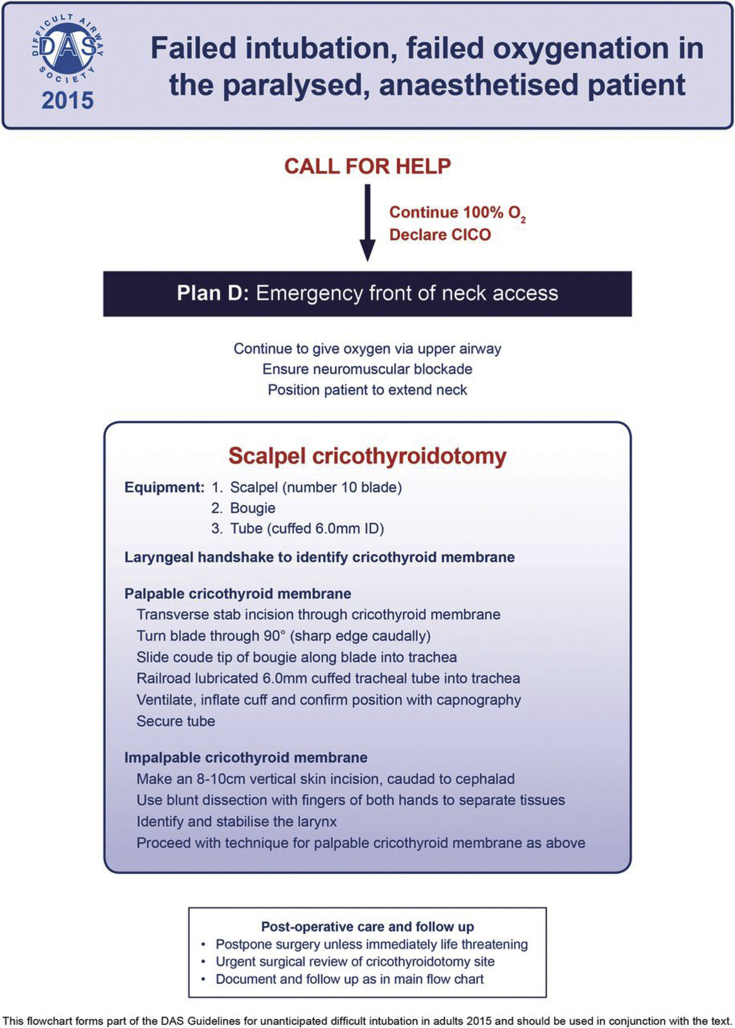
DAS 2015 guidelines for failed intubation, failed oxygenation in the paralysed, anaesthetised patient. Technique for scalpel cricothyroidotomy. With permission from the Difficult Airway Society.
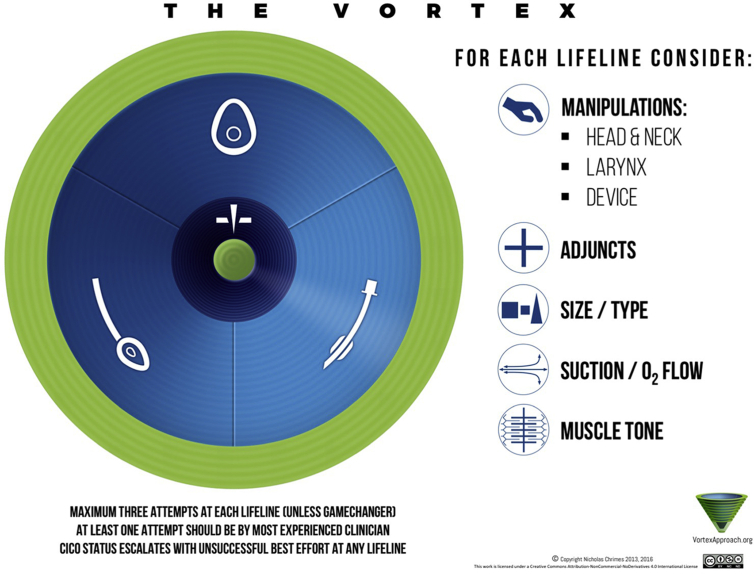
The Vortex implementation tool. Copyright Nicholas Chrimes. Used with permission.

Difficult Airway Society algorithm for tracheal intubation in critically ill adults. With permission of the Difficult Airway Society.

Difficult Airway Society guidelines for the management of tracheal intubation in critically ill adults - “Can’t intubate, Can’t oxygenate” algorithm. With permission of the Difficult Airway Society.

Laryngeal handshake. Step 1: Using the thumb and index finger of the non-dominant hand, palpate the top of the larynx and roll from side to side. Step 2: Slide the finger and thumb down over the thyroid laminae. Step 3: Palpate the cricoid cartilage with the middle finger and thumb. Now use the index finger to palpate the cricothyroid membrane.

Supplementary figure 4The longitudinal ‘string of pearls’ method for ultrasound identification of the cricothyroid membrane. With permission from Michael S. Kristensen, The Scandinavian Airway management course, www.airwaymanagement.dk, illustration from British Journal of Anaesthesia 2016; 117(S1): i39-i48.

‘Scalpel-bougie-tube’ cricothyroidotomy technique.

The CICO status implementation tool. Copyright Nicholas Chrimes. Used with permission.
References
-
- Cook T.M., Woodall N., Frerk C. Fourth National Audit Project of the Royal College of Anaesthetists and Difficult Airway Society. In: Cook T.M., Woodall N., Frerk C., editors. Major complications of airway management in the United Kingdom. Report and findings. Royal College of Anaesthetists; London: London: 2011. - PubMed
-
- Higgs A., McGrath B.A., Goddard C. Guidelines for the management of tracheal intubation in critically ill adults. Br J Anaesth. 2018;120:323–352. - PubMed
-
- Peterson G.N., Domino K.B., Caplan R.A., Posner K.L., Lee L.A., Cheney F.W. Management of the difficult airway: a closed claims analysis. Anesthesiology. 2005;103:33–39. - PubMed
-
- Weightman W., Gibbs N.M. Prevalence of major vessels anterior to the trachea at sites of potential front-of-neck emergency airway access in adults. Br J Anaesth. 2018;121:1166–1172. - PubMed
Publication types
LinkOut - more resources
Full Text Sources
