Magnetic resonance imaging reduces the rate of unnecessary operations in pregnant patients with suspected acute appendicitis: a retrospective study
- PMID: 33457396
- PMCID: PMC7791189
- DOI: 10.4174/astr.2021.100.1.40
Magnetic resonance imaging reduces the rate of unnecessary operations in pregnant patients with suspected acute appendicitis: a retrospective study
Abstract
Purpose: This is a retrospective single-institution study performed to compare the rate of unnecessary operations in pregnant women with suspected acute appendicitis with and without the use of MRI.
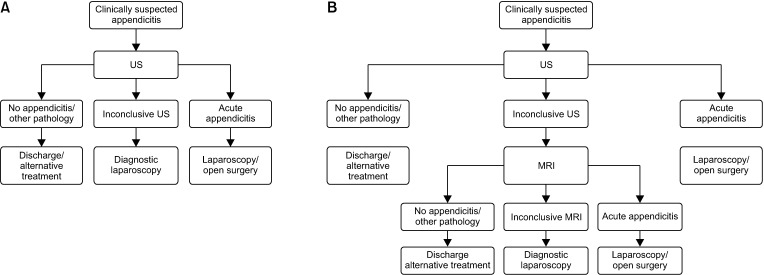
Methods: The study subjects were all pregnant women with suspected acute appendicitis admitted to a tertiary institution from January 2012 to December 2019. If acute appendicitis was not excluded clinically and by ultrasound (US), laparoscopies were performed until May 2017 (US-only group). MRI was added as a diagnostic tool when US was inconclusive from May 2017 (US + MRI group). Surgery was considered unnecessary when no inflamed appendix was found. The rate of unnecessary surgery, postoperative complications, length of stay were analyzed.
Results: Seventy-six women were included in the study; 38 women in the US-only group and 38 women in the US + MRI group. There were no differences in admission characteristics between the groups. One of 38 women (2.6%) underwent unnecessary surgery in the US + MRI group vs. 10 of 38 (26.3%) in the US-only group (P = 0.007). The patients in the US + MRI group were significantly less likely to undergo a diagnostic operation than in the US-only group (5.26% vs. 55.3%, respectively; P < 0.001) and their hospital stay was significantly shorter (0.74 ± 1.64 days vs. 3.7 ± 3.0 days, respectively; P < 0.001). The obstetric outcomes were not different between the groups. MRI had a sensitivity of 83.3% and specificity of 100% in the series.
Conclusion: The rate of unnecessary surgery was significantly reduced in pregnant women, who underwent MRI after inconclusive transabdominal US.
Keywords: Appendicitis; Diagnostic imaging; Magnetic resonance imaging; Pregnancy.
Copyright © 2021, the Korean Surgical Society.
Conflict of interest statement
Conflict of Interest: No potential conflict of interest relevant to this article was reported.
Figures
References
-
- De Wilde JP, Rivers AW, Price DL. A review of the current use of magnetic resonance imaging in pregnancy and safety implications for the fetus. Prog Biophys Mol Biol. 2005;87:335–353. - PubMed
-
- Mourad J, Elliott JP, Erickson L, Lisboa L. Appendicitis in pregnancy: new information that contradicts long-held clinical beliefs. Am J Obstet Gynecol. 2000;182:1027–1029. - PubMed
LinkOut - more resources
Full Text Sources
Other Literature Sources