


Optimizing radiosurgery with photons for ocular melanoma
- PMID: 33458394
- PMCID: PMC7807539
- DOI: 10.1016/j.phro.2018.06.001
Optimizing radiosurgery with photons for ocular melanoma
Abstract
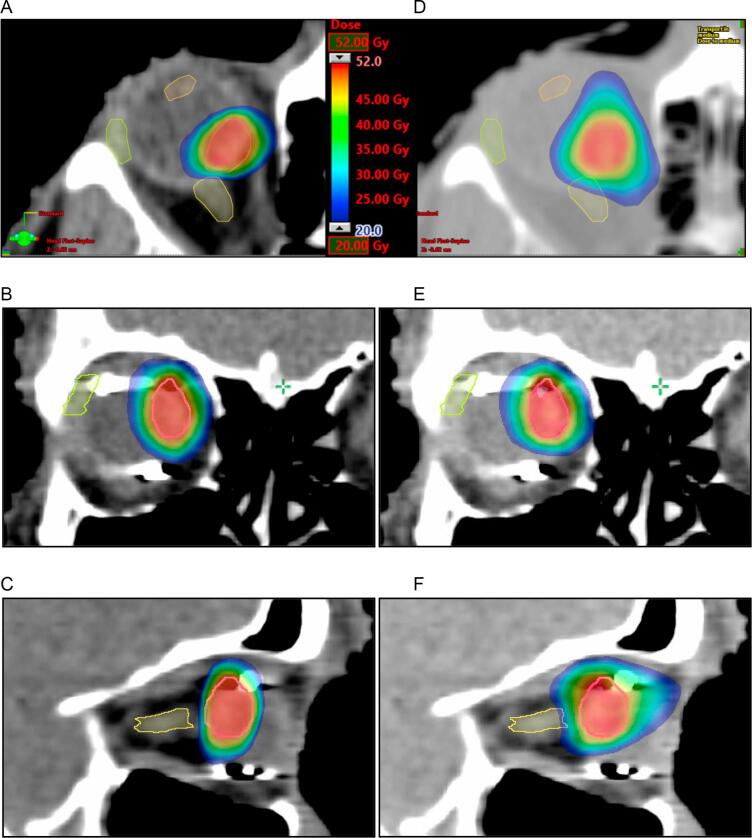
Background and purpose: Photon radiotherapy has been established for the treatment of ocular melanoma (OM). Here we investigate the planning qualities of two different planning approaches, a combination of dynamic conformal arcs (DCA) complemented with multiple non-coplanar static intensity-modulated (IMRT) fields (DCA-IMRT), and volumetric modulated arc therapy (VMAT) in combination with automated planning (AP).
Materials and methods: Thirteen consecutive patients treated for ocular melanoma with curative intent on a Linac-based radiosurgery system were analyzed. Fractionated stereotactic radiosurgery (fSRS) was applied using 50 Gy in 5 fractions using the combination of DCA-IMRT. Plans were reviewed and the thirteen cases were compared to plans obtained with optimized automated VMAT based on a set of 28 distinct patients treated with DCA-IMRT who were selected to generate the AP model for the prediction of dose volume constraints.
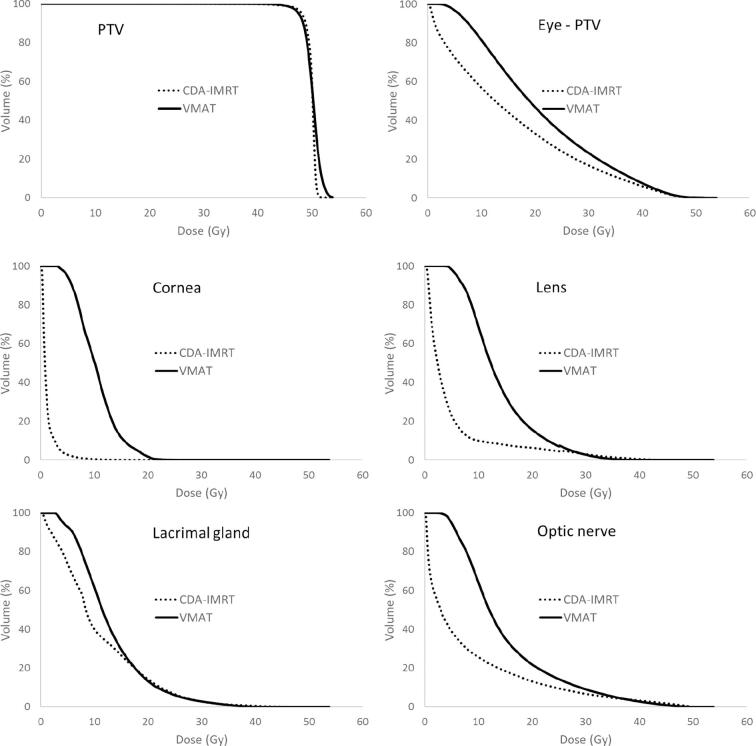
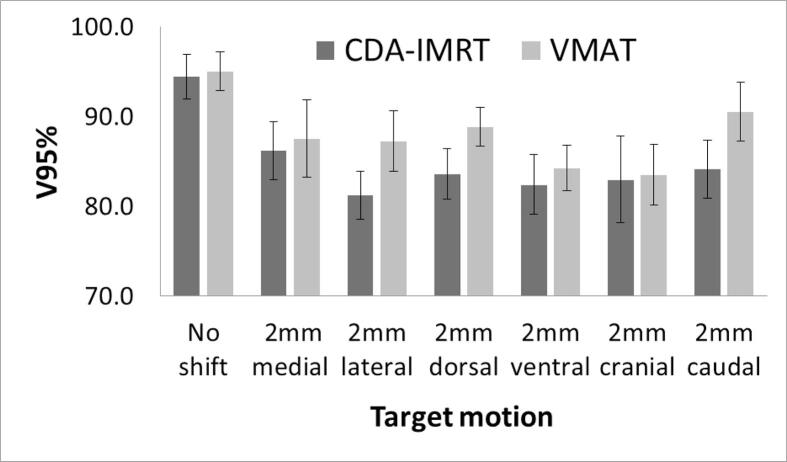
Results: Overall, plan quality of DCA-IMRT was superior to AP with VMAT. PTV coverage did not exceed 107% in any case treated with DCA-IMRT, compared to seven patients with VMAT. The median PTV covered by >95% was 98.3% (91.9%-99.7%) with DCA-IMRT, compared to 95.1% (91.5%-97.9%) (p < 0.01) with VMAT. The median mean dose delivered to the treated eye was 22.4 Gy (12.3 Gy-33.3 Gy) with DCA-IMRT compared to 27.2 Gy (15.5 Gy-33.7 Gy) (p < 0.01). Dose to the ipsilateral lacrimal gland and the ipsilateral optic nerve were comparable for DCA-IMRT and VMAT, however, the dose to the lens was lower with DCA-IMRT compared to VMAT.
Conclusions: The combination of multiple arcs complemented with multiple IMRT fields sets the gold standard for fSRS of ocular melanoma for photon therapy.
Keywords: Automated planning; Choroidal melanoma; HybridArc; IMRT; Melanoma; Ocular melanoma; Radiosurgery; SBRT; Stereotactic; Uveal melanoma; VMAT.
© 2018 The Authors.
Figures
References
-
- Georg D., Dieckmann K., Bogner J., Zehetmayer M., Potter R. Impact of a micromultileaf collimator on stereotactic radiotherapy of uveal melanoma. Int J Radiat Oncol Biol Phys. 2003;55:881–891. - PubMed
-
- Dieckmann K., Georg D., Zehetmayer M., Bogner J., Georgopoulos M., Potter R. LINAC based stereotactic radiotherapy of uveal melanoma: 4 years clinical experience. Radiother Oncol. 2003;67:199–206. - PubMed
-
- Weber D.C., Bogner J., Verwey J., Georg D., Dieckmann K., Escude L. Proton beam radiotherapy versus fractionated stereotactic radiotherapy for uveal melanomas: A comparative study. Int J Radiat Oncol Biol Phys. 2005;63:373–384. - PubMed
-
- Hocht S., Stark R., Seiler F., Heufelder J., Bechrakis N.E., Cordini D. Proton or stereotactic photon irradiation for posterior uveal melanoma? A planning intercomparison. Strahlenther Onkol. 2005;181:783–788. - PubMed
-
- Muller K., Naus N., Nowak P.J., Schmitz P.I., de Pan C., van Santen C.A. Fractionated stereotactic radiotherapy for uveal melanoma, late clinical results. Radiother Oncol. 2012;102:219–224. - PubMed
LinkOut - more resources
Full Text Sources
