. 2018 Dec 20:9:14-20.
doi: 10.1016/j.phro.2018.12.002. eCollection 2019 Jan.

Cone beam computed tomography-based monitoring and management of target and organ motion during external beam radiotherapy in cervical cancer

Affiliations

Cone beam computed tomography-based monitoring and management of target and organ motion during external beam radiotherapy in cervical cancer

Nina Boje Kibsgaard Jensen et al. Phys Imaging Radiat Oncol. .

Abstract

Background and purpose: Organ motion is a challenge during high-precision external beam radiotherapy in cervical cancer, and improved strategies for treatment adaptation and monitoring of target dose coverage are needed. This study evaluates a cone beam computed tomography (CBCT)-based approach.

Materials and methods: In twenty-three patients, individualized internal target volumes (ITVs) were generated from pre-treatment MRI and CT scans with full and empty bladders. The target volumes encompassed high-risk clinical target volume (CTV-T HR) (gross tumor volume + remaining cervix) and low risk (LR) CTV-T (CTV-T HR + uterus + parametriae + upper vagina). Volumetric Modulated Arc Therapy (VMAT) was used to deliver a dose of 45 Gy in 25 fractions. CBCTs were used for setup and for radiation therapists (RTTs) to evaluate the target coverage (inside/outside the planning target volume). CBCTs were reviewed offline. Estimates of the dose delivered with minimum (point) doses across all fractions to CTV-T HR (aim 42.75 Gy) and CTV-T LR (aim 40 Gy) were assessed. In patients with insufficient dose coverage, re-plans were generated based on previous imaging.

Results: Median (range) of the ITV-margins (mean of anterior-posterior margins) related to uterus and cervix was 1.2 (0.5-2.2 and 1.0-2.1) cm. RTTs were able to assess the target coverage in 90% of all CBCTs (505/563). With re-planning, one patient had considerable benefit (12.7 Gy increase of minimum dose) to CTV-T LR_vagina, four patients had improved dose to the CTV-T LR_uterus (1.2-1.8 Gy), and 3 patients did not benefit from re-planning.

Conclusions: Daily CBCT-based monitoring of target coverage by the RTTs has proven safe with limited workload. It allows for reduction in the treated volumes without compromising the target dose coverage.

Keywords: Adaptive radiotherapy; Cervical cancer; Cone-beam computed tomography; External beam radiotherapy; Image guidance; Interfraction motion.


Figures

Fig. 1
Fig. 1
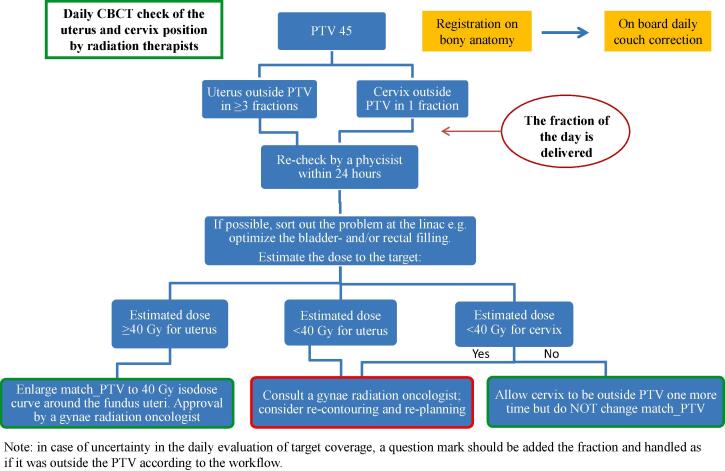
Clinical adaptive workflow with thresholds for action according to target coverage and minimum point dose estimates. Abbreviations: PTV 45 = planning target volume treated to 45 Gy; Match_PTV = a structure applied by the physicists to verify target dose coverage.
Fig. 2
Fig. 2
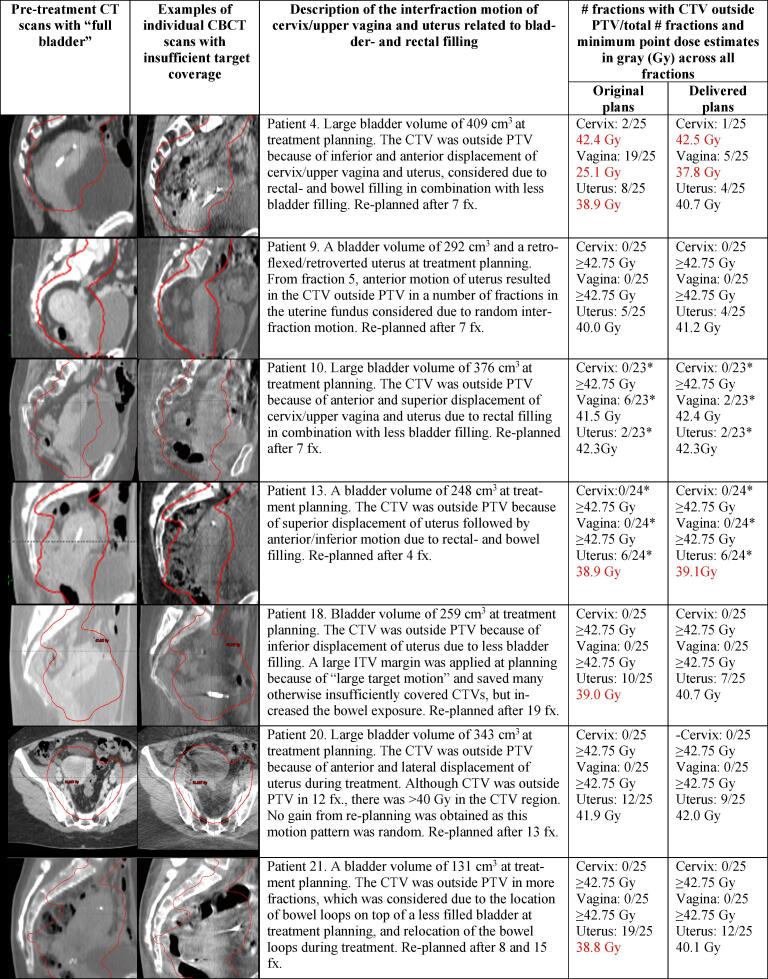
Target- and organ-related motion illustrated with the pre-treatment CT and a cone beam CT scan (CBCT) in re-planned patients. Number of fractions (fx.) with CTV outside PTV for cervix, upper vagina and uterus are provided with minimum point dose estimates across all fractions for original- and delivered plans (dose estimates from the original plan up to re-planning + dose estimates from the re-plan). “Large planning bladder volumes” are defined as volumes exceeding 300 cm3. Abbreviations: PTV = planning target volume (red line); CTV = clinical target volume; ITV = internal target volume. *Three CBCTs are not available in the database. (For interpretation of the references to colour in this figure legend, the reader is referred to the web version of this article.)
Fig. 3
Fig. 3
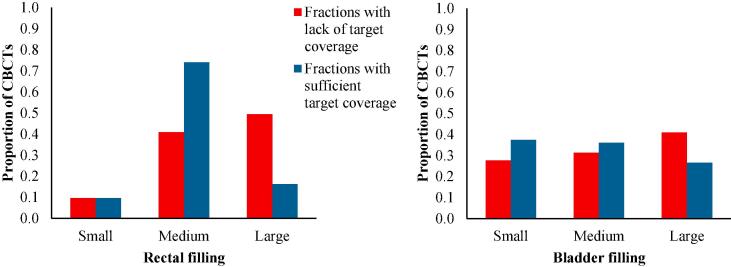
The influence of rectum and bladder fillings on target coverage in 23 patients with a total of 569 cone beam CTs (CBCTs) (75 CBCTs were not included in the right panel because the bladder filling protocol was not applied in three patients). Blue columns represent pooled fractions with sufficient target coverage (cervix, upper vagina and uterus) with a total of 486 CBCTs in the left panel and 411 CBCTs in the right panel. Red columns represent pooled fractions with lack of target coverage (total of 83 CBCTs). (For interpretation of the references to colour in this figure legend, the reader is referred to the web version of this article.)
Fig. 4
Fig. 4
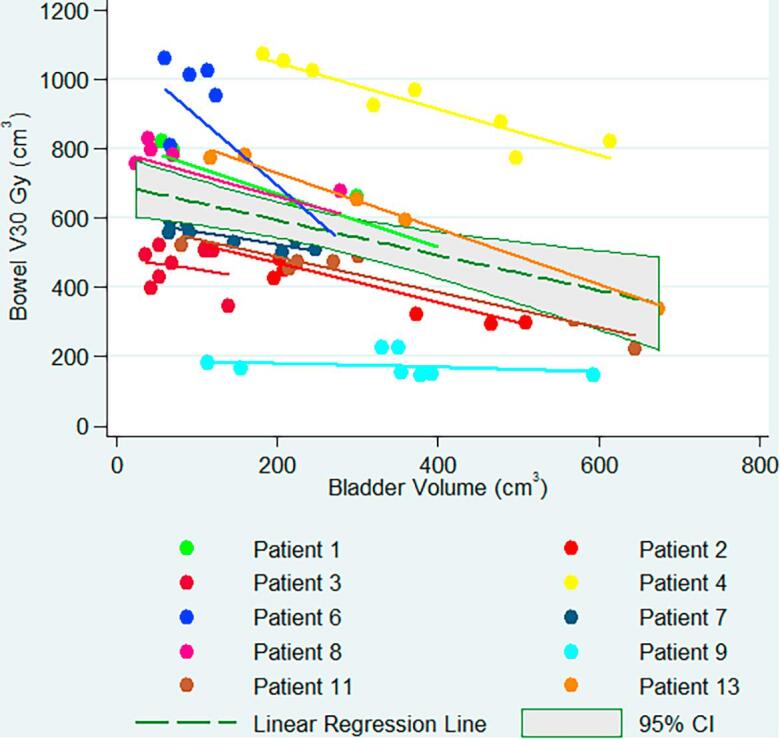
Volume of bowel receiving 30 Gy as a function of bladder volume in 10 patients.

References

    1. Hymel R., Jones G.C., Simone C.B., 2nd Whole pelvic intensity-modulated radiotherapy for gynecological malignancies: a review of the literature. Crit Rev Oncol Hematol. 2015;94:371–379. doi: 10.1016/j.critrevonc.2014.12.015. - DOI - PMC - PubMed
    1. Jadon R., Pembroke C.A., Hanna C.L., Palaniappan N., Evans M., Cleves A.E. A systematic review of organ motion and image-guided strategies in external beam radiotherapy for cervical cancer. Clin Oncol. 2014;26:185–196. doi: 10.1016/j.clon.2013.11.031. - DOI - PubMed
    1. Bondar L., Hoogeman M., Mens J.W., Dhawtal G., de Pree I., Ahmad R. Toward an individualized target motion management for IMRT of cervical cancer based on model-predicted cervix-uterus shape and position. Radiother Oncol. 2011;99:240–245. doi: 10.1016/j.radonc.2011.03.013. - DOI - PubMed
    1. Tyagi N., Lewis J.H., Yashar C.M., Vo D., Jiang S.B., Mundt A.J. Daily online cone beam computed tomography to assess interfractional motion in patients with intact cervical cancer. Int J Radiat Oncol Biol Phys. 2011;80:273–280. doi: 10.1016/j.ijrobp.2010.06.003. - DOI - PubMed
    1. Bondar M.L., Hoogeman M.S., Mens J.W., Quint S., Ahmad R., Dhawtal G. Individualized nonadaptive and online-adaptive intensity-modulated radiotherapy treatment strategies for cervical cancer patients based on pretreatment acquired variable bladder filling computed tomography scans. Int J Radiat Oncol Biol Phys. 2012;83:1617–1623. doi: 10.1016/j.ijrobp.2011.10.011. - DOI - PubMed

LinkOut - more resources