Quadriceps muscle strength in Duchenne muscular dystrophy and effect of corticosteroid treatment
- PMID: 33458575
- PMCID: PMC7783426
- DOI: 10.36185/2532-1900-023
Quadriceps muscle strength in Duchenne muscular dystrophy and effect of corticosteroid treatment
Abstract
Objectives: In Duchenne muscular dystrophy, quadriceps weakness is recognized as a key factor in gait deterioration. The objective of this work was three-fold: first, to document the strength of the quadriceps in corticosteroid-naïve DMD boys; second, to measure the effect of corticosteroids on quadriceps strength; and third, to evaluate the correlation between baseline quadriceps strength and the age when starting corticosteroids with the loss of ambulation.
Methods: Quadriceps muscle strength using hand-held dynamometry was measured in 12 ambulant DMD boys who had never taken corticosteroids and during corticosteroid treatment until the loss of ambulation.
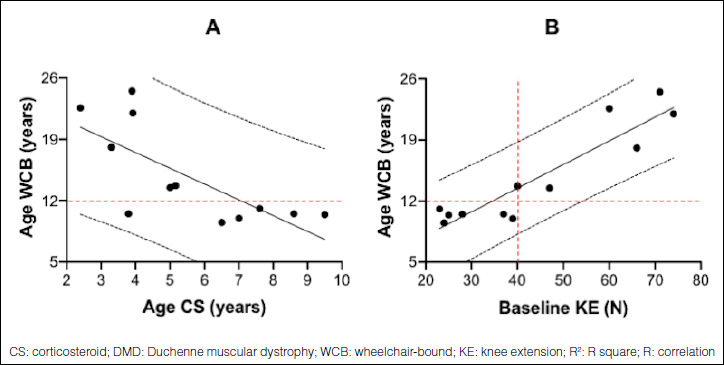
Results: Baseline quadriceps muscle strength at 6 years of age was 28% that of normal children of the same age; it decreased to 15% at 8 years and to 6% at 10 years. The increase in quadriceps muscle strength obtained after 1 year of corticosteroid treatment had a strong direct correlation with the baseline strength (R = 0.96). With corticosteroid treatment, the age of ambulation loss showed a very strong direct relationship (R = 0.92) with baseline quadriceps muscle strength but only a very weak inverse relationship (R = -0.73) with the age of starting treatment. Age of loss of ambulation was 10.3 ± 0.5 vs 19.1 ± 4.7 (P < 0.05) in children with baseline quadriceps muscle strength less than or greater than 40 N, respectively.
Conclusions: Corticosteroid-naïve DMD boys have a quantifiable severe progressive quadriceps weakness. This long-term study, for the first time, shows that both of the positive effects obtained with CS treatment, i.e. increasing quadriceps strength and delaying the loss of ambulation, have a strong and direct correlation with baseline quadriceps muscle strength. As such, hand-held dynamometry may be a useful tool in the routine physical examination and during clinical trial assessment.
Keywords: Duchenne muscular dystrophy; corticosteroid treatment; hand-held dynamometry; prolongation of walking; quadriceps muscle strength.
©2020 Gaetano Conte Academy - Mediterranean Society of Myology, Naples, Italy.
Conflict of interest statement
Conflict of interest The Authors declare no conflict of interest
Figures


References
-
- Gowers WR. A manual of disease of the nervous system. London: Churchill; 1886.
-
- Sussman M. Duchenne muscular dystrophy. J Am Acad Orthop Surg 2002;10:138-51. https://doi.org/10.5435/00124635-200203000-00009 10.5435/00124635-200203000-00009 - DOI - PubMed
-
- Bryanton MA, Carey JP, Kennedy MD, et al. Quadriceps effort during squat exercise depends on hip extensor muscle strategy. Sports Biomech 2015;14:122-38. https://doi.org/10.1080/14763141.2015.1024716 10.1080/14763141.2015.1024716 - DOI - PubMed
-
- Ganjwala D, Shah H. Management of the knee problems in spastic cerebral palsy. Indian J Orthop 2019;53:53-62. https://doi.org/10.4103/ortho.IJOrtho_339_17 10.4103/ortho.IJOrtho_339_17 - DOI - PMC - PubMed
-
- Scott OM, Hyde SA, Goddard C, et al. Quantitation of muscle function in children: a prospective study in Duchenne muscular dystrophy. Muscle Nerve 1982;5:291-301. https://doi.org/10.1002/mus.880050405 10.1002/mus.880050405 - DOI - PubMed
MeSH terms
Substances
LinkOut - more resources
Full Text Sources
Medical
Research Materials