


Improving the Diagnosis of the Frontal Variant of Alzheimer's Disease with the DAPHNE Scale
- PMID: 33459637
- PMCID: PMC7990430
- DOI: 10.3233/JAD-201088
Improving the Diagnosis of the Frontal Variant of Alzheimer's Disease with the DAPHNE Scale
Abstract
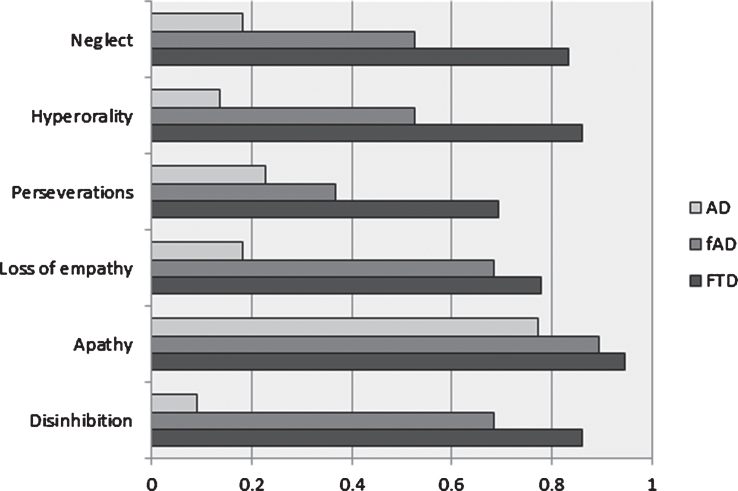
Background: The frontal variant of Alzheimer's disease (fAD) is poorly understood and poorly defined. The diagnosis remains challenging. The main differential diagnosis is the behavioral variant of frontotemporal degeneration (bvFTD). For fAD, there is some dissociation between the clinical frontal presentation and imaging and neuropathological studies, which do not always find a specific involvement of the frontal lobes. DAPHNE is a behavioral scale, which demonstrated excellent performance to distinguish between bvFTD and AD.
Objective: The aim of the present study was to assess the reliability of this new tool to improve the clinical diagnosis of fAD.
Methods: Twenty fAD patients and their caregivers were prospectively included and were compared with 36 bvFTD and 22 AD patients.
Results: The three main behavioral disorders in the fAD patients were apathy, loss of empathy, and disinhibition. Three disorders were discriminant because they were less frequent and less severe in the fAD patients than in the bvFTD patients, namely hyperorality, neglect, and perseverations. This specific pattern of behavioral disorders was corroborated by SPECT or 18FDG PET-CT scan that showed that patients with fAD could have a medial frontal hypoperfusion, whereas in bvFTD patients the orbitofrontal cortex was the main involved region, with more diffuse hypoperfusion.
Conclusion: We demonstrated that DAPHNE had good sensitivity and good specificity to discriminate between the three groups and in particular between fAD and bvFTD patients. DAPHNE is a quick tool that could help clinicians in memory clinics not only to differentiate bvFTD from typical AD but also from fAD.
Keywords: Alzheimer’s disease; behavioral disorders; frontotemporal dementia; scale.
Conflict of interest statement
Authors’ disclosures available online (
Figures

References
-
- Mesulam M-M (1982) Slowly progressive aphasia without generalized dementia. Ann Neurol 11, 592–598. - PubMed
-
- Benson DF, Davis RJ, Snyder BD (1988) Posterior cortical atrophy. Arch Neurol 45, 789–793. - PubMed
-
- McKhann GM, Knopman DS, Chertkow H, Hyman BT, Jack CR, Kawas CH, Klunk WE, Koroshetz WJ, Manly JJ, Mayeux R, Mohs RC, Morris JC, Rossor MN, Scheltens P, Carrillo MC, Thies B, Weintraub S, Phelps CH (2011) The diagnosis of dementia due to Alzheimer’s disease: Recommendations from the National Institute on Aging-Alzheimer’s Association workgroups on diagnostic guidelines for Alzheimer’s disease. Alzheimers Dement 7, 263–269. - PMC - PubMed
-
- Johnson JK, Head E, Kim R, Starr A, Cotman CW (1999) Clinical and pathological evidence for a frontal variant of Alzheimer disease. Arch Neurol 56, 1233–1239. - PubMed
-
- Blennerhassett R, Lillo P, Halliday GM, Hodges JR, Kril JJ (2014) Distribution of pathology in frontal variant Alzheimer’s disease. J Alzheimers Dis 39, 63–70. - PubMed
Publication types
MeSH terms
LinkOut - more resources
Full Text Sources
Other Literature Sources
Medical
