


Predictive role of microsatellite instability for PD-1 blockade in patients with advanced gastric cancer: a meta-analysis of randomized clinical trials
- PMID: 33460964
- PMCID: PMC7815473
- DOI: 10.1016/j.esmoop.2020.100036
Predictive role of microsatellite instability for PD-1 blockade in patients with advanced gastric cancer: a meta-analysis of randomized clinical trials
Abstract
Background: Several post hoc analyses of randomized controlled trials (RCTs) suggested the importance of microsatellite instability (MSI) as a positive predictive factor to immunotherapy in patients with advanced gastric cancer (GC); however, individually these have low statistical power.
Methods: RCTs investigating treatment with or without an anti-programmed cell death protein 1 (PD-1) agent for advanced GC and providing outcome according to MSI status were selected. The hazard ratio (HR) and the odds ratio were used to compare the treatment effect on survival outcomes and tumor response, respectively, for anti-PD-1-based therapy compared with standard therapy. Evidence for treatment effect by MSI status was evaluated by a test of interaction.
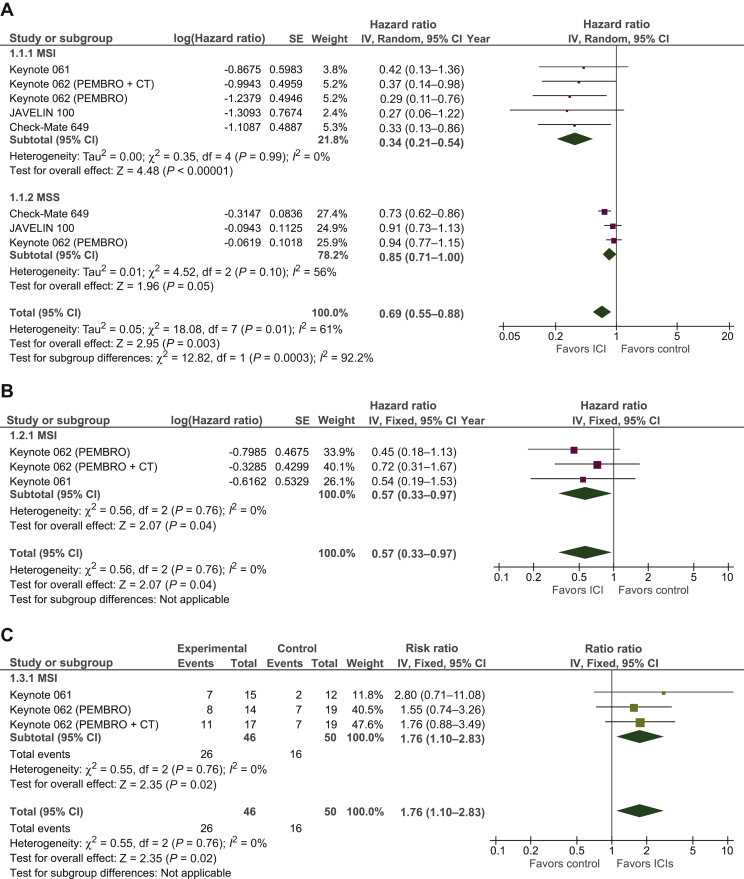
Results: The phase III KEYNOTE-062, CheckMate-649, JAVELIN Gastric 100 and KEYNOTE-061 trials were included. A total of 2545 patients with evaluable MSI status were included and 123 (4.8%) had MSI-high cancers. The HR for overall survival benefit with anti-PD-1-based regimens was 0.34 (95% CI: 0.21-0.54) for MSI-high cancers versus 0.85 [95% confidence interval (CI): 0.71-1.00] for microsatellite stable. The treatment effect was significantly different in the two subgroups (P for interaction 0.003). In the MSI-high subgroup, the HR for progression-free survival was 0.57 (95% CI: 0.33-0.97; P = 0.04) and the odds ratio for response was 1.76 (95% CI: 1.10-2.83; P = 0.02).
Conclusions: Patients with MSI-high GC should be regarded as a specific and highly immunosensitive population worthy of dedicated clinical trials.
Keywords: advanced gastric cancer; immune checkpoint inhibitors; meta-analysis; microsatellite instability; randomized clinical trials.
Copyright © 2020. Published by Elsevier Ltd.
Conflict of interest statement
Disclosure FP reports personal fees from Amgen, Roche, Sanofi, Bayer, Servier, Merck-Serono, Lilly; advisory role with Amgen, Bayer, Servier, Merk-Serono and research grants from Bristol-Myers Squibb. AIRC under IG 2019 - ID. 23624 project – P.I. Pietrantonio Filippo. JC reports grants and personal fees from Merck, Amgen, Macrogenics, Ono Pharmaceuticals, Foundation Medicine, Daiichi-Sankyo and Bristol Myers Squibb. ES reports personal fees from AstraZeneca, Astellas, Bristol Myers Squibb, Celgene, Five Prime, Gritstone, Merck, Roche, Servier and Zymworks. The other authors have declared no conflicts of interest.
Figures
References
-
- Overman M.J., Lonardi S., Wong K.Y.M. Durable clinical benefit with nivolumab plus ipilimumab in DNA mismatch repair-deficient/microsatellite instability-high metastatic colorectal cancer. J Clin Oncol. 2018;36(8):773–779. - PubMed
MeSH terms
Substances
LinkOut - more resources
Full Text Sources
Other Literature Sources
Medical
Research Materials
Miscellaneous
