Review
. 2021 Apr 26;30(R1):R119-R128.
doi: 10.1093/hmg/ddab004.

Evolutionary history of sickle-cell mutation: implications for global genetic medicine

Affiliations
Review

Evolutionary history of sickle-cell mutation: implications for global genetic medicine

Kevin Esoh et al. Hum Mol Genet. .

Abstract

Resistance afforded by the sickle-cell trait against severe malaria has led to high frequencies of the sickle-cell mutation [HBB; c.20T>A, p.Glu6Val; OMIM: 141900 (HBB-βS)] in most parts of Africa. High-coverage sequencing and genotype data have now confirmed the single African origin of the sickle-cell gene variant [HBB; c.20T>A, p.Glu6Val; OMIM: 141900 (HBB-βS)]. Nevertheless, the classical HBB-like genes cluster haplotypes remain a rich source of HBB-βS evolutionary information. The overlapping distribution of HBB-βS and other disease-associated variants means that their evolutionary genetics must be investigated concurrently. In this review: (1) we explore the evolutionary history of HBB-βS and its implications in understanding human migration within and out of Africa: e.g. HBB haplotypes and recent migration paths of the Bantu expansion, occurrence of ~7% of the Senegal haplotype in Angola reflecting changes in population/SCD dynamics, and existence of all five classical HBB haplotype in Cameroon and Egypt suggesting a much longer presence of HBB-βS in these regions; (2) we discuss the time estimates of the emergence of HBB-βS in Africa and finally, (3) we discuss implications for genetic medicine in understanding complex epistatic interactions between HBB-βS and other gene variants selected under environmental pressure in Africa e.g. variants in HBB, HBA, G6PD, APOL1, APOE, OSBPL10 and RXRA.


Figures

Figure 1
Figure 1
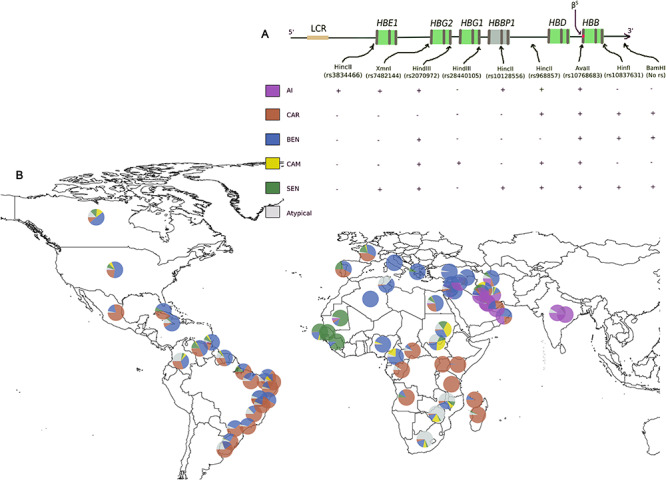
HBB-like genes cluster haplotypes: (A) Haplotypes defined by presence (+) or absence (−) of specific restriction sites that are associated with the HbS mutation; LCR = locus control region. (B) Global distribution of HBB haplotypes. CAR = Central African Republic, BEN = Benin, CAM = Cameroon, SEN = Senegal.
Figure 2
Figure 2
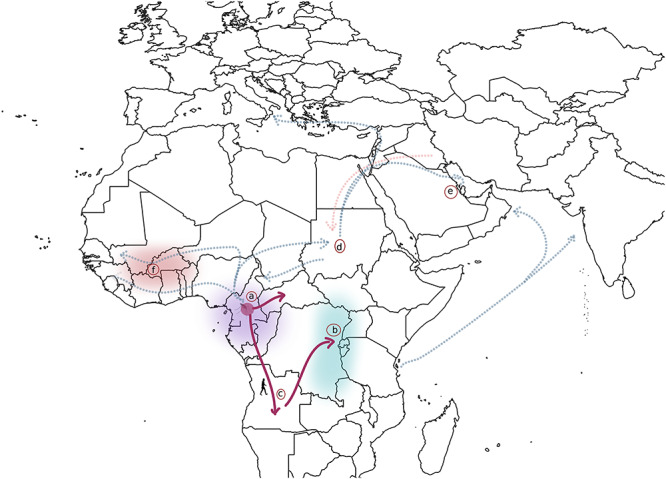
HBB-βS origin in Africa, population migration dynamics, and evolving research questions. Current data support a single origin of the HBB-βS variant in central-west Africa in the vicinity of present day Cameroon ~7300 years ago (1), or ~22 000 years ago (14) (A); the precise date of occurrence still remains to be determined. This is supported by the following lines of evidence; First, P. falciparum diverged from its common ancestor with P. praefalciparum 40 000–60 000 years ago in gorillas found around Cameroon (86); the absence of Plasmodium infection in eastern gorillas (B) further supported this observation. Subterranean malaria pressure probably led to the emergence of HBB-βS on a CAM HBB haplotype background (a) as recently reported (1). It is therefore possible that the occurrence of the HBB-βS variant is much older than the current estimates. A genetic bottleneck ~5000–6000 years ago and selection of more virulent strains of P. falciparum, as a consequence, with a rapid parasite expansion then occurred (38,40), possibly triggering at least one of the waves of the Bantu expansion (C). With Bantu expansion, and populations settling in various parts of Africa, it is likely that genomic recombination events within the HBB-like genes cluster have generated the other classical HBB haplotypes (Fig. 1B), and the regional distributions of these haplotypes have been subsequently shaped by intra African back and forth migratory events, whose sequences and dates are still to be determined (D). The distribution of the HBB-βS variant from Africa into the Mediterranean, the Middle East, and the Indian sub-continent, where the Benin and Indian-Arab haplotype are the most prevalent, could reflect a much recent historical regional migration out of Africa as well as population admixtures, which still need to be properly investigated (E). The high prevalence of HbC in West Africa, even though HbS associated genotypes are known to demonstrate excess of average fitness higher than HbC associated genotypes, indicate that HBB-βS is recent in this West African region (F); This needs to be properly investigated from an evolutionary genetic point of view. Lastly, from the time HBB-βS attained equilibrium in populations [currently estimated at 5000 years ago (1)], it is likely that the pressure because of SCA on the human genome could have contributed to the enrichment of additional adaptive signatures, that still need to be investigated, as suggested by the enrichment of recurrent variants in numerous genes that are relevant to pathophysiology of SCD among patients in Africa (57).
Figure 3
Figure 3
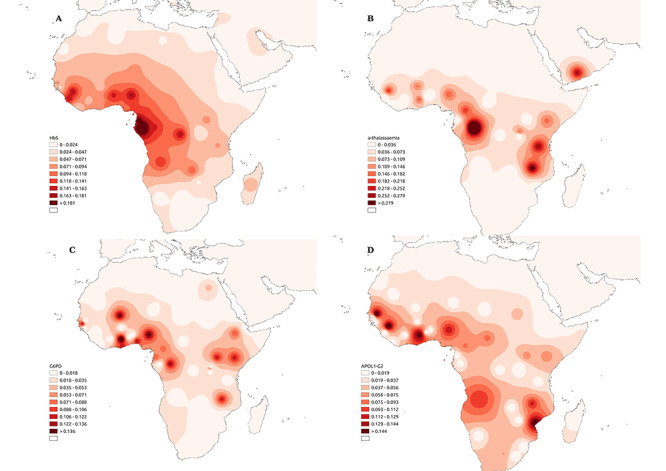
Co-evolution of the HBB-βS variant and other malaria, and trypanosome associated genes variant in Africa: (A) Distribution of the HBB-βS variant [frequencies adapted from (13)]. (B) Distribution of the 3·7 kb alpha-globin gene (HBA1/HBA2) deletion [frequencies adapted from (59) and (11)]. (C) Distribution of the G6PD deficiency. (D) Distribution of the APOL1 G2 [frequencies adapted from (87)].

References

    1. Shriner, D. and Rotimi, C.N. (2018) Whole-genome-sequence-based haplotypes reveal single origin of the sickle allele during the Holocene wet phase. Am. J. Hum. Genet., 102, 547–556. - PMC - PubMed
    1. Piel, F.B., Hay, S.I., Gupta, S., Weatherall, D.J. and Williams, T.N. (2013) Global burden of sickle cell anaemia in children under five, 2010–2050: modelling based on demographics, excess mortality, and interventions. Osrin D (ed.). PLoS Med., 10, e1001484. - PMC - PubMed
    1. Piel, F.B., Tatem, A.J., Huang, Z., Gupta, S., Williams, T.N. and Weatherall, D.J. (2014) Global migration and the changing distribution of sickle haemoglobin: a quantitative study of temporal trends between 1960 and 2000. Lancet Glob. Health, 2, e80–e89. - PMC - PubMed
    1. Ha, J., Martinson, R., Iwamoto, S.K. and Nishi, A. (2019) Hemoglobin E, malaria and natural selection. Evol. Med. Public Heal, 2019, 232–241. - PMC - PubMed
    1. Williams, T.N. and Weatherall, D.J. (2012) World distribution, population genetics, and health burden of the hemoglobinopathies. Cold Spring Harb. Perspect. Med., 2, a011692–a011692. - PMC - PubMed

Publication types