


Mobilising people as assets for active ageing promotion: a multi-stakeholder perspective on peer volunteering initiatives
- PMID: 33461519
- PMCID: PMC7812118
- DOI: 10.1186/s12889-020-10136-2
Mobilising people as assets for active ageing promotion: a multi-stakeholder perspective on peer volunteering initiatives
Abstract
Background: Successful peer volunteering is central to many community-based, active ageing initiatives. This study synthesises the perspectives of a range of stakeholders involved in peer volunteering initiatives and provides recommendations as to how peer volunteers can be effectively mobilised as community assets.
Methods: An evidence synthesis of qualitative data from (a) the evaluation of ACE (Active, Connected, Engaged), a feasibility trial of a peer volunteering active ageing intervention, and (b) interviews with volunteers and managers of third sector organisations providing peer volunteering programmes. Data were analysed using directed content analysis.
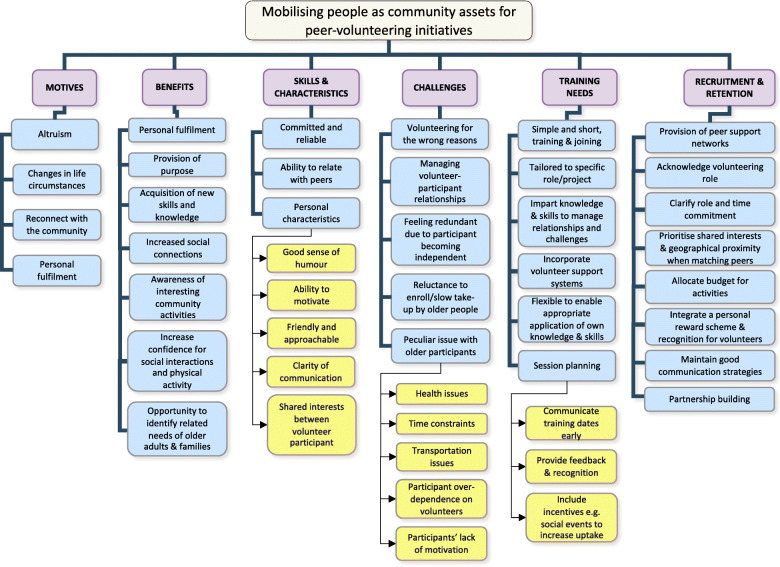
Results: Ten managers, 22 volunteers and 20 ACE participants were interviewed. The analysis identified six main themes, 33 higher and 22 sub themes. Main themes were: (i) Motives, (ii) Benefits, (iii) Skills and Characteristics, (iv) Challenges, (v) Training Needs, (vi) Recruitment and Retention. Altruism, changes in life circumstances, opportunities to reconnect with the community and personal fulfilment were the main reasons for volunteering. Volunteering was described as being personally rewarding, an avenue to acquire new skills and knowledge, and an opportunity for increased social connections and physical activity. Good peer volunteers are committed, reliable, have a good sense of humour, good interpersonal skills and are able to relate to participants. When pairing volunteers with participants, shared interests and geographical proximity are important to consider. Clarity of role, level of time commitment, regular feedback, recognition of effort and strong networks for on-going support are important strategies to facilitate volunteer retention.
Conclusions: The findings of this study support the value of peer volunteering as a strategy for mobilising community assets in promoting active ageing. To ensure success and longevity, these schemes require appropriate funding and efficient administrative support.
Keywords: Community; Health promotion; Physical activity; Qualitative synthesis; Volunteering.
Conflict of interest statement
The authors declare that they have no competing interests.
Figures
References
-
- Public Health England. Health matters: community-centred approaches for health and wellbeing. London 2018 [Available from: https://www.gov.uk/government/publications/health-matters-health-and-wel....
-
- NICE. Community engagement: improving health and wellbeing: National Institute for Health and Care Excellence; 2017 [Available from: https://www.nice.org.uk/guidance/qs148/resources/community-engagement-im....
-
- Department for Health and Social Care. Prevention is better than cure: our vision to help you live well for longer. London 2018 [Available from: https://assets.publishing.service.gov.uk/government/uploads/system/uploa....
-
- NICE. Guideline (PH49) Behaviour Change: Individual Approaches London: NICE; 2014 [Available from: https://www.nice.org.uk/Guidance/PH49.
Publication types
MeSH terms
Grants and funding
LinkOut - more resources
Full Text Sources
Other Literature Sources
Medical
Miscellaneous
