


Exploring the impact of a community participatory intervention on women's capability: a qualitative study in Gulu Northern Uganda
- PMID: 33461541
- PMCID: PMC7812725
- DOI: 10.1186/s12905-020-01170-8
Exploring the impact of a community participatory intervention on women's capability: a qualitative study in Gulu Northern Uganda
Abstract
Background: Community participatory interventions mobilizing women of childbearing age are an effective strategy to promote maternal and child health. In 2017, we implemented this strategy in Gulu Northern Uganda. This study explored the perceived impact of this approach on women's capability.
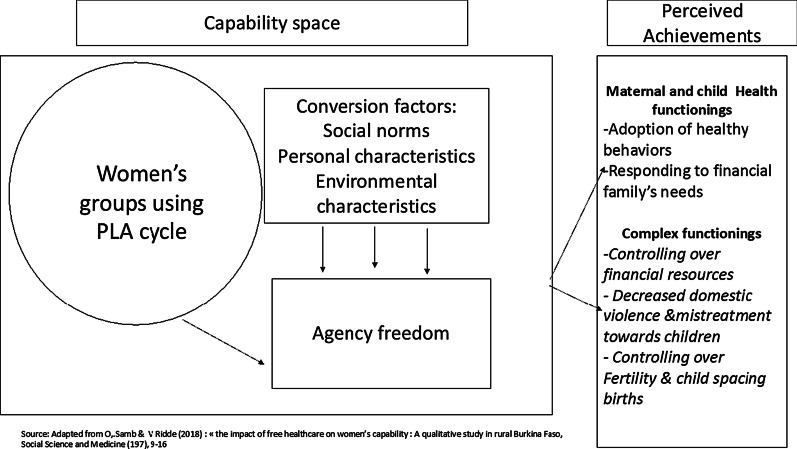
Methods: We conducted a qualitative study based on three data collection methods: 14 in-depth individual interviews with participating women of childbearing age, five focus group discussions with female facilitators, and document analysis. We used the Sen capability approach as a conceptual framework and undertook a thematic analysis.
Results: Women adopted safe and healthy behaviors for themselves and their children. They were also able to respond to some of their family's financial needs. They reported a reduction in domestic violence and in mistreatment towards their children. The facilitators perceived improved communication skills, networking, self-confidence, and an increase in their social status. Nevertheless, the women still faced unfreedoms that deprived them of living the life they wanted to lead. These unfreedoms are related to their lack of access to economic opportunities and socio-cultural norms underlying gender inequalities.
Conclusion: To expand women's freedoms, we need more collective political actions to tackle gender inequalities and need to question the values underlying women's social status.
Keywords: Community mobilization; Gender norms; Maternal and child health; Northern Uganda; Participatory learning action cycle; Post-conflict setting; Qualitative study; Reproductive; Women's capability.
Conflict of interest statement
The authors declare that they have no competing interests.
References
-
- WHO . WHO recommendation on community mobilization through facilitated participatory learning and action cycles with women's groups for maternal and newborn health. Geneva: WHO; 2014. - PubMed
-
- Freire P. Pedagogy of oppressed. New York: Herder and Herder; 1972.
-
- Prost A, Colbourn T, Seward N, Azad K, Coomarasamy A, Copas A, et al. Women's groups practicing participatory learning and action to improve maternal and newborn health in low-resource settings: a systematic review and meta-analysis. Lancet. 2013;381(9879):1736–1746. doi: 10.1016/S0140-6736(13)60685-6. - DOI - PMC - PubMed
-
- Seward N, Neuman M, Colbourn T, Osrin D, Lewycka S, Azad K, et al. Effects of women's groups practicing participatory learning and action on preventive and care-seeking behaviors to reduce neonatal mortality: a meta-analysis of cluster-randomized trials. PLoS Med. 2017;14(12):e1002467. doi: 10.1371/journal.pmed.1002467. - DOI - PMC - PubMed
Publication types
MeSH terms
Grants and funding
LinkOut - more resources
Full Text Sources
Other Literature Sources
