. 2021 Jan 18;20(1):6.
doi: 10.1186/s12944-021-01431-x.

Proprotein convertase subtilisin/kexin type 9 (PCSK9) levels are not associated with severity of liver disease and are inversely related to cholesterol in a cohort of thirty eight patients with liver cirrhosis

Affiliations

Proprotein convertase subtilisin/kexin type 9 (PCSK9) levels are not associated with severity of liver disease and are inversely related to cholesterol in a cohort of thirty eight patients with liver cirrhosis

Susanne Feder et al. Lipids Health Dis. .

Abstract

Background: Proprotein convertase subtilisin/kexin type 9 (PCSK9) is of particular importance in cholesterol metabolism with high levels contributing to hypercholesterolemia. Cholesterol and sphingolipids are low in patients with liver cirrhosis. Purpose of this study was to find associations of plasma PCSK9 with circulating cholesterol and sphingolipid species and measures of liver disease severity in patients with liver cirrhosis.

Methods: PCSK9 protein levels were determined by ELISA in systemic vein (SVP), hepatic vein (HVP) and portal vein plasma of patients with mostly alcoholic liver cirrhosis. PCSK9 and LDL-receptor protein expression were analysed in cirrhotic and non-cirrhotic liver tissues.

Results: Serum PCSK9 was reduced in patients with liver cirrhosis in comparison to non-cirrhotic patients. In liver cirrhosis, plasma PCSK9 was not correlated with Child-Pugh score, Model for End-Stage Liver Disease score, bilirubin or aminotransferases. A negative association of SVP PCSK9 with albumin existed. PCSK9 protein in the liver did not change with fibrosis stage and was even positively correlated with LDL-receptor protein levels. Ascites volume and variceal size were not related to PCSK9 levels. Along the same line, transjugular intrahepatic shunt to lower portal pressure did not affect PCSK9 concentrations in the three blood compartments. Serum cholesterol, sphingomyelin and ceramide levels did not correlate with PCSK9. Stratifying patients by high versus low PCSK9 levels using the median as cut-off, several cholesteryl ester species were even low in the subgroup with high PCSK9 levels. A few sphingomyelin species were also reduced in the patients with PCSK9 levels above the median. PCSK9 is highly expressed in the liver but systemic, portal and hepatic vein levels were similar. PCSK9 was not correlated with the inflammatory proteins C-reactive protein, IL-6, galectin-3, resistin or pentraxin 3. Of note, HVP PCSK9 was positively associated with HVP chemerin and negatively with HVP adiponectin levels.

Conclusions: In the cohort of patients with liver cirrhosis mostly secondary to alcohol consumption high PCSK9 was associated with low levels of certain cholesteryl ester and sphingomyelin species. Positive correlations of PCSK9 and LDL-receptor protein in the liver of patients with chronic liver injury are consistent with these findings.

Keywords: Alcoholic; Ascites; Ceramide; Chemerin; Hepatitis C; Model for end-stage liver disease score; Sphingomyelin; Varices.


Conflict of interest statement

The authors have no competing interests.

Figures
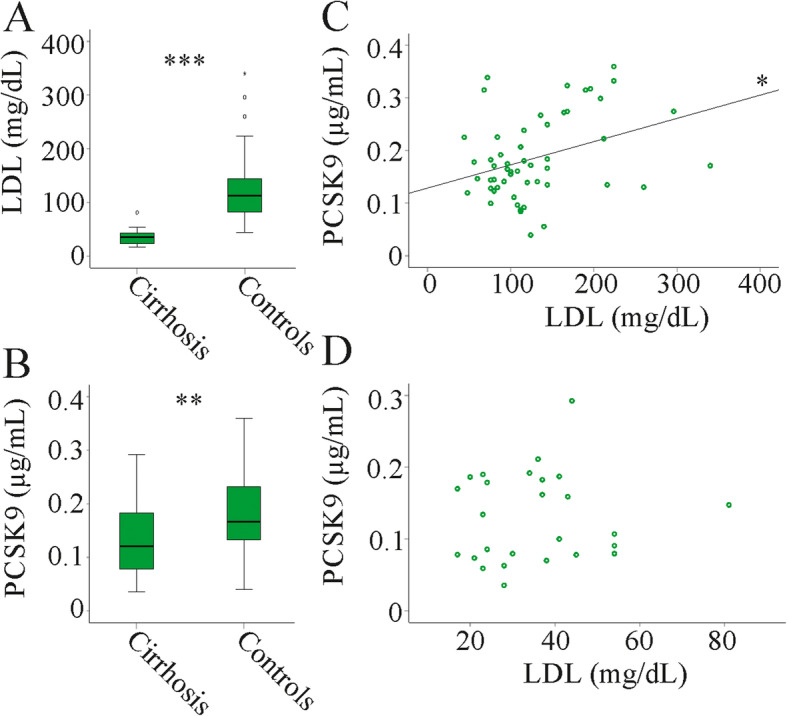
Fig. 1
Fig. 1
PCSK9 and LDL in serum of patients with and without liver cirrhosis. a LDL in serum of patients with and without liver cirrhosis (Controls). b PCSK9 in serum of patients with and without liver cirrhosis (Controls). c Correlation of PCSK9 and LDL in the control cohort. d Correlation of PCSK9 and LDL in the cirrhosis cohort. * P < 0.05
Fig. 2
Fig. 2
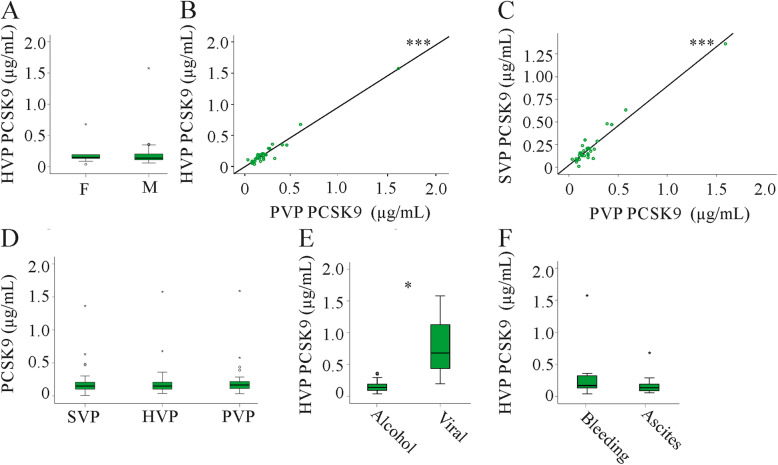
PCSK9 in plasma of patients with liver cirrhosis. a PCSK9 levels in females (F) and males (M). b Correlation of hepatic vein plasma (HVP) and portal vein plasma (PVP) PCSK9. c Correlation of systemic vein plasma (SVP) and PVP PCSK9. d PCSK9 in SVP, HVP and PVP. e HVP PCSK9 in 31 patients with alcoholic and 3 patients with viral disease etiology. f HVP PCSK9 in 12 patients and 24 patients, respectively, where variceal bleeding or ascites were the major complication. *** p < 0.001
Fig. 3
Fig. 3
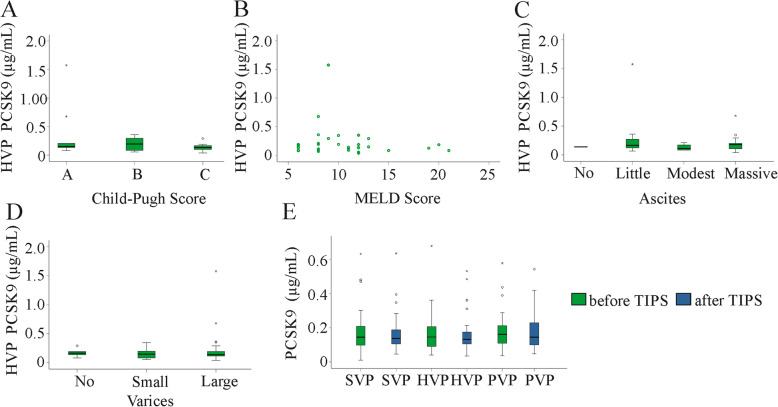
Associations of PCSK9 with Child-Pugh and MELD score and complications of liver cirrhosis. a PCSK9 in hepatic vein plasma (HVP) of patients stratified for Child-Pugh scores. b Correlation of HVP PCSK9 with the MELD score. c HVP PCSK9 in patients without (No), little, modest and massive ascites. d HVP PCSK9 in patients without, with small and large varices. e PCSK9 in the three compartments before and shortly after TIPS
Fig. 4
Fig. 4
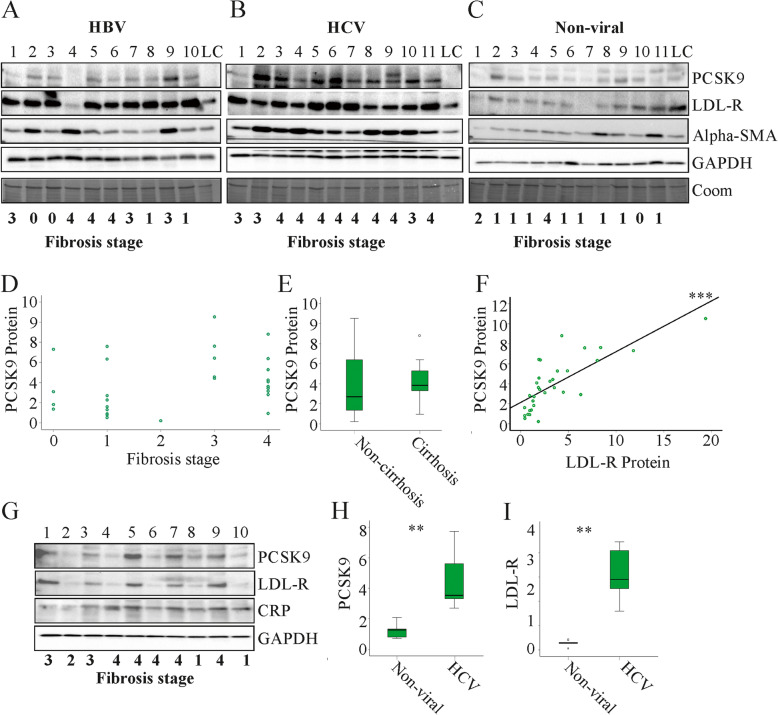
PCSK9 and LDL-receptor protein in the liver of patients with chronic liver diseases. PCSK9, LDL-receptor, alpha-SMA and GAPDH protein in the liver of patients with a chronic HBV infection, b chronic HCV infection and c non-viral liver disease. The respective fibrosis stages are listed below the figure panels. LC is the loading control and was used for normalization of the different immunoblots. d Correlation of hepatic PCSK9 protein with fibrosis stage. e PCSK9 in the liver of patients with fibrosis stage 0 to 3 (non-cirrhosis) and in patients with liver cirrhosis (fibrosis stage 4). f Correlation of hepatic PCSK9 and LDL-receptor protein. g PCSK9, LDL-receptor, CRP and GAPDH protein in the liver of patients with chronic HCV infection (patient number 1, 3, 5, 7, 9) and non-viral disease (patient number 2, 4, 6, 8, 10). The respective fibrosis stages are listed below the figure. h Quantification of PCSK9 and i LDL-receptor in the liver of patients with chronic HCV infection and non-viral disease. Coomassie stained membranes are shown to further confirm equal loading of the immunoblots. ** P < 0.01, *** P < 0.001
Fig. 5
Fig. 5
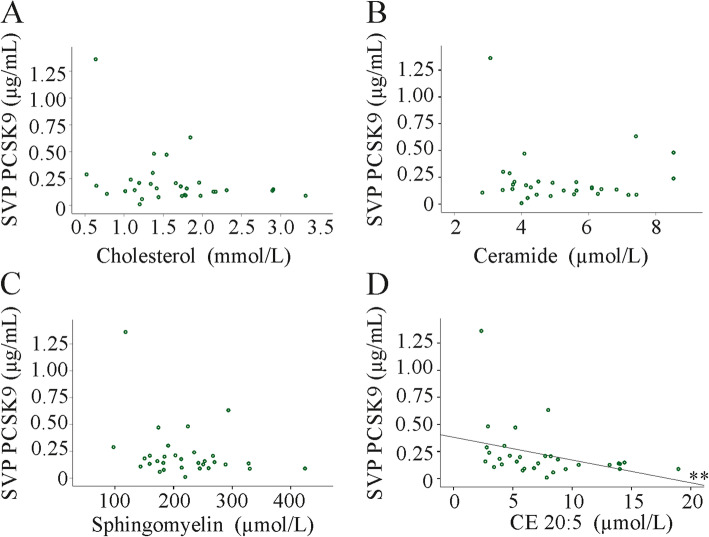
Associations of PCSK9 with cholesterol and sphingolipids in patients with liver cirrhosis. a Correlation of systemic vein plasma (SVP) PCSK9 with cholesterol (which is the sum of all cholesteryl esters and free cholesterol). b Correlation of SVP PCSK9 with ceramide. c Correlation of SVP PCSK9 with sphingomyelin (d) Correlation of SVP PCSK9 with cholesteryl ester (CE) 20:5. ** P < 0.01
Fig. 6
Fig. 6
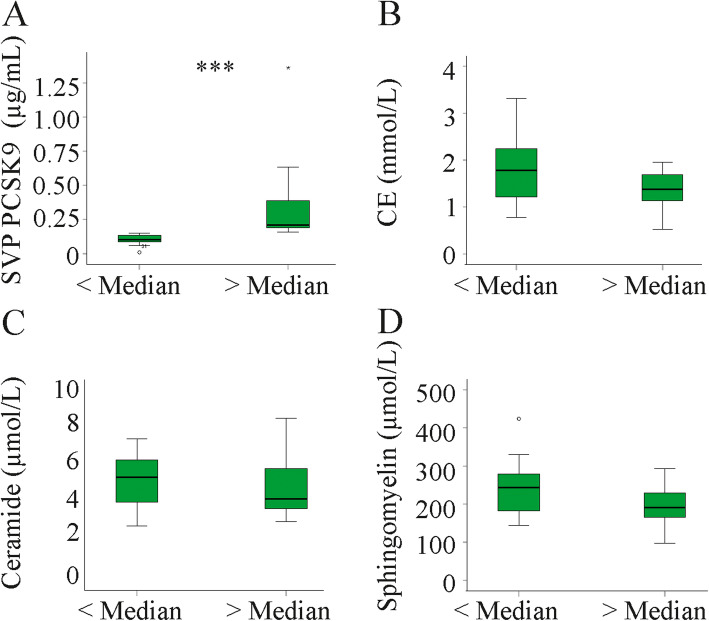
PCSK9 and lipids in patients with PCSK9 levels below or above the median plasma value. a PCSK9 in patients with PCSK9 below or above the median value. b Cholesteryl ester (CE) levels in patients with PCSK9 below or above the median value. c Ceramide in patients with PCSK9 below or above the median value. d Sphingomyelin in patients with PCSK9 below or above the median value. *** P < 0.001

References

    1. Wiegand J, Berg T. The etiology, diagnosis and prevention of liver cirrhosis: part 1 of a series on liver cirrhosis. Dtsch Arztebl Int. 2013;110:85–91. - PMC - PubMed
    1. Nusrat S, Khan MS, Fazili J, Madhoun MF. Cirrhosis and its complications: evidence based treatment. World J Gastroenterol. 2014;20:5442–5460. doi: 10.3748/wjg.v20.i18.5442. - DOI - PMC - PubMed
    1. Peng Y, Qi X, Guo X. Child-Pugh Versus MELD Score for the Assessment of Prognosis in Liver Cirrhosis: A Systematic Review and Meta-Analysis of Observational Studies. Medicine (Baltimore) 2016;95:e2877. doi: 10.1097/MD.0000000000002877. - DOI - PMC - PubMed
    1. Breier C, Lisch HJ, Braunsteiner H. Lipoproteins, HDL-apolipoproteins, activities of hepatic lipase and lecithin-cholesterol acyltransferase in the plasma of patients with post-alcoholic end-stage liver cirrhosis. Klin Wochenschr. 1983;61:929–931. doi: 10.1007/BF01537534. - DOI - PubMed
    1. Cicognani C, Malavolti M, Morselli-Labate AM, Zamboni L, Sama C, Barbara L. Serum lipid and lipoprotein patterns in patients with liver cirrhosis and chronic active hepatitis. Arch Intern Med. 1997;157:792–796. doi: 10.1001/archinte.1997.00440280120012. - DOI - PubMed

MeSH terms