Review
. 2021 Jan 19;6(1):23.
doi: 10.1038/s41392-020-00384-4.

The BET family in immunity and disease

Affiliations
Review

The BET family in immunity and disease

Nian Wang et al. Signal Transduct Target Ther. .

Abstract

Innate immunity serves as the rapid and first-line defense against invading pathogens, and this process can be regulated at various levels, including epigenetic mechanisms. The bromodomain and extraterminal domain (BET) family of proteins consists of four conserved mammalian members (BRD2, BRD3, BRD4, and BRDT) that regulate the expression of many immunity-associated genes and pathways. In particular, in response to infection and sterile inflammation, abnormally expressed or dysfunctional BETs are involved in the activation of pattern recognition receptor (e.g., TLR, NLR, and CGAS) pathways, thereby linking chromatin machinery to innate immunity under disease or pathological conditions. Mechanistically, the BET family controls the transcription of a wide range of proinflammatory and immunoregulatory genes by recognizing acetylated histones (mainly H3 and H4) and recruiting transcription factors (e.g., RELA) and transcription elongation complex (e.g., P-TEFb) to the chromatin, thereby promoting the phosphorylation of RNA polymerase II and subsequent transcription initiation and elongation. This review covers the accumulating data about the roles of the BET family in innate immunity, and discusses the attractive prospect of manipulating the BET family as a new treatment for disease.


Conflict of interest statement

The authors declare no competing interests.

Figures
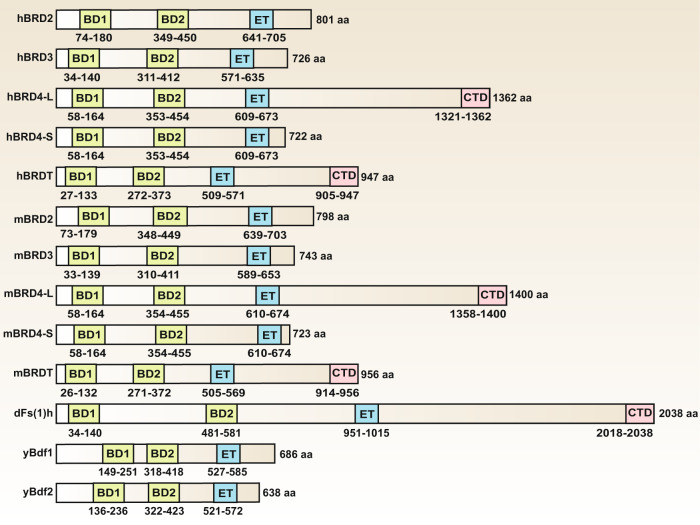
Fig. 1
Fig. 1
Domain architecture of BET family proteins in human (h), mouse (m), Drosophila (d), and yeast (y). Numbers indicate the amino acid boundaries of each domain in individual proteins. Alignment of amino acid sequences was based on published information using the following accession numbers retrieved from GenBank databases: hBRD2, NM_005104; hBRD3, NM_007371.4; hBRD4-L, NM_058243; hBRD4-S, NM_014299; hBRDT, NM_001242805; mBRD2, NM_010238; mBRD3, NM_001113574; mBRD4-L, NM_020508; mBRD4-S, NM_198094; mBRDT, NM_014299; dfs(1)h, NM_078523; yBdf1, NM_001182287; yBdf2, AJV11655. Abbreviations: BD1, the first bromodomain; BD2, the second bromodomain; Bdf1, chromatin-binding protein BDF1; BRD, bromodomain protein (numbers 2–4); CTD, C-terminal domain; ET, extraterminal domain; Fs(1)h, female sterile (1) homeotic
Fig. 2
Fig. 2
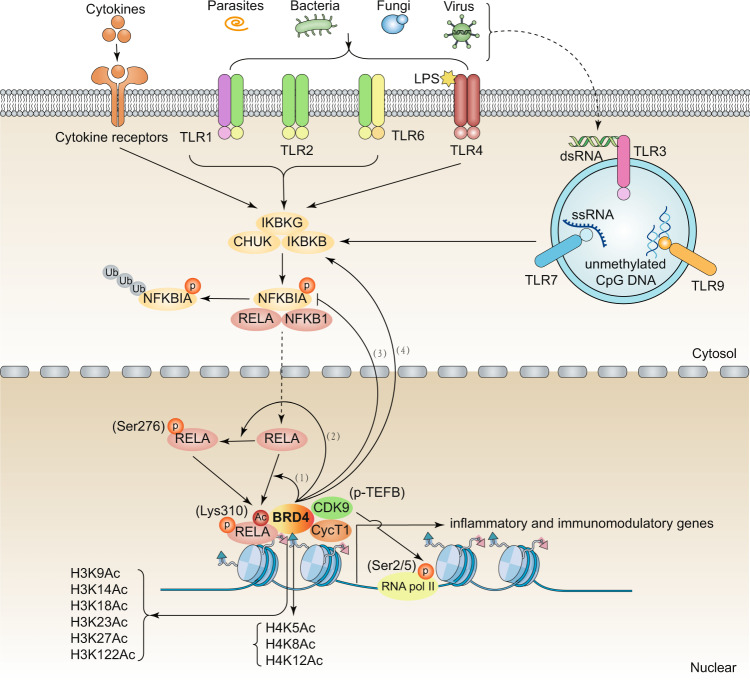
The role BRD4 in regulating the NF-κB pathway in inflammation and immunity. BRD4 regulates the activation of the NF-κB pathway caused by TLR ligands through at least four pathways: (1) BRD4 directly acetylates RELA through its atypical histone acetyltransferase activity; (2) BRD4 directly promotes the phosphorylation of RELA; and (3–4) BRD4 promotes the phosphorylation of RELA through inhibiting the translation of NFKBIA and increasing the phosphorylation of NFKBIA and IKBKB. Abbreviations: CDK9, cyclin-dependent kinase 9; CHUK, component of inhibitor of nuclear factor kappa B kinase complex; CycT1, cyclin T1; IKBKB, inhibitor of nuclear factor kappa B kinase regulatory subunit beta; IKBKG, inhibitor of nuclear factor kappa B kinase regulatory subunit gamma; NFKBIA, NFKB inhibitor alpha; NFKB1, nuclear factor kappa B subunit 1; p-TEFb, positive transcription elongation factor b; RELA, RELA proto-oncogene; RNA pol II, RNA polymerase II; TLR, toll-like receptor (numbers 1–9)
Fig. 3
Fig. 3
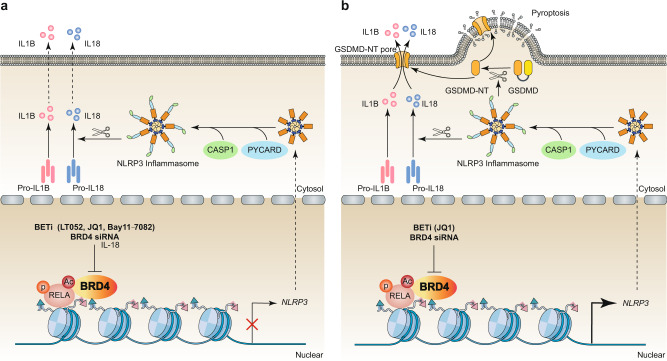
The role BRD4 in regulating the NLRP3 pathway in inflammation and pyroptosis. a In TNF-primed rat nucleus pulposus cells, in which monosodium urate induced acute gouty arthritis, and middle cerebral artery occlusion induced glial activation, BRD4 inhibits RELA-mediated NLRP3 transcription and subsequent CASP1-dependent inflammasome activation. b In renal cell carcinoma tissues and cells, BRD4 is required for RELA-mediated NLRP3 transcription and subsequent CASP1-dependent inflammasome activation and GSDMD-mediated pyroptosis. Abbreviations: BETi, bromodomain and extraterminal inhibitor; BRD4, bromodomain containing 4; CASP1, caspase 1; GSDMD, gasdermin D; GSDMD-NT, gasdermin D N-terminal domain; IL1B, interleukin 1 beta; IL18, interleukin 18; NLRP3, NLR family pyrin domain containing 3; PYCARD, PYD and CARD domain containing; RELA, RELA proto-oncogene; TNF, tumor necrosis factor
Fig. 4
Fig. 4
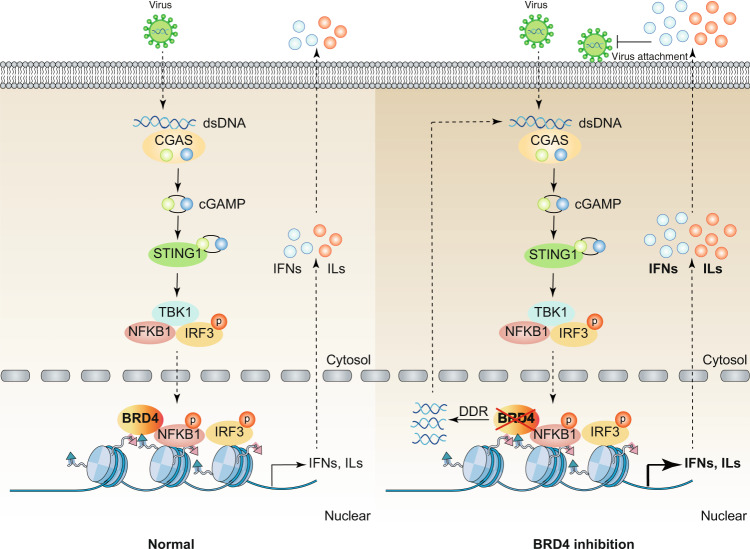
The role of BRD4 in regulating the STING1 pathway in antiviral immunity. Cytoplasmic DNA derived from various viruses activates CGAS and produces endogenous cyclic dinucleotide cGAMP, which binds to STING1 located in the endoplasmic reticulum, and then promotes the dimerization and translocation of STING1 from the ER to the perinuclear region. During trafficking, STING1 recruits and activates TBK1, stimulates the phosphorylation and nuclear translocation of IRF3, and to a lesser extent NFKB1, which leads to the production of type 1 IFN and other inflammatory cytokines (e.g., IL). The nuclear activity of IRF3 and NFKB1 is inhibited by BRD4. In addition, after BRD4 inhibition, the activation of DDR can induce the release of host dsDNA from the nucleus to the cytoplasm, leading to further activation of the CGAS-STING1 pathway to limit viral infection. Abbreviations: BRD4, bromodomain containing 4; cGAMP, cyclic GMP-AMP; CGAS, cyclic GMP-AMP synthase; DDR, DNA damage response; dsDNA, double-stranded DNA; IFN, interferon; IL, interleukin; IRF3, interferon regulatory factor 3; NFKB1, nuclear factor kappa B subunit 1; STING1, stimulator of interferon response cGAMP interactor 1; TBK1, TANK binding kinase 1
Fig. 5
Fig. 5
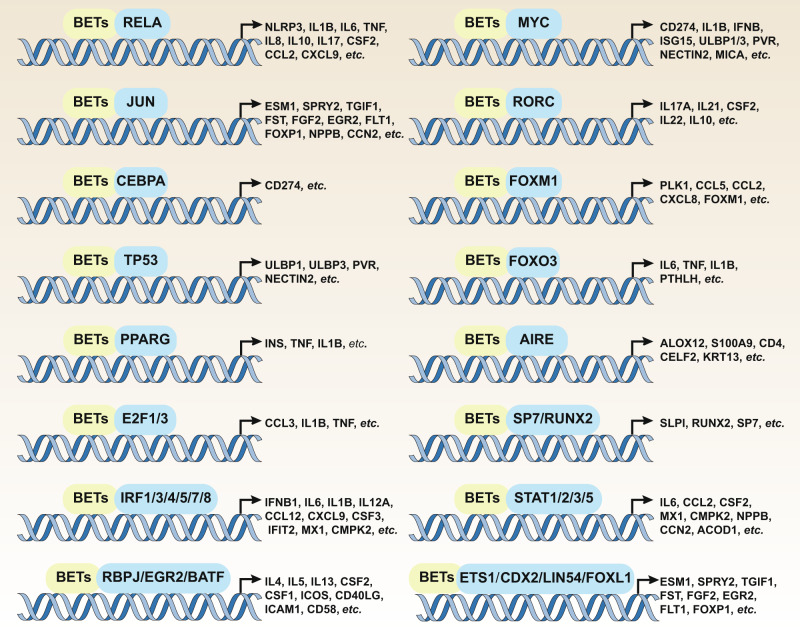
The role of BETs in regulating the expression of immune genes mediated by transcription factors. Abbreviations: ACOD1, aconitate decarboxylase 1; AIRE, autoimmune regulator; ALOX12, arachidonate 12-lipoxygenase, 12 S type; BATF, basic leucine zipper ATF-like transcription factor; CCL, C-C motif chemokine ligand (numbers 2–12); CCN2, cellular communication network factor 2; CD, CD molecule (numbers 4–274); CD40LG, CD40 ligand; CDX2, caudal-type homeobox 2; CEBPA, CCAAT enhancer binding protein alpha; CELF2, CUGBP Elav-like family member 2; CMPK2, cytidine/uridine monophosphate kinase 2; CSF1, colony stimulating factor (numbers 1–3); CXCL9, C-X-C motif chemokine ligand 9; E2F1, E2F transcription factor 1; EGR2, early growth response 2; ESM1, endothelial cell-specific molecule 1; ETS1, ETS proto-oncogene 1; FGF2, fibroblast growth factor 2; FLT1, fms-related receptor tyrosine kinase 1; FOXL1, forkhead box L1; FOXM1, forkhead box M1; FOXO3, forkhead box O3; FOXP1, forkhead box P1; FST, follistatin; ICAM1, intercellular adhesion molecule 1; ICOS, inducible T-cell costimulatory; IFIT2, interferon-induced protein with tetratricopeptide repeats 2; IFNB1, interferon beta 1; IL1B, interleukin 1 beta; IL, interleukin (numbers 4–22, including “A” variants); INS, insulin; IRF, interferon regulatory factor; JUN, Jun proto-oncogene, AP-1 transcription factor subunit; KRT13, keratin 13; LIN54, lin-54 DREAM MuvB core complex component; MX1, MX dynamin-like GTPase 1; MYC, MYC proto-oncogene, bHLH transcription factor; NECTIN2, nectin cell adhesion molecule 2; NLRP3, NLR family pyrin domain containing 3; NPPB, natriuretic peptide B; PLK1, polo-like kinase 1; PPARG, peroxisome proliferator activated receptor gamma; PTHLH, parathyroid hormone-like hormone; PVR, PVR cell adhesion molecule; RBPJ, recombination signal binding protein for immunoglobulin kappa J region; RELA, RELA proto-oncogene, NF-κB subunit; RORC, RAR-related orphan receptor C; RUNX2, RUNX family transcription factor 2; S100A9, S100 calcium-binding protein A9; SLPI, secretory leukocyte peptidase inhibitor; SP7, Sp7 transcription factor; SPRY2, sprouty RTK signaling antagonist 2; STAT, signal transducer and activator of transcription; TGIF1, TGFB-induced factor homeobox 1; TNF, tumor necrosis factor; TP53, tumor protein p53; ULBP1, UL16 binding protein (numbers 1–3)

References

    1. Visvanathan K, Lewin SR. Immunopathogenesis: role of innate and adaptive immune responses. Semin Liver Dis. 2006;26:104–115. doi: 10.1055/s-2006-939755. - DOI - PubMed
    1. Medzhitov R, Janeway C., Jr Innate immunity. N. Engl. J. Med. 2000;343:338–344. doi: 10.1056/NEJM200008033430506. - DOI - PubMed
    1. Woo SR, Corrales L, Gajewski TF. Innate immune recognition of cancer. Annu. Rev. Immunol. 2015;33:445–474. doi: 10.1146/annurev-immunol-032414-112043. - DOI - PubMed
    1. Pino SC, Kruger AJ, Bortell R. The role of innate immune pathways in type 1 diabetes pathogenesis. Curr. Opin. Endocrinol. Diabetes Obes. 2010;17:126–130. doi: 10.1097/MED.0b013e3283372819. - DOI - PMC - PubMed
    1. Wiersinga WJ, Leopold SJ, Cranendonk DR, van der Poll T. Host innate immune responses to sepsis. Virulence. 2014;5:36–44. doi: 10.4161/viru.25436. - DOI - PMC - PubMed

Publication types