. 2021 Jan 18;12(1):424.
doi: 10.1038/s41467-020-20731-x.

Modelling the global burden of drug-resistant tuberculosis avertable by a post-exposure vaccine

Affiliations

Modelling the global burden of drug-resistant tuberculosis avertable by a post-exposure vaccine

Han Fu et al. Nat Commun. .

Abstract

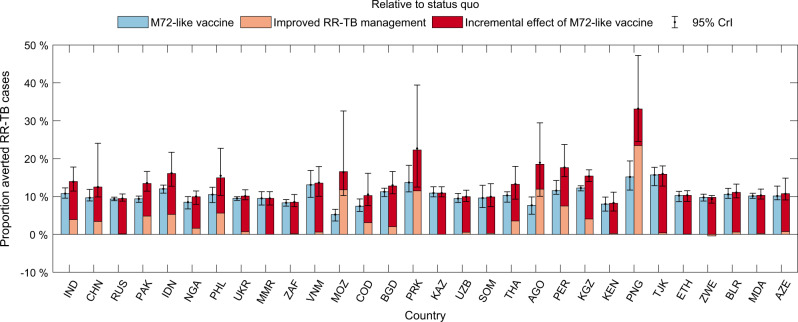
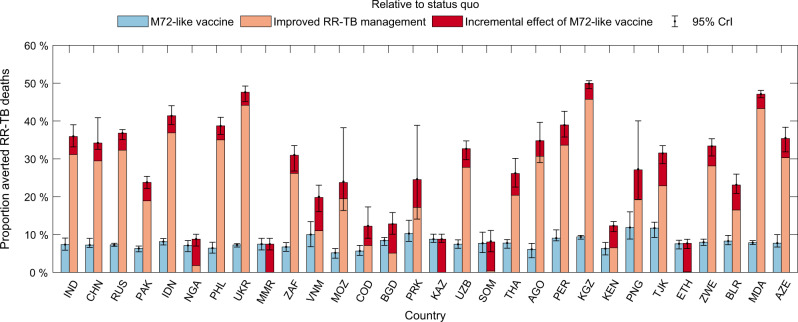
There have been notable advances in the development of vaccines against active tuberculosis (TB) disease for adults and adolescents. Using mathematical models, we seek to estimate the potential impact of a post-exposure TB vaccine, having 50% efficacy in reducing active disease, on global rifampicin-resistant (RR-) TB burden. In 30 countries that together accounted for 90% of global RR-TB incidence in 2018, a future TB vaccine could avert 10% (95% credible interval: 9.7-11%) of RR-TB cases and 7.3% (6.6-8.1%) of deaths over 2020-2035, with India, China, Indonesia, Pakistan, and the Russian Federation having the greatest contribution. This impact would increase to 14% (12-16%) and 31% (29-33%) respectively, when combined with improvements in RR-TB diagnosis and treatment relative to a scenario of no vaccine and no such improvements. A future TB vaccine could have important implications for the global control of RR-TB, especially if implemented alongside enhancements in management of drug resistance.


Conflict of interest statement

The authors declare no competing interests.

Figures
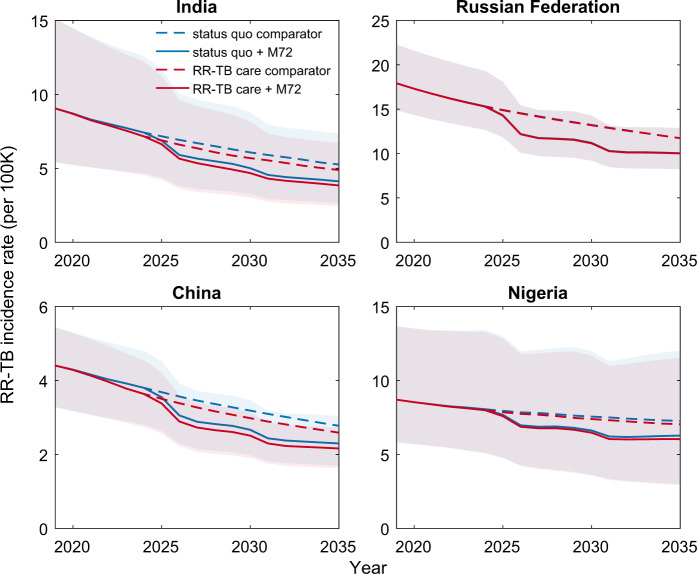
Fig. 1
Fig. 1. Illustration of the projected impact on RR-TB of an M72-like vaccine.
n = 200 posterior samples. Median (solid and dashed lines) and 95% Bayesian credible intervals (CrIs) of rifampicin-resistant tuberculosis (RR-TB) incidence rates over 2019–2035 are presented. For clarity, uncertainty regions with CrIs are only shown for the vaccine (not comparator) scenarios. These projections correspond to a post-exposure vaccine that reduces the risk of reactivation of latent TB infection by 50%, and that is implemented through routine vaccination and catch-up campaign amongst those over 15-years old. The figure shows projections for the countries with the highest absolute burden of RR-TB from each of the country categories listed in Table 1. Blue dashed curves illustrate a ‘status quo’ baseline, assuming no vaccine implementation and no change in the management of RR-TB. Blue solid curves show the impact of vaccination. Red curves show corresponding dynamics, under an alternative ‘improved RR-TB management’ baseline where the detection of RR-TB at the point of TB diagnosis is increased to 85%, and second-line treatment success is increased to 75%, in countries that have not yet achieved these targets. The Russian Federation in particular shows a lower impact of improved RR-TB management than other countries, owing to its already-higher coverage of drug susceptibility tests (Supplementary Fig. 10). Although the 95% CrIs for these projected dynamics with vaccination overlap in these regions, the overall incidence reductions are significant, in the sense of having uncertainty intervals that are strictly positive (Table 2, Supplementary Fig. 9).
Fig. 2
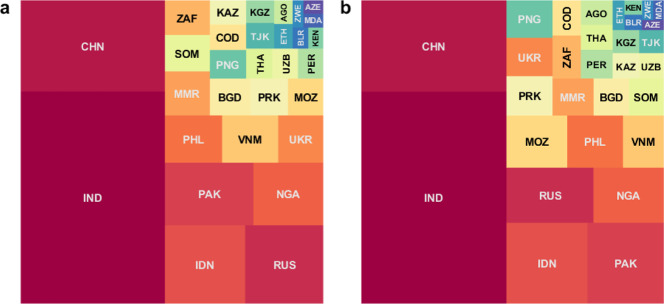
Fig. 2. Country-wise contribution to vaccine-avertable incidence of RR-TB.
The area of each square is proportional to the median estimate from n = 200 posterior samples, for the absolute number of avertable rifampicin-resistant tuberculosis (RR-TB) cases by a post-exposure, M72-like vaccine, between 2020 and 2035. Panel a shows cases averted by a vaccine alone, while panel b shows cases averted by a combination of a vaccine and measures to improve the management of RR-TB (both relative to a scenario of no vaccine, and no improvement in RR-TB, i.e. status quo). Countries are denoted by their ISO alpha-3 codes and their corresponding full names are listed in Table 1. Colours for each country are only for the purpose of display, and do not designate any quantitative scale.
Fig. 3
Fig. 3. Projected percent cases of RR-TB averted by an M72-like vaccine.
Rectangular bars show median estimates and error bars show 95% Bayesian credible intervals (CrIs), both estimated from n = 200 posterior samples for each country. Blue bars show the vaccine-avertable proportions of rifampicin-resistant tuberculosis (RR-TB) cases relative to a ‘status quo’ scenario, while adjacent bars together show averted proportions in combination with ‘improved RR-TB management’, as outlined in the caption to Fig. 1. The latter bars are stratified to show: (i) the impact of improved management of RR-TB alone, i.e. in the absence of vaccination (orange segment), and (ii) the incremental impact of vaccination, acting in combination with these improvements (red segment). Error bars on the stacked orange and red bars show the 95% CrIs of the total impact of a vaccine combined with improved management of RR-TB. Countries are ranked in a descending order according to the number of RR-TB incident cases in 2018.
Fig. 4
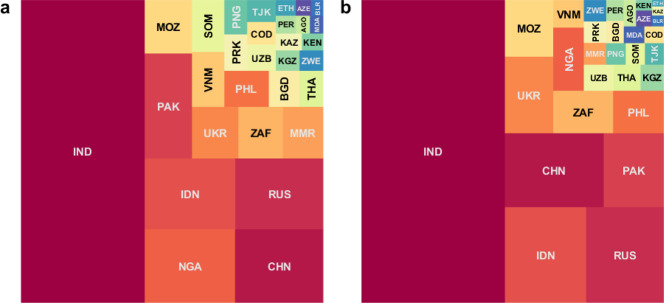
Fig. 4. Country-wise contribution to vaccine-avertable deaths from RR-TB.
As for Fig. 2, the area of each square here is proportional to the median estimate from n = 200 posterior samples, for the absolute number of avertable rifampicin-resistant tuberculosis (RR-TB) deaths by a post-exposure, M72-like vaccine, between 2020 and 2035. Panel a shows deaths averted by a vaccine alone, while panel b shows deaths averted by a combination of a vaccine and measures to improve the management of RR-TB (both relative to a scenario of no vaccine, and no improvement in RR-TB, i.e. status quo). Countries are denoted by their ISO alpha-3 codes and their corresponding full names are listed in Table 1. Colours for each country are only for the purpose of display, and do not designate any quantitative scale.
Fig. 5
Fig. 5. Projected percent deaths from RR-TB averted, as a result of anti-TB vaccination.
Rectangular bars show median estimates and error bars show 95% Bayesian credible intervals (CrIs), both estimated from n = 200 posterior samples for each country. As in Fig. 3, blue bars here show the vaccine-avertable proportions of rifampicin-resistant tuberculosis (RR-TB) deaths relative to a ‘status quo’ scenario, while adjacent bars show averted proportions in combination with ‘improved RR-TB management’, as outlined in the caption to Fig. 1. The latter bars are stratified to show: (i) the impact of improved management of RR-TB alone, i.e. in the absence of vaccination (orange segment), and (ii) the incremental impact of vaccination, acting in combination with these improvements (red segment). Error bars on the stacked orange and red bars show the 95% CrIs of the total impact of a vaccine combined with improved management of RR-TB. Countries are ranked in a descending order according to the number of RR-TB incident cases in 2018.

References

    1. Dheda K, et al. The Lancet Respiratory Medicine Commission: 2019 update: epidemiology, pathogenesis, transmission, diagnosis, and management of multidrug-resistant and incurable tuberculosis. Lancet Respir. Med. 2019;7:820–826. doi: 10.1016/S2213-2600(19)30263-2. - DOI - PubMed
    1. World Health Organization. Global tuberculosis report 2019. https://apps.who.int/iris/bitstream/handle/10665/329368/9789241565714-en... (2019).
    1. Gandhi, N. R., Brust, J. C. M. & Shah, N. S. A new era for treatment of drug-resistant tuberculosis. Eur. Respir J.52, 10.1183/13993003.01350-2018 (2018). - PMC - PubMed
    1. Nunn AJ, et al. A trial of a shorter regimen for rifampin-resistant tuberculosis. N. Engl. J. Med. 2019;380:1201–1213. doi: 10.1056/NEJMoa1811867. - DOI - PubMed
    1. World Health Organization. WHO consolidated guidelines on drug-resistant tuberculosis treatment. https://apps.who.int/iris/bitstream/handle/10665/311389/9789241550529-en... (2019). - PubMed

Publication types

MeSH terms