


Present cum future of SARS-CoV-2 virus and its associated control of virus-laden air pollutants leading to potential environmental threat - A global review
- PMID: 33462561
- PMCID: PMC7805399
- DOI: 10.1016/j.jece.2020.104973
Present cum future of SARS-CoV-2 virus and its associated control of virus-laden air pollutants leading to potential environmental threat - A global review
Abstract
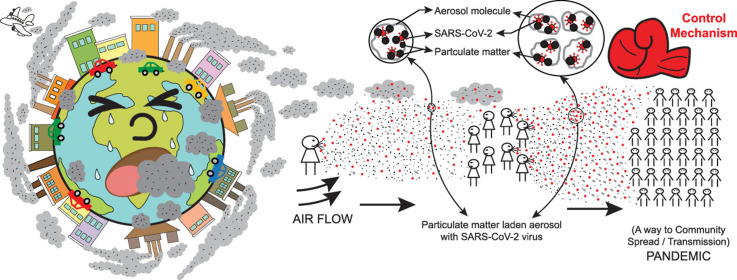
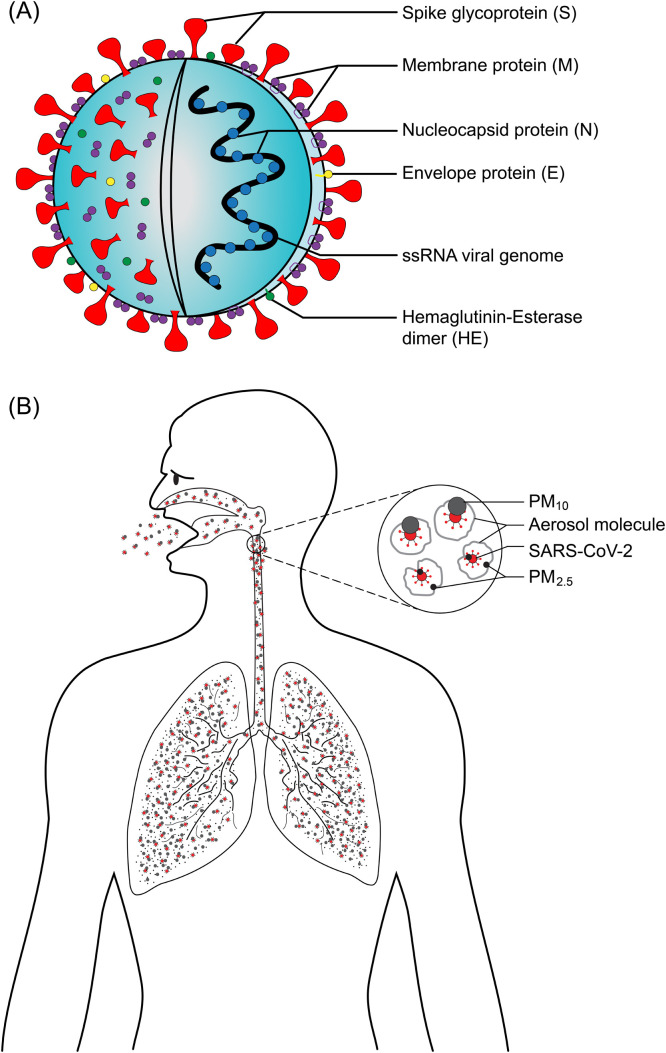
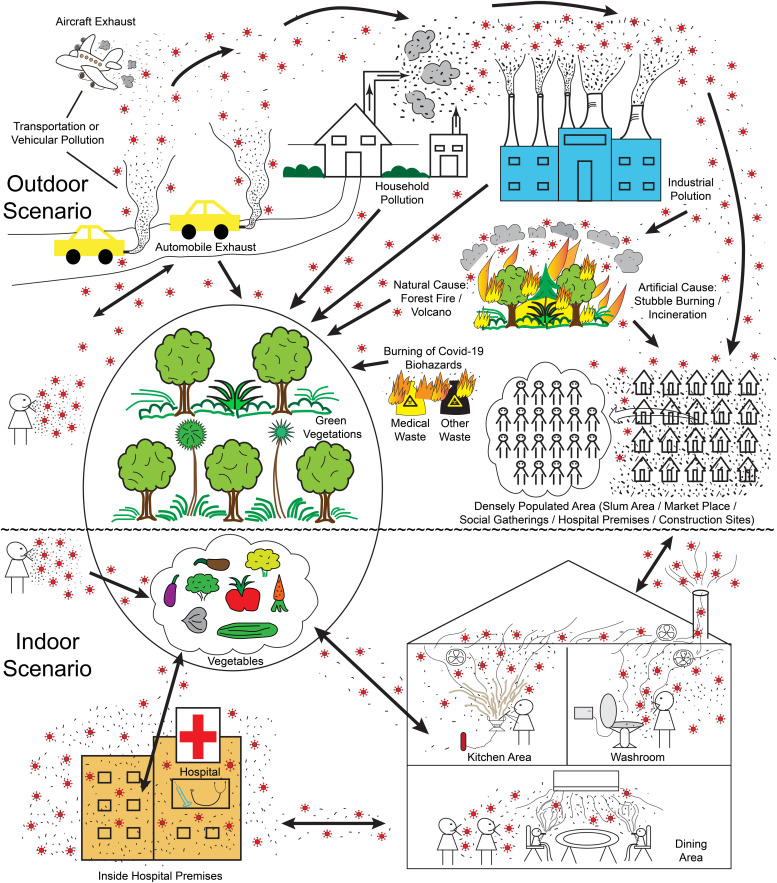
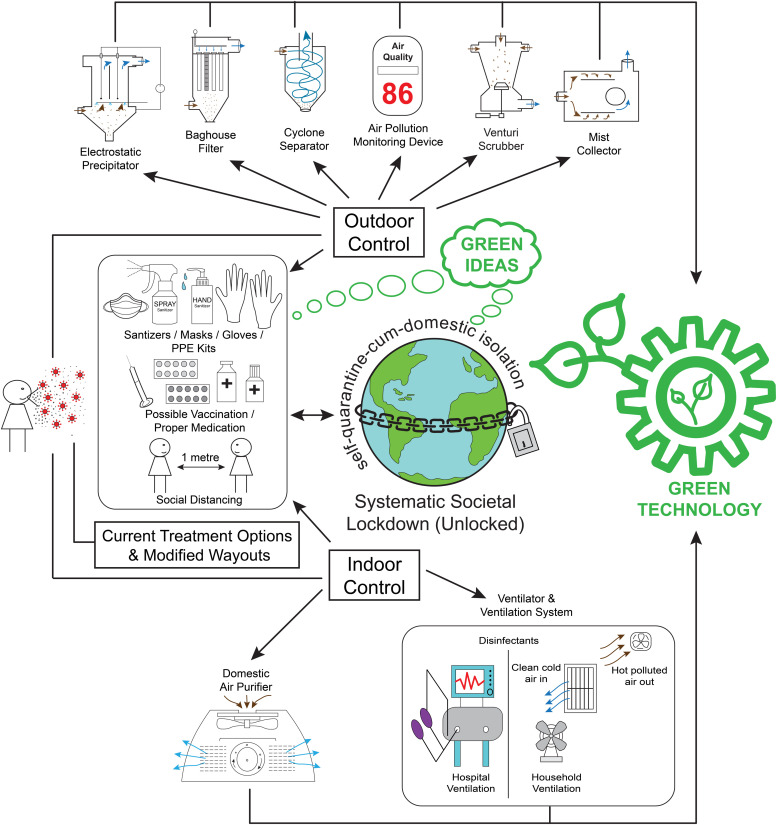
The world is presently infected by the biological fever of COVID-19 caused by SARS-CoV-2 virus. The present study is mainly related to the airborne transmission of novel coronavirus through airway. Similarly, our mother planet is suffering from drastic effects of air pollution. There are sufficient probabilities or evidences proven for contagious virus transmission through polluted airborne-pathway in formed aerosol molecules. The pathways and sources of spread are detailed along with the best possible green control technologies or ideas to hinder further transmission. The combined effects of such root causes and unwanted outcomes are similar in nature leading to acute cardiac arrest of our planet. To maintain environmental sustainability, the prior future of such emerging unknown biological hazardous air emissions is to be thoroughly researched. So it is high time to deal with the future of hazardous air pollution and work on its preventive measures. The lifetime of such an airborne virus continues for several hours, thus imposing severe threat even during post-lockdown phase. The world waits eagerly for the development of successful vaccination or medication but the possible outcome is quite uncertain in terms of equivalent economy distribution and biomedical availability. Thus, risk assessments are to be carried out even during the post-vaccination period with proper environmental surveillance and monitoring. The skilled techniques of disinfection, sanitization, and other viable wayouts are to be modified with time, place, and prevailing climatic conditions, handling the pandemic efficiently. A healthy atmosphere makes the earth a better place to dwell, ensuring its future lifecycle.
Keywords: 2019-nCoV, 2019 novel coronavirus; ACE2, angiotensin-converting enzyme 2; ALRI, Acute Lower Respiratory Infections; ANN, artificial neural network; API, air pollution index; ASTM, American Society for Testing and Materials; Aerosol or particulate matter; Airborne virus; BCG, Bacillus Calmette Guérin; COCOREC, Collaborative Study COVID Recurrence; COPD, Chronic Obstructive Pulmonary Disorder; COVID-19, coronavirus disease, 2019; CSG, Coronavirus Study Group; CoV, Coronavirus; Dispersion; EPA, Environmental Protection Agency; FCVS, filtered containment venting systems; HEME, High-Efficiency Mist Eliminator; ICTV, International Committee on Taxonomy of Viruses; IHD, Ischemic Heart Disease; ISO, International organization of Standardization; IoT, Internet of Things; MERS-CoV, Middle-East Respiratory Syndrome coronavirus; NAAQS, National Ambient Air Quality Standard; NFKB, nuclear factor kappa-light-chain-enhancer of activated B cells; NRF2, nuclear factor erythroid 2-related factor 2; Novel coronavirus; PM, particulate matter; Pathways of transmission; Prevention and control measures; ROS, reactive oxygen species; SARS-CoV-2; SARS-CoV-2, severe acute respiratory syndrome coronavirus 2; USEPA, United States Environmental Protection Agency; UVGI, Ultraviolet Germicidal Irradiation; VOC, volatile organic compound; WHO, World Health Organization.
© 2020 Elsevier Ltd. All rights reserved.
Conflict of interest statement
The authors declare that they have no known competing financial interests or personal relationships that could have appeared to influence the work reported in this paper.
Figures
References
-
- Morawska L., Tang J.W., Bahnfleth W., Bluyssen P.M., Boerstra A., Buonanno G., Cao J., Dancer S., Floto A., Franchimon F., Haworth C., Hogeling J., Isaxon C., Jimenez J.L., Kurnitski J., Li Y., Loomans M., Marks G., Marr L.C., Mazzarella L., Melikov A.K., Miller S., Milton D.K., Nazaroff W., Nielsen P.V., Noakes C., Peccia J., Querol X., Sekhar C., Seppänen O., Tanabe S., Tellier R., Tham K.W., Wargocki P., Wierzbicka A., Yao M. How can airborne transmission of COVID-19 indoors be minimised? Environ. Int. 2020;142 doi: 10.1016/j.envint.2020.105832. - DOI - PMC - PubMed
-
- World Health Organization, Modes of transmission of virus causing COVID-19: implications for IPC precaution recommendations, Scientific Brief, 2020, pp. 1–3. 〈 10.1056/NEJMoa2001316.5〉. - DOI
Publication types
LinkOut - more resources
Full Text Sources
Other Literature Sources
Research Materials
Miscellaneous