. 2020 Dec;11(12):e00259.
doi: 10.14309/ctg.0000000000000259.

The Spectrum of Gastrointestinal Symptoms in Patients With Coronavirus Disease-19: Predictors, Relationship With Disease Severity, and Outcome

Affiliations

The Spectrum of Gastrointestinal Symptoms in Patients With Coronavirus Disease-19: Predictors, Relationship With Disease Severity, and Outcome

Uday C Ghoshal et al. Clin Transl Gastroenterol. 2020 Dec.

Abstract

Introduction: We prospectively studied the frequency, spectrum, and predictors of gastrointestinal (GI) symptoms among patients with coronavirus disease-19 (COVID-19) and the relationship between GI symptoms and the severity and outcome.

Methods: Consecutive patients with COVID-19, diagnosed in a university hospital referral laboratory in northern India, were evaluated for clinical manifestations including GI symptoms, their predictors, and the relationship between the presence of these symptoms, disease severity, and outcome on univariate and multivariate analyses.

Results: Of 16,317 subjects tested for severe acute respiratory syndrome coronavirus 2 (SARS-CoV-2) RNA in their oropharyngeal and nasopharyngeal swabs during April-May 2020, 252 (1.5%) were positive. Of them, 208 (82.5%) were asymptomatic; of the 44 symptomatic patients, 18 (40.9%) had non-GI symptoms, 15 (34.1%) had a combination of GI and non-GI symptoms, and 11 (25.0%) had GI symptoms only. Thirty-three had mild-to-moderate disease, 8 severe, and 5 critical. Five patients (1.98%) died. On multivariate analysis, the factors associated with the presence of GI symptoms included the absence of contact history and presence of non-GI symptoms and comorbid illnesses. Patients with GI synptoms more often had severe, critical illness and fatal outcome than those without GI symptoms.

Discussion: Eighty-two percent of patients with COVID-19 were asymptomatic, and 10.3% had GI symptoms; severe and fatal disease occurred only in 5% and 2%, respectively. The presence of GI symptoms was associated with a severe illness and fatal outcome on multivariate analysis. Independent predictors of GI symptoms included the absence of contact history, presence of non-GI symptoms, and comorbid illnesses.(Equation is included in full-text article.).


Conflict of interest statement

Guarantor of the article: Uday C. Ghoshal, MD, DNB, DM, FACG, FAMS, RFF.

Specific author contributions: Uday C. Ghoshal, MD, DNB, DM, FACG, FAMS, RFF and Ujjala Ghoshal, MD, MNAMS, contributed equally to this work and are therefore, the joint first authors. U.C.G. designed the study, collected clinical data electronically using an online questionnaire, analyzed the data, wrote the first draft of the study; U.G., A.G., D.S., S.S., J.S., and A.P. did microbiological works and helped clinical data collection, A.M. collected clinical data remotely as well on-site, R.K.S. and A.N. cared for the admitted patients, S.R. helped online data collection and analysis, S.V. collected clinical specimens and helped microbiological works, and R.K.D. supervised the whole study.

Financial support: Department of Biotechnology, Government of India, for the funding of the study (project No. BT/PR40311/COD/139/9/2020).

Potential competing interests: None to report.

Figures

Figure 1.
Figure 1.
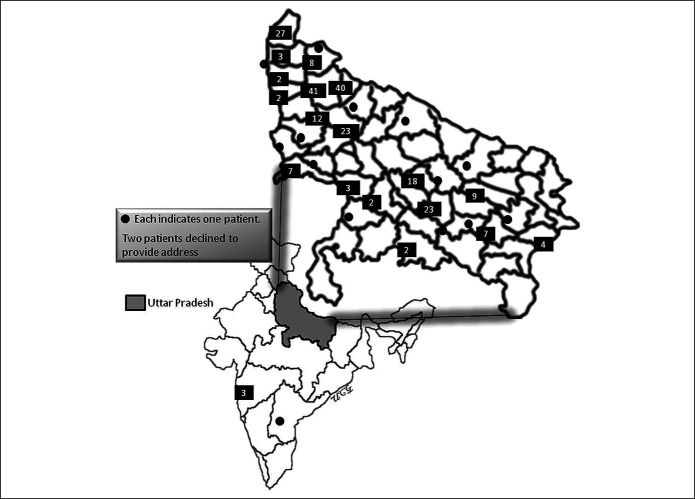
A map of India showing the state of Uttar Pradesh from where the study subjects (except 4 participants) were included through the Integrated Disease Surveillance Program. The number within each black box within the enlarged map of Uttar Pradesh represents the number of patients from that particular region. The filled circle indicates one patient in each area. Two patients declined to provide their addresses.
Figure 2.
Figure 2.
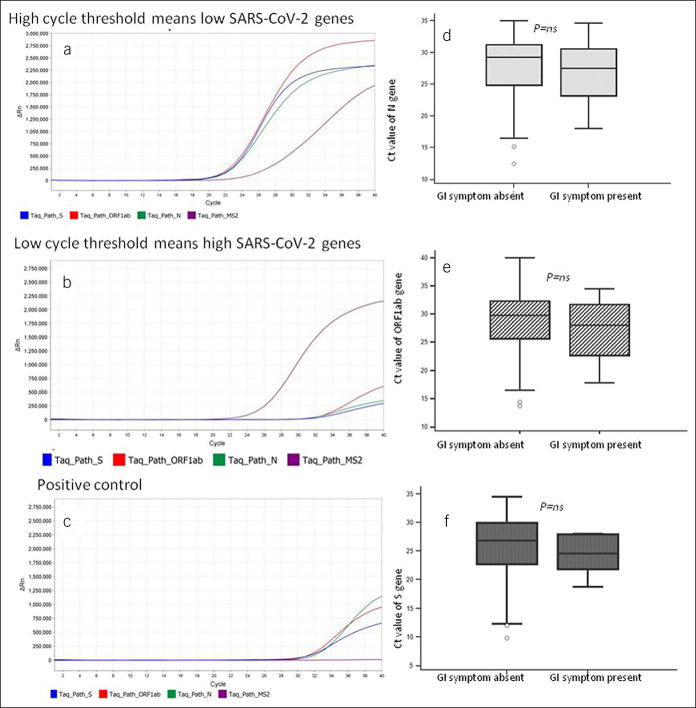
Amplification plots of real-time polymerase chain reactions of 2 representative patients with severe acute respiratory distress syndrome coronavirus-2 (SARS-CoV-2) infection. (a) High Ct, (b). Low Ct, (c) Positive control. Comparison of Ct values of nucleocapsid protein (N) gene (d), open reading frame 1ab gene (e), and spike protein (S) gene (f) among patients with and without gastrointestinal (GI) symptoms. The P values were not significant (NS) for any of the comparisons. MS2 represents control indicating the adequacy of RNA extraction. Ct, Cycle threshold; GI, gastrointestinal.

References

    1. Zhai P, Ding Y, Wu X, et al. he epidemiology, diagnosis and treatment of COVID-19. Int J Antimicrob Agents 2020;55:105955. - PMC - PubMed
    1. Kumar SU, Kumar DT, Christopher BP, et al. The rise and impact of COVID-19 in India. Front Med (Lausanne) 2020;7:250. - PMC - PubMed
    1. Tang D, Comish P, Kang R. The hallmarks of COVID-19 disease. Plos Pathog 2020;16:e1008536. - PMC - PubMed
    1. Wan Y, Shang J, Graham R, et al. Receptor recognition by the novel coronavirus from Wuhan: An analysis based on decade-long structural studies of SARS coronavirus. J Virol 2020;94:e00127–20. - PMC - PubMed
    1. Ding S, Liang TJ. Is SARS-CoV-2 also an enteric pathogen with potential fecal-oral transmission: A COVID-19 virological and clinical review. Gastroenterology 2020;159:53–61. - PMC - PubMed

Publication types