


A Shared Cancer Follow-Up Model of Care Between General Practitioners and Radiation Oncologists for Patients With Breast, Prostate, and Colorectal Cancer: Protocol for a Mixed Methods Implementation Study
- PMID: 33464209
- PMCID: PMC7854032
- DOI: 10.2196/21752
A Shared Cancer Follow-Up Model of Care Between General Practitioners and Radiation Oncologists for Patients With Breast, Prostate, and Colorectal Cancer: Protocol for a Mixed Methods Implementation Study
Abstract
Background: The rising incidence of cancer and increasing numbers of cancer survivors have resulted in the need to find alternative models of care for cancer follow-up care. The acceptability for follow-up care in general practice is growing, and acceptance increases with shared-care models where oncologists continue to oversee the care. However, a major barrier to this model is the effective exchange of information in real time between oncologists and general practitioners. Improved communication technology plays an important role in the acceptability and feasibility of shared cancer follow-up care.
Objective: The aim of this study is to evaluate the feasibility and acceptability of a shared cancer follow-up model of care between patients, general practitioners and radiation oncologists.
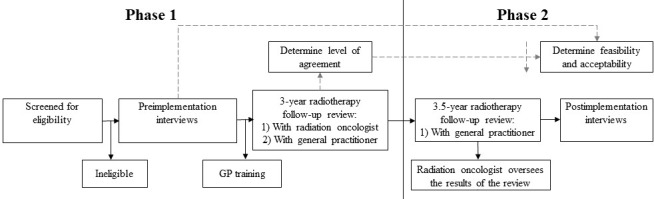
Methods: This is a mixed methods, multisite implementation study exploring shared follow-up care for breast, colorectal, and prostate cancer patients treated with curative radiotherapy in New South Wales, Australia. This study uses web-based technology to support general practitioners in performing some aspects of routine radiotherapy follow-up care, while being overseen by a radiation oncologist in real time. The study has two phases: Phase 1 is designed to establish the level of agreement between general practitioners and radiation oncologists and Phase 2 is designed to implement shared follow-up care into practice and to evaluate this implementation.
Results: Recruitment of radiation oncologists, patients, and general practitioners commenced in December 2020 and will continue until February 2021. Data collection will occur during 2021, and data will be ready for analysis by the end of 2021.
Conclusions: Few studies have investigated the role of health technologies in supporting communication deficiencies for shared cancer follow-up care. The implementation and evaluation of models of care need to be conducted using a person-centered approach that is responsive to patients' preferences and needs. Should the findings of the study be acceptable and feasible to radiation oncologists, general practitioners, and patients, it can be quickly implemented and expanded to other tumor groups or to medical oncology and hematology.
Trial registration: Australian New Zealand Clinical Trials Registry ACTRN12620001083987; http://www.anzctr.org.au/Trial/Registration/TrialReview.aspx?id=380057.
International registered report identifier (irrid): PRR1-10.2196/21752.
Keywords: cancer; communication; follow-up; general practice; health technology; radiation oncology; shared care.
©Tiffany Sandell, Heike Schütze, Andrew Miller. Originally published in JMIR Research Protocols (http://www.researchprotocols.org), 19.01.2021.
Conflict of interest statement
Conflicts of Interest: None declared.
Figures
References
-
- Roorda C, de Bock G, Scholing C, van der Meer K, Berger M, de Fouw M, Berendsen A. Patients' preferences for post-treatment breast cancer follow-up in primary care vs secondary care: A qualitative study. Health Expect. 2015 Dec;18(6):2192–2201. doi: 10.1111/hex.12189. http://europepmc.org/abstract/MED/24661322 - DOI - PMC - PubMed
LinkOut - more resources
Full Text Sources
Other Literature Sources
Miscellaneous
