


Serum inhibin B for differentiating between congenital hypogonadotropic hypogonadism and constitutional delay of growth and puberty: a systematic review and meta-analysis
- PMID: 33464540
- PMCID: PMC8159787
- DOI: 10.1007/s12020-020-02582-0
Serum inhibin B for differentiating between congenital hypogonadotropic hypogonadism and constitutional delay of growth and puberty: a systematic review and meta-analysis
Abstract
Purpose: The distinction between congenital hypogonadotropic hypogonadism (CHH) and constitutional delay of growth and puberty (CDGP) in patients with delayed puberty is difficult to distinguish, but important for timely treatment. The aim of this study is to perform a systematic review and meta-analysis to determine the diagnostic performance of serum inhibin B (INHB) levels for differentiating CHH and CDGP.
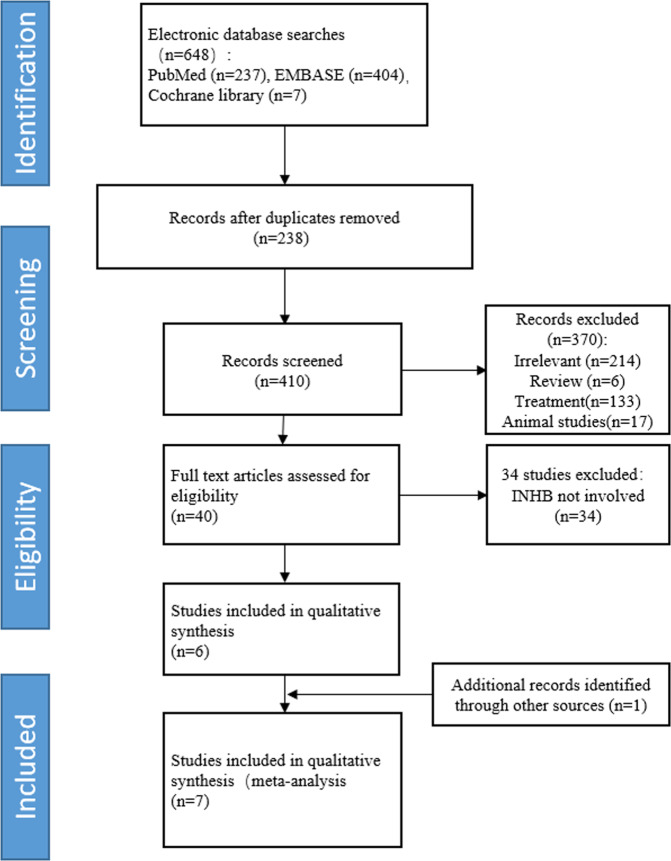
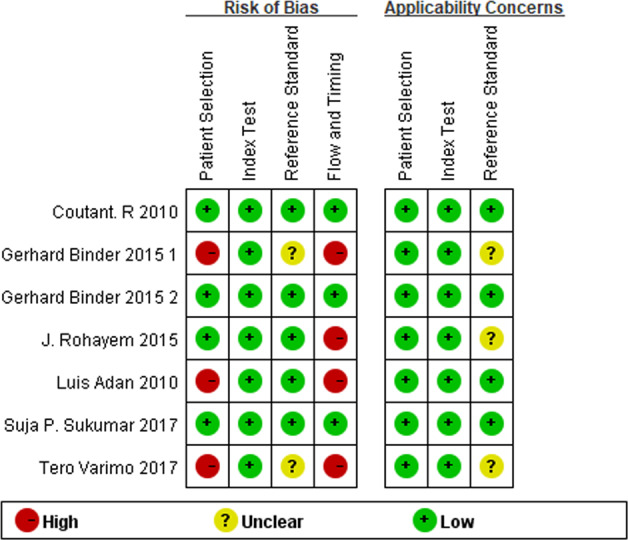
Methods: PubMed, EMBASE, and Cochrane Library databases were systematically searched from the date of database inception to November 10, 2019 for studies examining the use of serum INHB to discriminate between CHH and CDGP. Pooled odds ratios (OR), sensitivity, specificity, and 95% confidence intervals (CI) were calculated. The Quality Assessment of Diagnostic Studies-2 (QUADAS-2) was used to assess the quality of the included studies. Sub-analyses were performed including that based on testicular volume (TV) and study design.
Results: Seven studies, comprising of 349 patients (96 CHH and 253 CDGP), were included in the meta-analysis. For differentiating between CHH and CDGP, INHB level exhibited good diagnostic accuracy with a pooled sensitivity of 92% (95% confidence interval [CI]: 0.86-0.96, I2 = 0.4%, p = 0.4343), specificity of 92% (95% CI: 0.88-0.94, I2 = 68.1%, p = 0.0009), and pooled area under the receiver operating characteristic curve (AUC) of 0.9619. The cut-off values of INHB for boys were 56, 66, 80, 96, 94.7, 111, and 113 pg/ml (assay method standardized to Gen II ELISA). Sub-analyses showed that testicular volume and study design could be a source of statistically significant heterogeneity in specificity. In boys with a testicular volume of ≤3 ml, INHB performed well with a sensitivity of 92%, specificity of 98%, and AUC of 0.9956.
Conclusion: INHB exhibits excellent diagnostic efficiency in distinguishing CHH from CDGP, especially in boys with severe puberty deficiency (TV ≤ 3 ml).
Keywords: Congenital hypogonadotropic hypogonadism; Constitutional delay of growth and puberty; Inhibin B; Meta-analysis.
Conflict of interest statement
The authors declare that they have no conflict of interest.
Figures

References
-
- Palmert MR, Dunkel L. Delayed puberty. N. Engl. J. Med. 2012;366(5):443–453. - PubMed
-
- C. Wei, E.C. Crowne, Recent advances in the understanding and management of delayed puberty. Arch. Dis. Childhood. (2016) 10.1136/archdischild-2014-307963 - PubMed
-
- Boehm U, Bouloux PM, Dattani MT, et al. Expert consensus document: European Consensus Statement on congenital hypogonadotropic hypogonadism–pathogenesis, diagnosis and treatment. Nat. Rev. Endocrinol. 2015;11(9):547–564. - PubMed
Publication types
MeSH terms
Substances
Grants and funding
LinkOut - more resources
Full Text Sources
Other Literature Sources
