


Chronic kidney disease and the outcomes of fibrinolysis for ST-segment elevation myocardial infarction: A real-world study
- PMID: 33465135
- PMCID: PMC7815111
- DOI: 10.1371/journal.pone.0245576
Chronic kidney disease and the outcomes of fibrinolysis for ST-segment elevation myocardial infarction: A real-world study
Abstract
Background: In low-resource regions, fibrinolytic therapy is often the only option for ST-elevation myocardial infarction (STEMI) patients as primary percutaneous coronary intervention (PCI) is often not available and patients are hardly transferred to a medical center with PCI capacity within the first 120 minutes. Chronic kidney disease (CKD) is one of the most frequently encountered complications of STEMI. However, the evidence for the efficacy of fibrinolytic therapy in STEMI patients with CKD is still limited. The aim of this study is to test whether CKD modifies the association between fibrinolytic therapy and short-term major adverse cardiovascular events (MACEs) among patients with STEMI.
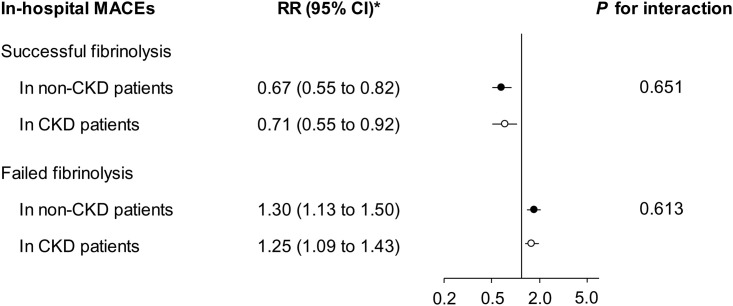
Methods and findings: This is a real-world study analyzing the data from 9508 STEMI patients (mean age: 64.0±12.4 years; male: 70.1%) in the third phase of Clinical Pathways in Acute Coronary Syndromes program (CPACS-3), which is a large study of the management of acute coronary syndromes (ACS) in 101 county hospitals without PCI capacity in China. CKD was defined as an estimated glomerular filtration rate of less than 60 mL/min per 1·73 m2 at the admission. The primary outcome is short-term MACEs, including all-cause death, recurrent myocardial infarction, or nonfatal stroke. Patients were recruited consecutively between October 2011 and November 2014. Out of them, 1282 patients (13.5%) were classified as having CKD. Compared with non-CKD patients, CKD patients were less likely to receive fibrinolytic therapy than non-CKD patients (26.4% vs. 38.9%, P<0.001), more likely to experience a failed fibrinolytic therapy (32.8% vs. 16.9%), and had a higher risk of short-term MACEs (19.7% vs. 5.6%). After full adjustment, use of fibrinolytic therapy was associated with a significantly lower risk of short-term MACEs in non-CKD patients (relative risk [RR] = 0.87, 95% confidence interval [CI]: 0.76-0.99), but not in CKD patients (P for interaction = 0.026). Further analysis stratified by the success of fibrinolysis showed that compared with patients who did not receive fibrinolytic therapy, patients with successful fibrinolysis had a lower risk of short-term MACEs that was similar between patients with (RR = 0.71, 95% CI: 0.55-0.82) and without CKD (RR = 0.67, 95% CI: 0.55-0.92), while patients with unsuccessful fibrinolysis had a similarly higher risk in CKD patients (RR = 1.25, 95% CI: 1.09-1.43) and non-CKD patients (RR = 1.30, 95% CI: 1.13-1.50).
Conclusions: CKD reduced the likelihood of successful fibrinolysis and increased the risk of short-term MACEs in patients with STEMI. Attention should be paid to how to improve the success rate of fibrinolytic therapy for STEMI patients with CKD.
Trial registration: The CPACS-3 study was registered on www.clinicaltrials.gov (NCT01398228).
Conflict of interest statement
The authors declare no competing interests. There are no other relevant declarations relating to employment, consultancy, patents, products in development or marketed products etc. to be made by Sanofi, China. This does not alter our adherence to PLOS ONE policies on sharing data and materials.
Figures
Similar articles
-
Outcomes of STEMI patients with chronic kidney disease treated with percutaneous coronary intervention: the Malaysian National Cardiovascular Disease Database - Percutaneous Coronary Intervention (NCVD-PCI) registry data from 2007 to 2014.BMC Cardiovasc Disord. 2018 Sep 24;18(1):184. doi: 10.1186/s12872-018-0919-9. BMC Cardiovasc Disord. 2018. PMID: 30249197 Free PMC article.
-
Efficacy and Safety of a Pharmaco-Invasive Strategy With Half-Dose Alteplase Versus Primary Angioplasty in ST-Segment-Elevation Myocardial Infarction: EARLY-MYO Trial (Early Routine Catheterization After Alteplase Fibrinolysis Versus Primary PCI in Acute ST-Segment-Elevation Myocardial Infarction).Circulation. 2017 Oct 17;136(16):1462-1473. doi: 10.1161/CIRCULATIONAHA.117.030582. Epub 2017 Aug 27. Circulation. 2017. PMID: 28844990 Clinical Trial.
-
Fibrinolytic therapy use for ST-segment elevation myocardial infarction and long-term outcomes in China: 2-year results from the China Acute Myocardial Infarction Registry.BMC Cardiovasc Disord. 2023 Feb 22;23(1):103. doi: 10.1186/s12872-023-03105-1. BMC Cardiovasc Disord. 2023. PMID: 36814182 Free PMC article.
-
Use of ticagrelor alongside fibrinolytic therapy in patients with ST-segment elevation myocardial infarction: Practical perspectives based on data from the TREAT study.Clin Cardiol. 2018 Oct;41(10):1322-1327. doi: 10.1002/clc.23043. Epub 2018 Oct 16. Clin Cardiol. 2018. PMID: 30098028 Free PMC article. Review.
-
Meta-analysis of randomized controlled trials comparing percutaneous coronary intervention with aspiration thrombectomy Vs. Conventional percutaneous coronary intervention during ST-segment elevation myocardial infarction.Catheter Cardiovasc Interv. 2016 Jun;87(7):1203-10. doi: 10.1002/ccd.26352. Epub 2015 Dec 23. Catheter Cardiovasc Interv. 2016. PMID: 26699698 Review.
Cited by
-
Dose-dependent effect of impaired renal function on all-cause mortality in patients following percutaneous coronary intervention.Clin Cardiol. 2022 Aug;45(8):882-891. doi: 10.1002/clc.23877. Epub 2022 Jun 27. Clin Cardiol. 2022. PMID: 35758306 Free PMC article.
References
-
- Lozano R, Naghavi M, Foreman K, Lim S, Shibuya K, Aboyans V, et al. Global and regional mortality from 235 causes of death for 20 age groups in 1990 and 2010: a systematic analysis for the Global Burden of Disease Study 2010. Lancet. 2012;380(9859):2095–128. Epub 2012/12/19. 10.1016/S0140-6736(12)61728-0 . - DOI - PMC - PubMed
-
- Ibanez B, James S, Agewall S, Antunes MJ, Bucciarelli-Ducci C, Bueno H, et al. 2017 ESC Guidelines for the management of acute myocardial infarction in patients presenting with ST-segment elevation: The Task Force for the management of acute myocardial infarction in patients presenting with ST-segment elevation of the European Society of Cardiology (ESC). Eur Heart J. 2018;39(2):119–77. Epub 2017/09/10. 10.1093/eurheartj/ehx393 . - DOI - PubMed
-
- O’Gara PT, Kushner FG, Ascheim DD, Casey DE Jr., Chung MK, de Lemos JA, et al. 2013 ACCF/AHA guideline for the management of ST-elevation myocardial infarction: a report of the American College of Cardiology Foundation/American Heart Association Task Force on Practice Guidelines. Circulation. 2013;127(4):e362–425. Epub 2012/12/19. 10.1161/CIR.0b013e3182742cf6 . - DOI - PubMed
-
- Li J, Li X, Wang Q, Hu S, Wang Y, Masoudi FA, et al. ST-segment elevation myocardial infarction in China from 2001 to 2011 (the China PEACE-Retrospective Acute Myocardial Infarction Study): a retrospective analysis of hospital data. Lancet. 2015;385(9966):441–51. Epub 2014/06/28. 10.1016/S0140-6736(14)60921-1 . - DOI - PMC - PubMed
-
- Association CSoCoCM, Cardiology EBoCJo. Guideline on the diagnosis and therapy of ST-segment elevation myocardial infarction. Chinese Journal of Cardiology. 2015;43(5):380–93. Epub 2015/10/01. . - PubMed
Publication types
MeSH terms
Associated data
LinkOut - more resources
Full Text Sources
Other Literature Sources
Medical
Miscellaneous
