


Behavioral economics and the aggregate versus proximal impact of sociality on heavy drinking
- PMID: 33465607
- PMCID: PMC7889694
- DOI: 10.1016/j.drugalcdep.2021.108523
Behavioral economics and the aggregate versus proximal impact of sociality on heavy drinking
Abstract
Background: Behavioral economic theory predicts decisions to drink are cost benefit analyses, and heavy episodic drinking occurs when benefits outweigh costs. Social interaction is a known benefit associated with alcohol use. Although heavy drinking is typically considered more likely during more social drinking events, people who drink heavily in isolation tend to report greater severity of use. This study explicitly disaggregates between-person and within-person effects of sociality on heavy episodic drinking and examines behavioral economic moderators.
Methods: We used day-level survey data over an 18-week period in a community adult sample recruited through crowdsourcing (mTurk; N = 223). Behavioral economic indices were examined to determine if macro person-level variables (alcohol demand, delay discounting, proportionate alcohol-related reinforcement [R-ratio]) interact with event-level social context to predict heavy drinking episodes.
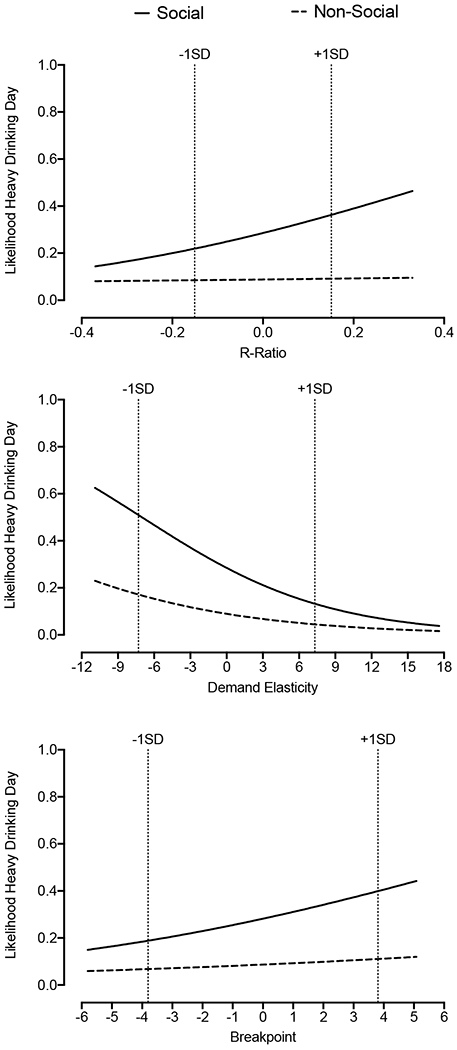
Results: Mixed effect models indicated significant between-person and within-person social context associations. Specifically, people with a higher proportion of total drinking occasions in social contexts had decreased odds of heavy drinking, whereas being in a social context for a specific drinking occasion was associated with increased odds of heavy drinking. Person-level R-Ratio, demand elasticity, and breakpoint variables interacted with social context to predict heavy episodic drinking, such that the event-level social context association was stronger when R-Ratios, alcohol price insensitivity, and demand breakpoints were high.
Conclusions: These results demonstrate an ecological fallacy, in which the size and direction of effects were divergent at different levels of analysis, and highlight the potential for merging behavioral economic variables with proximal contextual effects to predict heavy drinking.
Keywords: Alcohol; Behavioral economics; Decision-making; Demand; Discounting; Social.
Copyright © 2021 Elsevier B.V. All rights reserved.
Conflict of interest statement
Conflict of Interest
The authors have no conflicts of interest to disclose.
Figures
References
Publication types
MeSH terms
Grants and funding
LinkOut - more resources
Full Text Sources
Other Literature Sources
Medical
