Review
. 2021 Jan 15:104:261-266.
doi: 10.1016/j.placenta.2021.01.012. Epub 2021 Jan 11.

SARS-CoV-2 placentitis: An uncommon complication of maternal COVID-19

Affiliations
Review

SARS-CoV-2 placentitis: An uncommon complication of maternal COVID-19

Laura Linehan et al. Placenta. .

Abstract

We present a case of third trimester pregnancy complicated by SARS-CoV-2 infection and subsequent reduced fetal movements, resulting in emergency Caesarean delivery with demonstrable placental SARS-CoV-2 placentitis. We show through illustration of this case and literature review that SARS-Co-V-2 placentitis is an uncommon but readily recognisable complication of maternal SARS-CoV-2 infection that may be a marker of potential vertical transmission and that may have the capacity to cause fetal compromise through a direct injurious effect on the placenta.

Keywords: Histiocytic intervillositis; Placental pathology; Placentitis; SARS-CoV-2; Vertical transmission.


Conflict of interest statement

The authors declare that they have no conflicts of interest, professionally or financially, to hinder the publication of this work.

Figures

Fig. 1
Fig. 1
Gross appearance:a) The gross appearance of the cut surface of the placenta shows pale nodules and streaks (white arrowheads) resembling massive perivillous fibrinoid deposition with involvement of a significant volume of placental parenchyma. b) Although the gross appearance suggests fibrin deposition, an MSB stain (200x) shows only focal fibrin deposition (orange/red), at the arrowhead tip, in what would have been the pale areas grossly.
Fig. 2
Fig. 2
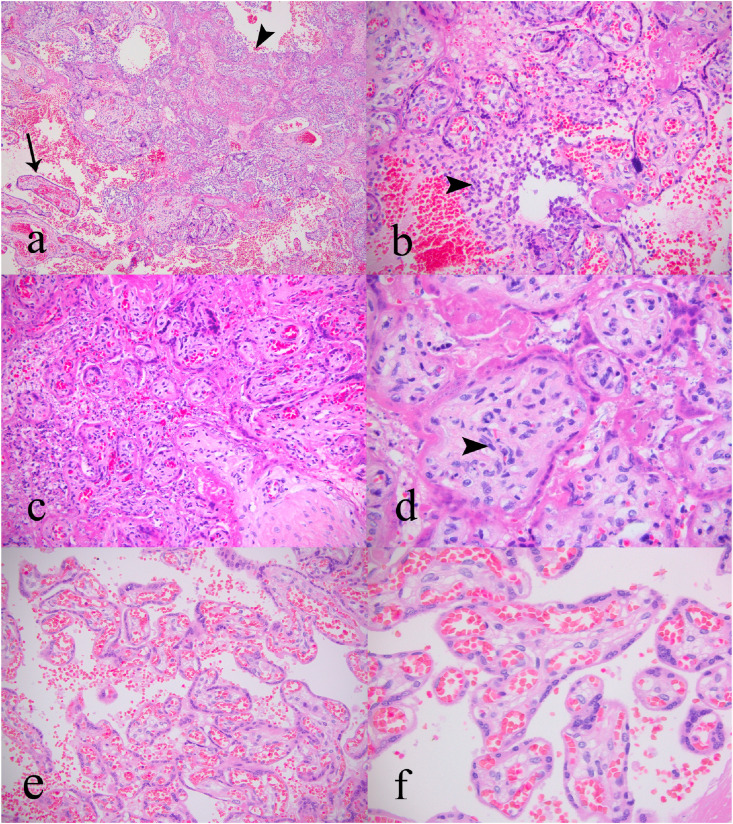
H/E appearances:a) On low power (50x) there is conspicuous clumping and adherence of villi with obliteration of the intervillous space in involved areas (arrowhead). This contrasts with the non-clumped areas (arrow). b) There is a conspicuous intervillositis, with inflammatory cells in the intervillous space (arrowhead, 200x). c) In the clumped areas the intervillous space is filled with eosinophilic material and cellular debris as a result of trophoblast necrosis (200x). d) A higher power view (400x) shows sparing of the villous stroma (arrowhead) but obvious trophoblast necrosis and debris accumulation in the intervillous space. e) A normal term placenta at 200x, for comparison with panel 2c, shows preservation of the intervillous space and separated villi. f) A normal term placenta at 400x, for comparison with panel 2 d, shows normal villi with intact trophoblast and a clean intervillous space.
Fig. 3
Fig. 3
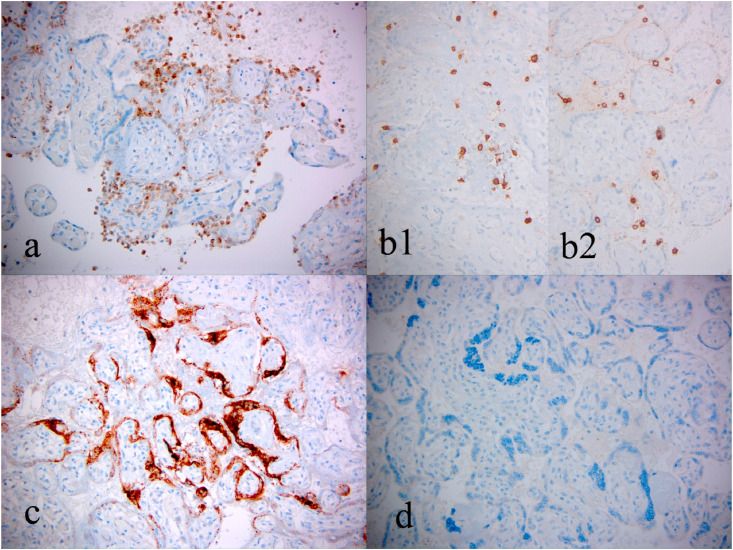
Immunohistochemistry:a) A CD68 stain confirms that most cells involved in the intervillositis are histiocytes. b) Only occasional CD3 positive T-lymphocytes (b1) and CD20 positive B-lymphocytes (b2) are present. c) There is strong positive staining for SARS-CoV-2 in involved areas of the placenta. This staining is confined to villous trophoblast. d) Shows negative staining in a control placenta.

References

    1. Home Johns Hopkins coronavirus resource center. https://coronavirus.jhu.edu/ [Internet]. [cited 2021 Jan 04]. Available from.
    1. Knight M., Bunch K., Vousden N., Morris E., Simpson N., Gale C., et al. Characteristics and outcomes of pregnant women admitted to hospital with confirmed SARS-CoV-2 infection in UK: national population based cohort study. BMJ. 2020;369:m2107. - PMC - PubMed
    1. Walker K.F., O'Donoghue K., Grace N., Dorling J., Comeau J.L., Li W., et al. Maternal transmission of SARS-COV-2 to the neonate, and possible routes for such transmission: a systematic review and critical analysis. BJOG An Int. J. Obstet. Gynaecol. 2020 0–2. - PMC - PubMed
    1. Badr D.A., Mattern J., Carlin A., Cordier A.-G., Maillart E., El Hachem L., et al. Are clinical outcomes worse for pregnant women ≥ 20 weeks' gestation infected with COVID-19? A multicenter case-control study with propensity score matching. Am J Obstet Gynecol. 2020 http://www.sciencedirect.com/science/article/pii/S0002937820307766 [Internet] Available from: - PMC - PubMed
    1. Huntley B.J.F., Huntley E.S., Di Mascio D., Chen T., Berghella V., Chauhan S.P. Rates of maternal and perinatal mortality and vertical transmission in pregnancies complicated by severe acute respiratory syndrome coronavirus 2 (SARS-Co-V-2) infection. Obstet. Gynecol. 2020;136(2):303–312. - PubMed