


Comparison of Interventional Strategies to Improve Recovery after Eccentric Exercise-Induced Muscle Fatigue
- PMID: 33466606
- PMCID: PMC7828692
- DOI: 10.3390/ijerph18020647
Comparison of Interventional Strategies to Improve Recovery after Eccentric Exercise-Induced Muscle Fatigue
Abstract
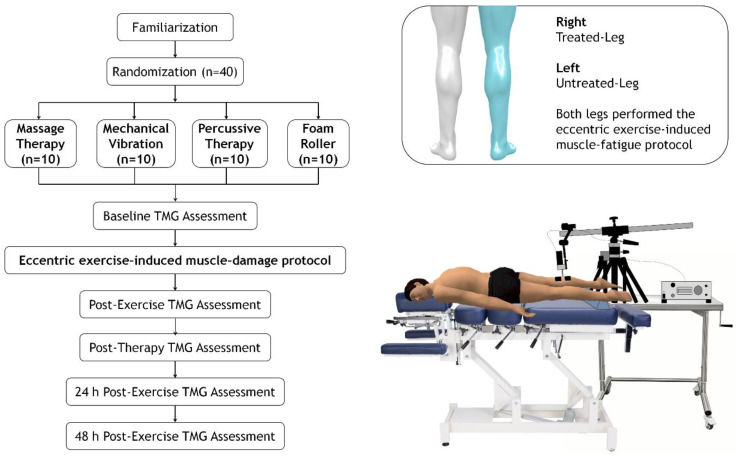
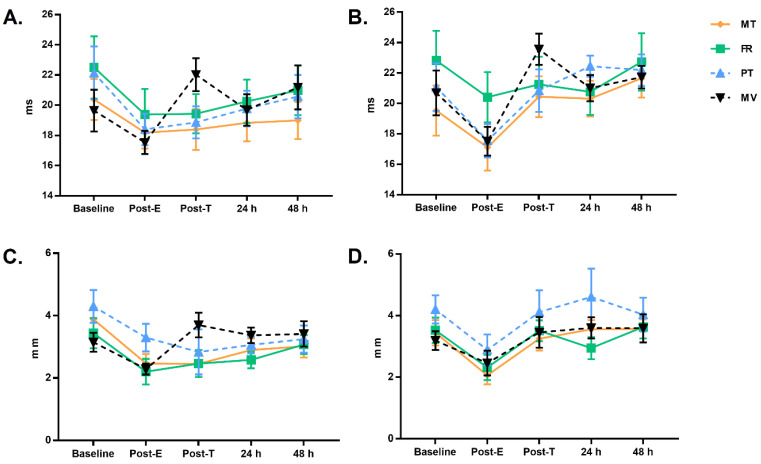
The aim of this study was to compare the effects of various recovery techniques on muscle tissue after eccentric exercise-induced muscle fatigue (EIMF). Forty subjects (24.3 ± 2.6 years; 77.45 ± 8.3 kg; 177.0 ± 6.4 cm; 24.66 ± 1.6 kg∙m-2) were randomly assigned to one of the following groups: manual therapy (n =10, MT), mechanical vibration (n = 10, MV), percussion therapy (n = 10, PT) or foam roller (n = 10, FR). The contraction time (Tc) and the radial displacement (Dm) of the gastrocnemius was evaluated through tensiomyography (TMG). The application of the different techniques had positive effects for Tc and Dm in the treated leg compared to the untreated leg (F = 50.01, p < 0.01, η2p = 0.58 and F = 27.58, p < 0.01, η2p = 0.43, respectively) and for the interaction of the factors (Time x Leg x Therapy: F = 5.76, p < 0.01, η2p = 0.32 and F = 5.93, p < 0.01, η2p = 0.33, respectively). The results of the various methods used were similar: Tc (F = 0.17, p = 0.917; η2p = 0.01) and Dm (F = 3.30, p = 0.031, η2p = 0.22). PT interventions show potential for restoring muscle compliance and reducing stiffness, similar to MT and possibly more effective (cost-time relationship) compared to MV or FR.
Keywords: fascia; injury prevention; muscle contraction; musculoskeletal manipulations; myalgia; range of motion.
Conflict of interest statement
The authors declare no conflict of interest.
Figures
References
Publication types
MeSH terms
LinkOut - more resources
Full Text Sources
Other Literature Sources
Medical
