Review
. 2021 Jan 14;13(2):284.
doi: 10.3390/cancers13020284.

Hematopoietic versus Solid Cancers and T Cell Dysfunction: Looking for Similarities and Distinctions

Affiliations
Review

Hematopoietic versus Solid Cancers and T Cell Dysfunction: Looking for Similarities and Distinctions

Chiara Montironi et al. Cancers (Basel). .

Abstract

Cancer cells escape, suppress and exploit the host immune system to sustain themselves, and the tumor microenvironment (TME) actively dampens T cell function by various mechanisms. Over the last years, new immunotherapeutic approaches, such as adoptive chimeric antigen receptor (CAR) T cell therapy and immune checkpoint inhibitors, have been successfully applied for refractory malignancies that could only be treated in a palliative manner previously. Engaging the anti-tumor activity of the immune system, including CAR T cell therapy to target the CD19 B cell antigen, proved to be effective in acute lymphocytic leukemia. In low-grade hematopoietic B cell malignancies, such as chronic lymphocytic leukemia, clinical outcomes have been tempered by cancer-induced T cell dysfunction characterized in part by a state of metabolic lethargy. In multiple myeloma, novel antigens such as BCMA and CD38 are being explored for CAR T cells. In solid cancers, T cell-based immunotherapies have been applied successfully to melanoma and lung cancers, whereas application in e.g., breast cancer lags behind and is modestly effective as yet. The main hurdles for CAR T cell immunotherapy in solid tumors are the lack of suitable antigens, anatomical inaccessibility, and T cell anergy due to immunosuppressive TME. Given the wide range of success and failure of immunotherapies in various cancer types, it is crucial to comprehend the underlying similarities and distinctions in T cell dysfunction. Hence, this review aims at comparing selected, distinct B cell-derived versus solid cancer types and at describing means by which malignant cells and TME might dampen T cell anti-tumor activity, with special focus on immunometabolism. Drawing a meaningful parallel between the efficacy of immunotherapy and the extent of T cell dysfunction will shed light on areas where we can improve immune function to battle cancer.

Keywords: T cell dysfunction; TME; immunotherapy; metabolism; microenvironment.


Conflict of interest statement

The authors declare no conflict of interest.

Figures
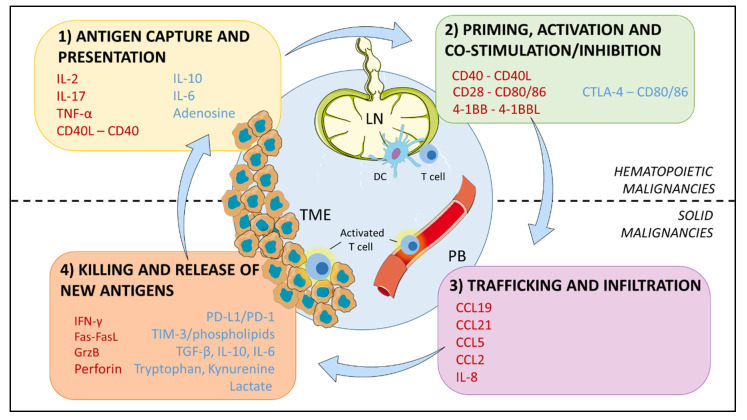
Figure 1
Figure 1
Cancer-immunity cycle. The immune response against cancer starts in the tumor microenvironment (TME) where antigens released by cancer cells are captured by dendritic cells (DCs), followed by antigen presentation to T cells in the lymph node (LN) for their priming. Activated T cells traffic through peripheral blood (PB) and infiltrate the tumor bed to kill cancer cells. The cycle is propagating with new antigen release. Immunostimulatory and inhibitory factors promoting or suppressing the cycle are indicated in red and blue, respectively. Antigen presentation and priming is the main mechanism affected in B cell malignancies, while T cell dysfunction in solid cancers is predominantly due to defective tumor infiltration and killing in the TME. Figure adapted from REF [3] to match the scope of this review.
Figure 2
Figure 2
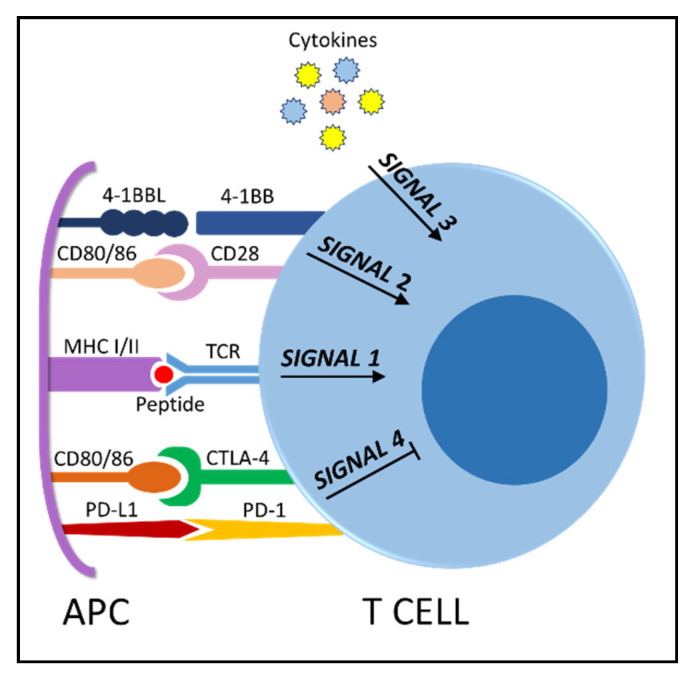
T cell activation requires 3 signals: T cell receptor (TCR) stimulation, co-stimulatory molecules such as CD28 or 4-1BB, immunostimulatory cytokines. Activating signals can be counteracted by inhibitory molecules (checkpoints, “signal 4”) such as CTLA-4 and PD-1. The respective ligands on the antigen presenting cell (APC) are indicated.
Figure 3
Figure 3
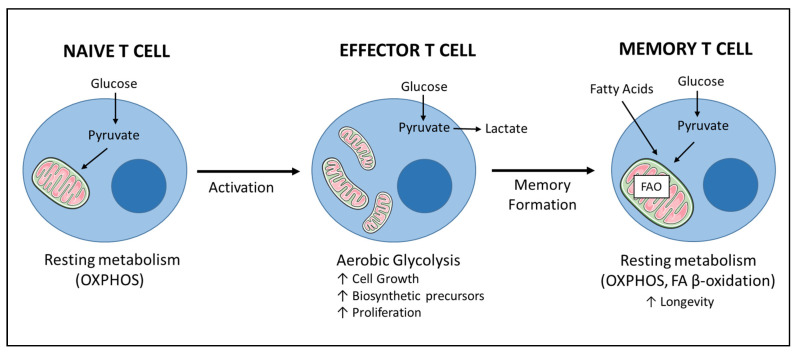
Simplified representation of metabolic remodeling during T cell activation and acquisition of memory phenotype. T lymphocytes exhibit distinct energy demands according to their differentiation status. Naïve, quiescent T cells predominantly use a resting metabolism relying on oxidative phosphorylation (OXPHOS) to produce ATP: the majority of pyruvate derived from glucose and other fuels (not shown) enters the mitochondria. Early after activation, effector T cells switch to a more glycolytic state to sustain cell growth and proliferation: glucose is mainly fermented into lactate; mitochondria appear punctate. After memory formation, T cells acquire a quiescent metabolic state predominantly fueled by β-oxidation of fatty acids (FAO) that ensures longevity after priming. Memory T cells are also characterized by a highly fused mitochondrial network. Note: there is an ongoing debate whether memory T cells derive from effector T cells, and/or directly from naive precursors after T cell activation. For clarity we have represented the first option, while not excluding the latter.

References

    1. Hanahan D., Weinberg R.A. Hallmarks of cancer: The next generation. Cell. 2011;144:646–674. doi: 10.1016/j.cell.2011.02.013. - DOI - PubMed
    1. Pilipow K., Darwich A., Losurdo A. T-cell-based breast cancer immunotherapy. Semin. Cancer Biol. 2020 doi: 10.1016/j.semcancer.2020.05.019. in press. - DOI - PubMed
    1. Chen D.S., Mellman I. Oncology meets immunology: The cancer-immunity cycle. Immunity. 2013;39:1–10. doi: 10.1016/j.immuni.2013.07.012. - DOI - PubMed
    1. Nurieva R., Wang J., Sahoo A. T-cell tolerance in cancer. Immunotherapy. 2013;5:513–531. doi: 10.2217/imt.13.33. - DOI - PMC - PubMed
    1. Ok C.Y., Young K.H. Checkpoint inhibitors in hematological malignancies. J. Hematol. Oncol. 2017;10:1–16. doi: 10.1186/s13045-017-0474-3. - DOI - PMC - PubMed