


Significance of Lauren Classification in Patients Undergoing Neoadjuvant/Perioperative Chemotherapy for Locally Advanced Gastric or Gastroesophageal Junction Cancers-Analysis from a Large Single Center Cohort in Germany
- PMID: 33466779
- PMCID: PMC7830383
- DOI: 10.3390/cancers13020290
Significance of Lauren Classification in Patients Undergoing Neoadjuvant/Perioperative Chemotherapy for Locally Advanced Gastric or Gastroesophageal Junction Cancers-Analysis from a Large Single Center Cohort in Germany
Abstract
Background: the purpose of this analysis was to analyze the outcomes of multimodal treatment that are related to Lauren histotypes in gastro-esophageal cancer (GEC).
Methods: patients with GEC between 1986 and 2013 were analyzed. Uni- and multivariate regression analysis were performed to identify predictors for overall survival. Lauren histotype stratified overall survival (OS)-rates were analyzed by the Kaplan-Meier method. Further, propensity score matching (PSM) was performed to balance for confounders.
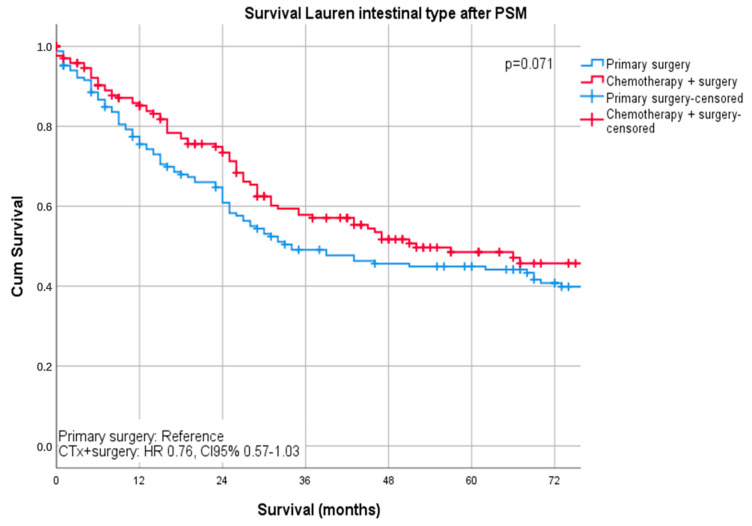
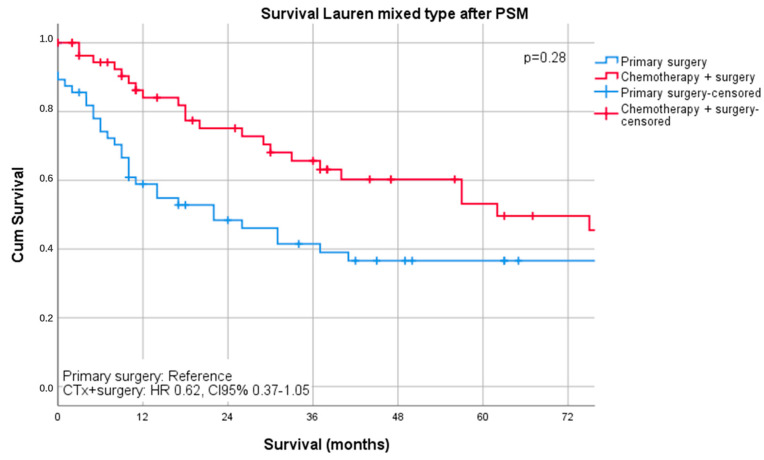
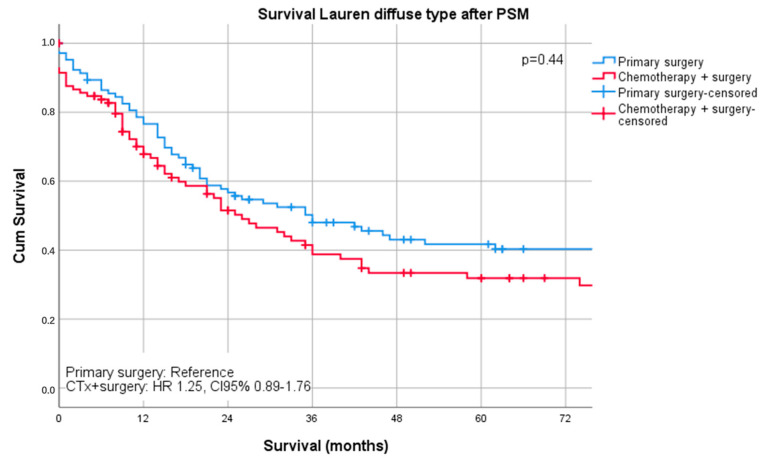
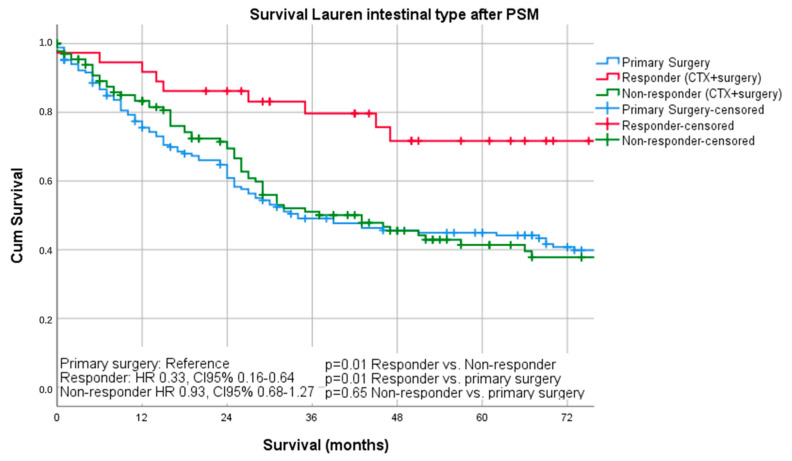
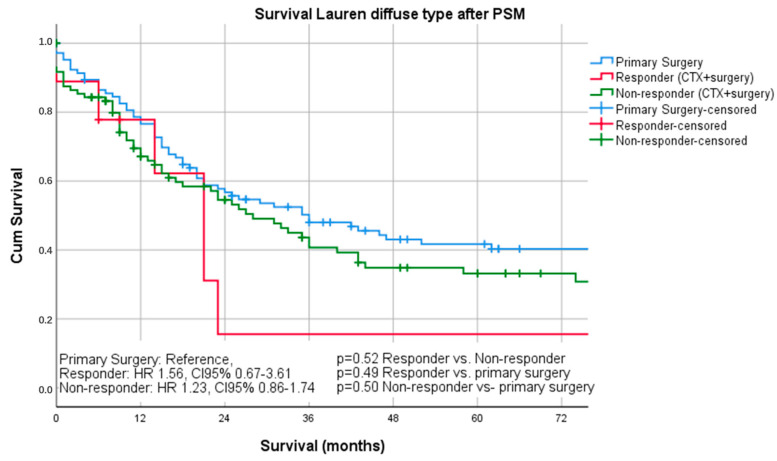
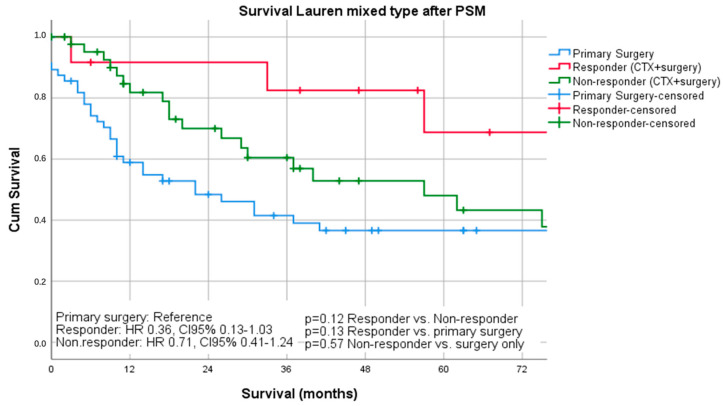
Results: 1290 patients were analyzed. After PSM, the median survival was 32 months for patients undergoing primary surgery (PS) and 43 months for patients undergoing neoadjuvant chemotherapy (nCTx) ahead of surgery. For intestinal types, median survival time was 34 months (PS) vs. 52 months (nCTx+surgery) p = 0.07, 36 months (PS) vs. (31) months (nCTx+surgery) in diffuse types (p = 0.44) and 31 months (PS) vs. 62 months (nCTx+surgery) for mixed types (p = 0.28). Five-/Ten-year survival rates for intestinal, diffuse, and mixed types were 44/29%, 36/17%, and 43/33%, respectively. After PSM, Kaplan-Meier showed a survival benefit for patients undergoing nCTx+surgery in intestinal and mixed types.
Conclusion: the Lauren histotype might be predictive for survival outcome in GEC-patients after neoadjuvant/perioperative chemotherapy.
Keywords: Lauren histotype; gastric/gastroesophageal cancer; perioperative chemotherapy.
Conflict of interest statement
The authors declare no conflict of interest.
Figures
References
-
- Cunningham D., Allum W.H., Stenning S.P., Thompson J.N., Van de Velde C.J.H., Nicolson M., Scarffe J.H., Lofts F.J., Falk S.J., Iveson T.J., et al. Perioperative chemotherapy versus surgery alone for resectable gastroesophageal cancer. N. Engl. J. Med. 2006;355:11–20. doi: 10.1056/NEJMoa055531. - DOI - PubMed
-
- Ychou M., Boige V., Pignon J.-P., Conroy T., Bouche O., Lebreton G., Ducourtieux M., Bedenne L., Fabre J.-M., Saint-Aubert B., et al. Perioperative Chemotherapy Compared With Surgery Alone for Resectable Gastroesophageal Adenocarcinoma: An FNCLCC and FFCD Multicenter Phase III Trial. J. Clin. Oncol. 2011;29:1715–1721. doi: 10.1200/JCO.2010.33.0597. - DOI - PubMed
-
- Van Hagen P., Hulshof M.C., van Lanschot J.J., Steyerberg E.W., van Berge Henegouwen M.I., Wijnhoven B.P., Richel D.J., Nieuwenhuijzen G.A., Hospers G.A., Bonenkamp J.J., et al. Preoperative chemoradiotherapy for esophageal or junctional cancer. N. Engl. J. Med. 2012;366:2074–2084. doi: 10.1056/NEJMoa1112088. - DOI - PubMed
LinkOut - more resources
Full Text Sources
Other Literature Sources
Miscellaneous
