Review
. 2021 Jan 15;10(1):167.
doi: 10.3390/cells10010167.

The Metabolic Role of GRK2 in Insulin Resistance and Associated Conditions

Affiliations
Review

The Metabolic Role of GRK2 in Insulin Resistance and Associated Conditions

Daniela Sorriento et al. Cells. .

Abstract

Insulin resistance (IRES) is a pathophysiological condition characterized by the reduced response to insulin of several tissues, including myocardial and skeletal muscle. IRES is associated with obesity, glucose intolerance, dyslipidemia, and hypertension, evolves toward type 2 diabetes, and increases the risk of developing cardiovascular diseases. Several studies designed to explore the mechanisms involved in IRES allowed the identification of a multitude of potential molecular targets. Among the most promising, G Protein Coupled Receptor Kinase type 2 (GRK2) appears to be a suitable one given its functional implications in many cellular processes. In this review, we will discuss the metabolic role of GRK2 in those conditions that are characterized by insulin resistance (diabetes, hypertension, heart failure), and the potentiality of its inhibition as a therapeutic strategy to revert both insulin resistance and its associated phenotypes.

Keywords: GRK2; diabetes; heart failure; hypertension; insulin resistance.


Conflict of interest statement

The authors declare no conflict of interest. The funders had no role in the design of the study; in the collection, analyses, or interpretation of data; in the writing of the manuscript, or in the decision to publish the results.

Figures
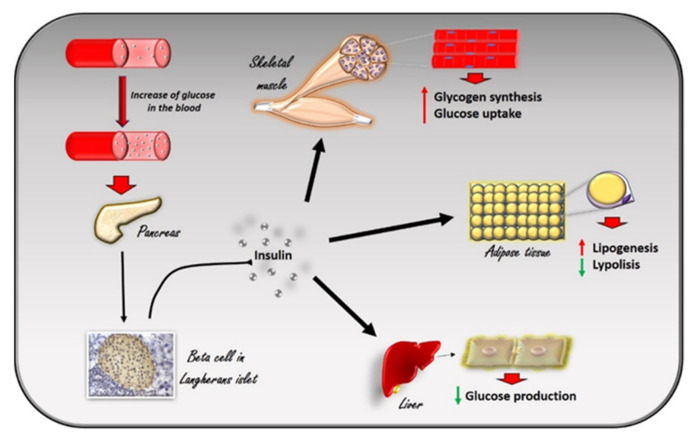
Figure 1
Figure 1
The effects of insulin in response to the increase in glucose levels in the blood. The increase in glucose in the blood stimulates beta cells in the pancreas to produce insulin. Circulating insulin exerts several effects in different tissues. In skeletal muscle, it promotes glucose utilization and storage by increasing glucose transport and glycogen synthesis. In the liver, insulin promotes glycogen synthesis, and inhibits glycogenolysis, gluconeogenesis, and ketogenesis. In white adipocyte tissue, insulin promotes the deposition of triglycerides, inhibits lipolysis, and promotes the absorption of glucose and fatty acids.
Figure 2
Figure 2
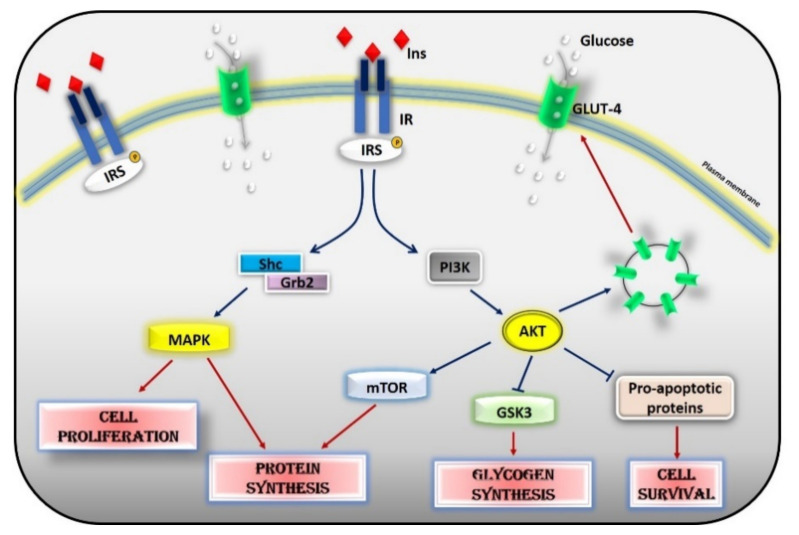
Insulin signaling cascade. Insulin activates the insulin receptor, which phosphorylates IRS in tyrosine residues. IRS, in turn, activates MAPK via SHc/Grb2 and AKT via PI3K. Activated AKT induces glycogen synthesis through inhibition of GSK-3, protein synthesis via mTOR signaling, cell survival through inhibition of several pro-apoptotic agents, and the translocation of GLUT-4 to the cell membrane. Activated MAPK induces cell proliferation and protein synthesis. Abbreviations: INS = Insulin; IR = Insulin Receptor; IRS = Insulin Receptor Substrate; Shc = Src Homology 2 Domain-Containing; Grb2 = Growth factor Receptor-Bound protein 2; MAPK = Mitogen-Activated Protein Kinase; PI3K = Phosphoinositide 3-kinase; AKT = Protein kinase B; mTOR = Mammalian Target of Rapamycin; GSK3 = Glycogen synthase kinase 3; GLUT4 = Glucose Transporter type 4.
Figure 3
Figure 3
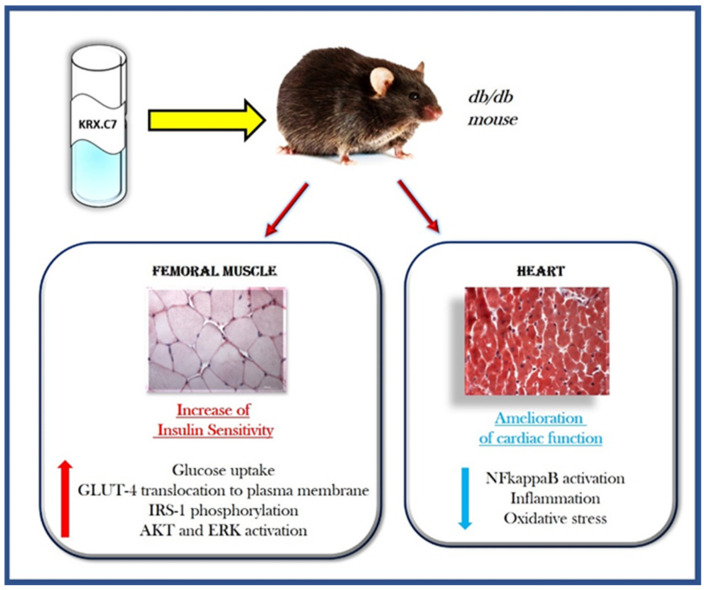
The double effect of GRK2 inhibition in diabetic mice. In db/db mice, the treatment with KRX-C7, a selective inhibitor of GRK2, increases insulin sensitivity by affecting the insulin signaling cascade. Indeed, it induces the phosphorylation of IRS-1 and the activation of AKT and MAPK signaling. This induces the translocation of GLUT-4 to the plasma membrane and increases glucose uptake. Abbreviations: KRX-C7 = cyclic peptide inhibitor of GRK2; GLUT4 = Glucose Transporter type 4; IRS = Insulin Receptor Substrate; AKT = Protein kinase B; ERK = Extracellular signal-Regulated Kinase; NFkappaB = Nuclear Factor kappa-light-chain-enhancer of activated B cells.
Figure 4
Figure 4
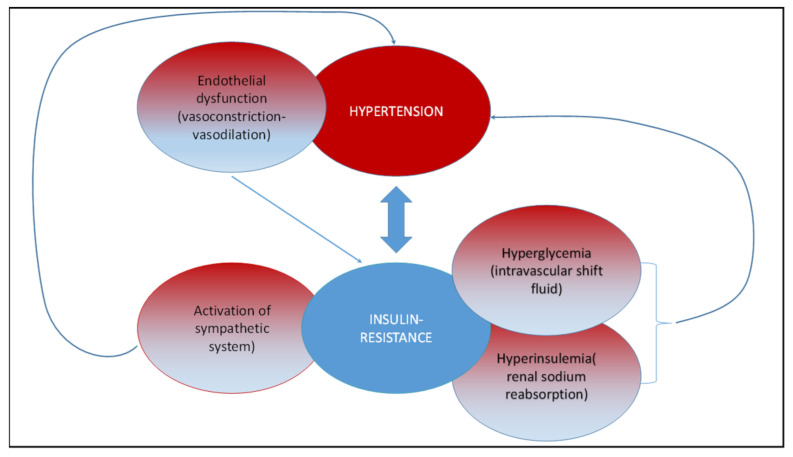
Network linking hypertension and insulin resistance. Hypertension and insulin resistance are strictly connected. Insulin resistance induces hyperglycemia, compensative hyperinsulinemia and activation of the sympathetic system, which, in turn, favors the development of a hypertensive state. On the other hand, hypertension is characterized by endothelial dysfunction, which induces insulin resistance.
Figure 5
Figure 5
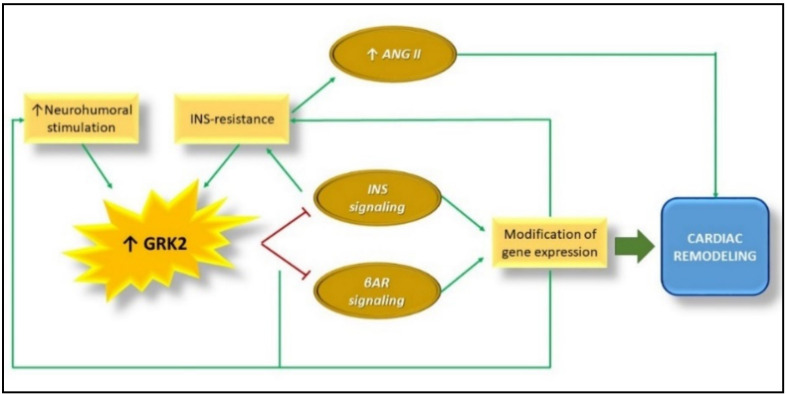
GRK2 up-regulation, Insulin resistance, and maladaptive cardiac remodeling in heart failure. Several studies showed that myocardial GRK2 activity and expression is increased in the failing heart. This promotes desensitization and downregulation of βAR and inhibits INS signaling, causing the modification of hypertrophic gene expression and, consequently, cardiac remodeling. The alterations of INS signaling cause Insulin resistance that in turn induces Ang II-dependent cardiac remodeling. Abbreviations: GRK2 = G Protein coupled Receptor Kinase type 2; βAR = beta adrenergic receptor; INS = Insulin; ANG II = Angiotensin II.

References

    1. Petersen M.C., Shulman G.I. Mechanisms of Insulin Action and Insulin Resistance. Physiol. Rev. 2018;98:2133–2223. doi: 10.1152/physrev.00063.2017. - DOI - PMC - PubMed
    1. Czech M.P. Insulin action and resistance in obesity and type 2 diabetes. Nat. Med. 2017;23:804–814. doi: 10.1038/nm.4350. - DOI - PMC - PubMed
    1. Dugani C.B., Klip A. Glucose transporter 4: Cycling, compartments and controversies. EMBO. Rep. 2005;6:1137–1142. doi: 10.1038/sj.embor.7400584. - DOI - PMC - PubMed
    1. Chadt A., Al-Hasani H. Glucose transporters in adipose tissue, liver, and skeletal muscle in metabolic health and disease. Pflug. Arch. 2020;472:1273–1298. doi: 10.1007/s00424-020-02417-x. - DOI - PMC - PubMed
    1. Haeusler R.A., McGraw T.E., Accili D. Biochemical and cellular properties of insulin receptor signalling. Nat. Rev. Mol. Cell Biol. 2018;19:31–44. doi: 10.1038/nrm.2017.89. - DOI - PMC - PubMed

Publication types