Review
. 2021 Jan 20;19(1):13.
doi: 10.1186/s12916-020-01885-3.

The gut microbiome: a key player in the complexity of amyotrophic lateral sclerosis (ALS)

Affiliations
Review

The gut microbiome: a key player in the complexity of amyotrophic lateral sclerosis (ALS)

Sarah L Boddy et al. BMC Med. .

Abstract

Background: Much progress has been made in mapping genetic abnormalities linked to amyotrophic lateral sclerosis (ALS), but the majority of cases still present with no known underlying cause. Furthermore, even in families with a shared genetic abnormality there is significant phenotypic variability, suggesting that non-genetic elements may modify pathogenesis. Identification of such disease-modifiers is important as they might represent new therapeutic targets. A growing body of research has begun to shed light on the role played by the gut microbiome in health and disease with a number of studies linking abnormalities to ALS.

Main body: The microbiome refers to the genes belonging to the myriad different microorganisms that live within and upon us, collectively known as the microbiota. Most of these microbes are found in the intestines, where they play important roles in digestion and the generation of key metabolites including neurotransmitters. The gut microbiota is an important aspect of the environment in which our bodies operate and inter-individual differences may be key to explaining the different disease outcomes seen in ALS. Work has begun to investigate animal models of the disease, and the gut microbiomes of people living with ALS, revealing changes in the microbial communities of these groups. The current body of knowledge will be summarised in this review. Advances in microbiome sequencing methods will be highlighted, as their improved resolution now enables researchers to further explore differences at a functional level. Proposed mechanisms connecting the gut microbiome to neurodegeneration will also be considered, including direct effects via metabolites released into the host circulation and indirect effects on bioavailability of nutrients and even medications.

Conclusion: Profiling of the gut microbiome has the potential to add an environmental component to rapidly advancing studies of ALS genetics and move research a step further towards personalised medicine for this disease. Moreover, should compelling evidence of upstream neurotoxicity or neuroprotection initiated by gut microbiota emerge, modification of the microbiome will represent a potential new avenue for disease modifying therapies. For an intractable condition with few current therapeutic options, further research into the ALS microbiome is of crucial importance.

Keywords: ALS; Amyotrophic lateral sclerosis; Disease modifiers; Microbial; Microbial metabolites; Microbiome.


Conflict of interest statement

The authors have no competing interests.

Figures
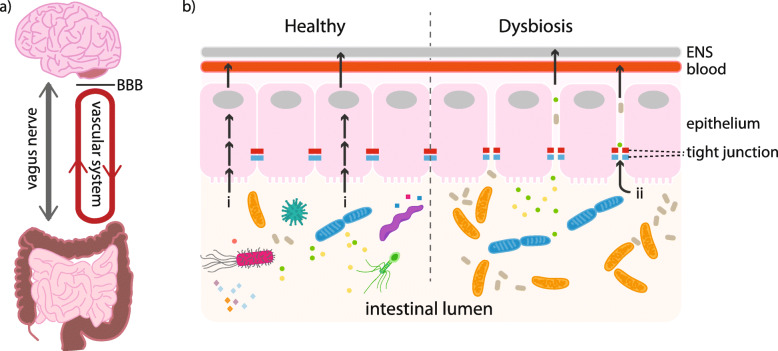
Fig. 1
Fig. 1
Pathways linking gut microbial function to changes in the CNS. a Macro-scale pathways: The enteric nervous system (ENS) intrinsic to the gut is connected to the central nervous system directly via the vagus nerve. As such, any microbe-derived metabolite that accesses the ENS has the potential to travel to and impact the brain and spinal cord. Likewise, an extensive network of blood capillaries collects nutrients absorbed from the gut for transfer around the body. Microbial metabolites that access the bloodstream can impact any part of the body, though still need to breach the blood-brain-barrier (BBB) to access the CNS. b Transit across the intestinal epithelium: In a healthy gut with functional tight junctions, selective uptake of contents of the intestinal lumen occurs across the epithelial cells (route “i”). Dysbiosis of the gut microbiota can damage the structural integrity of the epithelial barrier allowing uncontrolled transit of metabolites and other luminal contents to pass into the body (route “ii”)
Fig. 2
Fig. 2
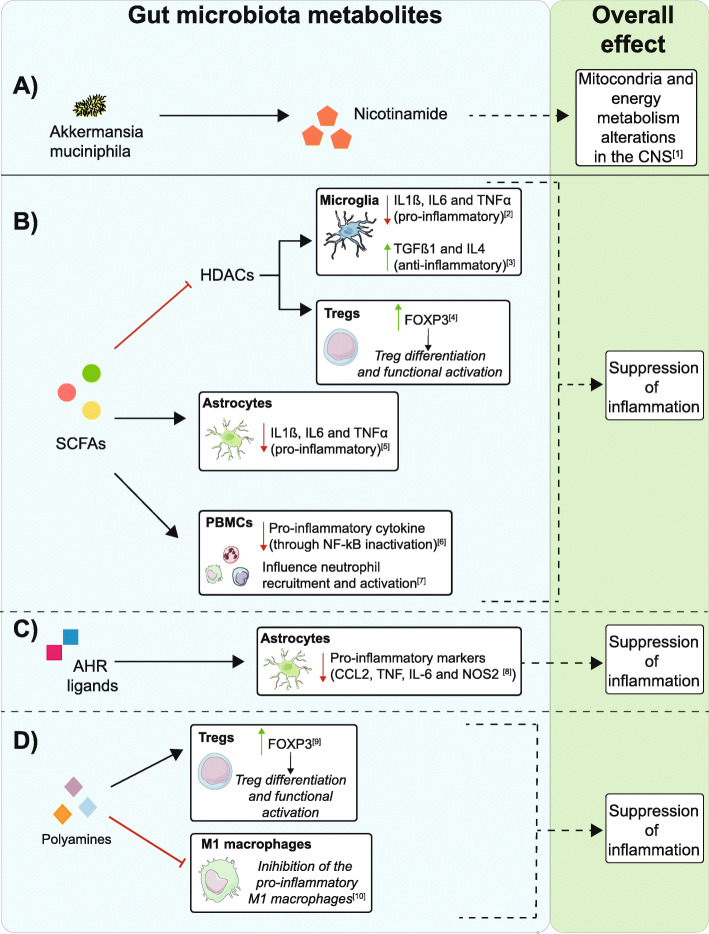
Metabolites produced by microbes found within the gut can influence neuronal health either directly or indirectly via CNS inflammation. a Metabolites released by the gut microbiome can enter the system circulation where they can access the CNS; in the case of nicotinamide released by Akkermansia muciniphila, this potentially modifies energy homeostasis and oxidative stress [17]. bd A number of proposed mechanisms exist by which metabolites produced by microbes found within the gut can influence the immune response and have an effect of the CNS inflammatory state. b Short-chain fatty acids (SCFAs) can reduce inflammation by inhibiting HDACs within microglial cells, leading to the downregulation of pro-inflammatory (IL1ß, IL6 and TNFα) and upregulation of anti-inflammatory markers (TGFβ and IL4) [56, 57]. SCFA-mediated HDAC inhibition can also impact Tregs increasing their activity via upregulation of FOXP3 [58, 59]. SCFAs also influence astrocytes, reducing their inflammatory impact through downregulation of IL1ß, IL6 and TNFα [60]. Lastly, SCFAs exert anti-inflammatory effects on different peripheral blood mononuclear cells: they inhibit NF-kB leading to reduced pro-inflammatory cytokine production and immune cell recruitment and activation [–63]. c Aryl hydrocarbon receptor (AHR) ligands can modulate astrocyte activities and give rise to anti-inflammatory properties [64]. d Polyamines induce FOXP3 expression in Treg cells promoting their differentiation and activation [65]. These molecules can also inhibit inflammatory macrophages (M1) thereby preventing macrophage-induced inflammation [66]

References

    1. Chio A, Logroscino G, Hardiman O, Swingler R, Mitchell D, Beghi E, et al. Prognostic factors in ALS: a critical review. Amyotroph Lateral Scler. 2009;10:310–323. doi: 10.3109/17482960802566824. - DOI - PMC - PubMed
    1. Rosen DR, Siddique T, Patterson D, Figlewicz DA, Sapp P, Hentati A, et al. Mutations in Cu/Zn superoxide dismutase gene are associated with familial amyotrophic lateral sclerosis. Nature. 1993;362:59–62. doi: 10.1038/362059a0. - DOI - PubMed
    1. Kwiatkowski TJ, Jr, Bosco DA, Leclerc AL, Tamrazian E, Vanderburg CR, Russ C, et al. Mutations in the FUS/TLS gene on chromosome 16 cause familial amyotrophic lateral sclerosis. Science. 2009;323:1205–1208. doi: 10.1126/science.1166066. - DOI - PubMed
    1. Sreedharan J, Blair IP, Tripathi VB, Hu X, Vance C, Rogelj B, et al. TDP-43 mutations in familial and sporadic amyotrophic lateral sclerosis. Science. 2008;319:1668–1672. doi: 10.1126/science.1154584. - DOI - PMC - PubMed
    1. DeJesus-Hernandez M, Mackenzie IR, Boeve BF, Boxer AL, Baker M, Rutherford NJ, et al. Expanded GGGGCC hexanucleotide repeat in noncoding region of C9ORF72 causes chromosome 9p-linked FTD and ALS. Neuron. 2011;72:245–256. doi: 10.1016/j.neuron.2011.09.011. - DOI - PMC - PubMed

Publication types

MeSH terms

Substances