


Long-term efficacy and safety of monotherapy with a single fresh fecal microbiota transplant for recurrent active ulcerative colitis: a prospective randomized pilot study
- PMID: 33468164
- PMCID: PMC7816432
- DOI: 10.1186/s12934-021-01513-6
Long-term efficacy and safety of monotherapy with a single fresh fecal microbiota transplant for recurrent active ulcerative colitis: a prospective randomized pilot study
Abstract
Background: To assess the long-term safety and efficacy of monotherapy with a single fresh fecal microbiota transplant (FMT) for recurrent ulcerative colitis (UC).
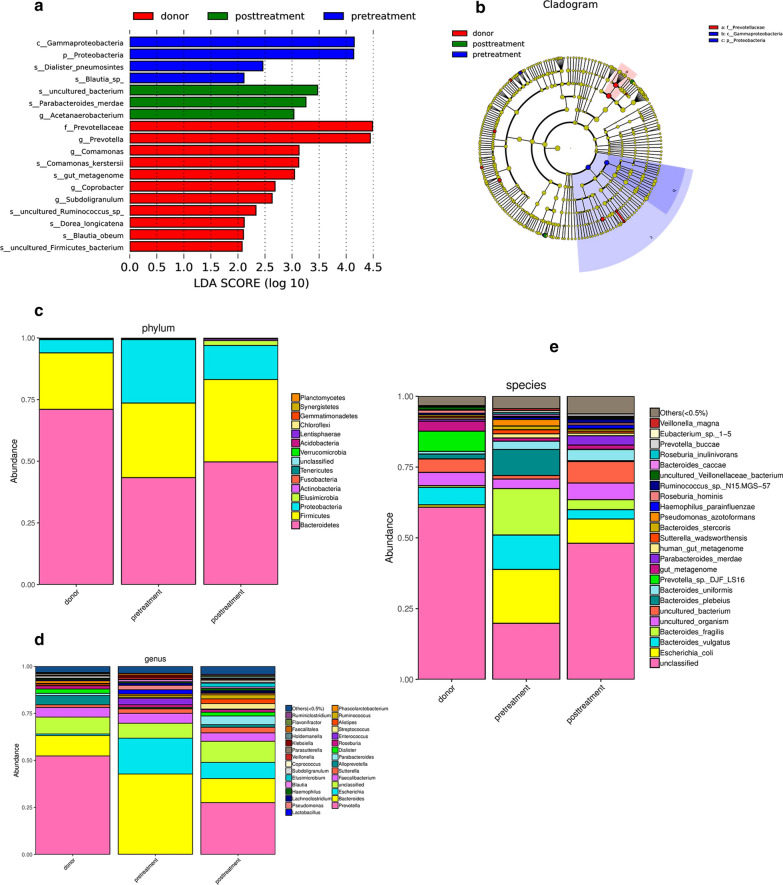
Results: Twenty-six eligible patients were enrolled, and 6 patients were excluded. Ultimately, 20 patients were randomized to the FMT group (n = 10) and the control group (n = 10); 80% were females (F/M = 16/4), the mean age was 48 ± 14 years, and the mean duration was 6.4 ± 8.2 years. The mean length of post-FMT follow-up was 19.1 ± 10.1 months (6-38). No statistically significant differences in baseline demographic or clinical characteristics were found between the groups. Ninety percent of patients in the FMT group and 50% of patients in the control group met the primary endpoint at week 8. The Mayo score was significantly decreased compared with that of the control group (n = 10) when reassessed at week 4 (P = 0.001) and week 8 (P = 0.019) after FMT; there was no significant difference 6 months after treatment. The median remission time was 24 months (95% CI 68.26-131.7%) in both the FMT (range 6-38 months) and control groups (range 7-35 months), with no significant difference (P = 0.895). Participants tolerated FMT treatment, and no adverse events occurred during long-term follow-up, with one treatment-related significant adverse event (EBV infection) occurring within 2 weeks after FMT. Stool microbiota composition analysis indicated improved gut microbiota diversity after FMT, with expansion of stool-donor taxa. Bacteroidetes, Firmicutes and Proteobacteria were the dominant bacterial phyla of the gut microbiota in active UC patients. The relative abundance of Bacteroidetes decreased and that of Proteobacteria increased significantly in active UC patients compared with donors, while Firmicutes showed no significant changes. A single fresh FMT could effectively reconstruct the gut microbiota composition in patients with active UC and maintain stability, with increased Bacteroidetes and decreased Proteobacteria abundance. FMT significantly reduced the relative abundance of Escherichia and increased the relative abundance of Prevotella at the genus level. Pyruvate metabolism, glyoxylate and dicarboxylate metabolism, and pantothenate and CoA biosynthesis showed significant differences after transplantation.
Conclusions: Monotherapy with a single fresh FMT is an effective and safe strategy to induce long-term remission without drugs in patients with active UC and may be an alternative induction therapy for recurrent UC or even primary UC.
Keywords: Fecal microbiota transplantation; Gut microbiota; Inflammatory bowel disease; Intestinal flora; Ulcerative colitis.
Conflict of interest statement
The authors have no financial or potential competing interests or affiliations with any institution, organization, or company relating to the manuscript.
Figures


References
-
- Ng SC, Shi HY, Hamidi N, Underwood FE, Tang W, Benchimol EI, Panaccione R, Ghosh S, Wu JCY, Chan FKL, Sung JJY, Kaplan GG. Worldwide incidence and prevalence of inflammatory bowel disease in the 21st century: a systematic review of population-based studies. Lancet. 2018;390(10114):2769–2778. doi: 10.1016/S0140-6736(17)32448-0. - DOI - PubMed
-
- Molodecky NA, Soon IS, Rabi DM, Ghali WA, Ferris M, ChernoffG, Benchimol EI, Panaccione R, Ghosh S, Barkema HW, Kaplan GG. Increasing incidence and prevalence of the inflammatory bowel diseases with time, based on systematic review. Gastroenterology 2012;142(1):46–54.e42 - PubMed
Publication types
MeSH terms
Grants and funding
LinkOut - more resources
Full Text Sources
Other Literature Sources
Medical
Miscellaneous
