


Monitoring the Epidemiology and Antifungal Resistance of Yeasts Causing Fungemia in a Tertiary Care Hospital in Madrid, Spain: Any Relevant Changes in the Last 13 Years?
- PMID: 33468487
- PMCID: PMC8097463
- DOI: 10.1128/AAC.01827-20
Monitoring the Epidemiology and Antifungal Resistance of Yeasts Causing Fungemia in a Tertiary Care Hospital in Madrid, Spain: Any Relevant Changes in the Last 13 Years?
Abstract
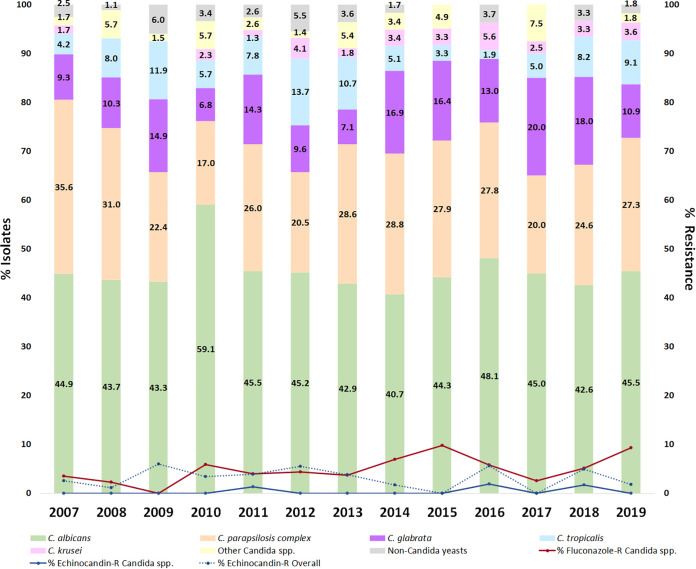
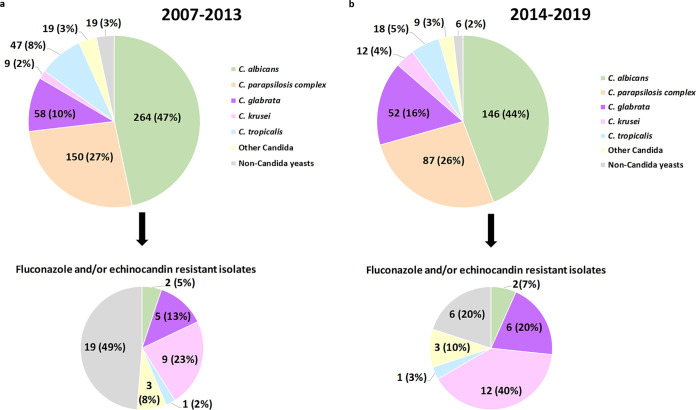
We conducted an updated analysis on yeast isolates causing fungemia in patients admitted to a tertiary hospital in Madrid, Spain, over a 13-year period. We studied 896 isolates associated with 872 episodes of fungemia in 857 hospitalized patients between January 2007 and December 2019. Antifungal susceptibility was assessed by EUCAST EDef 7.3.2. Mutations conferring azole and echinocandin resistance were further studied, and genotyping of resistant clones was performed with species-specific microsatellite markers. Candida albicans (45.8%) was the most frequently identified species, followed by the Candida parapsilosis complex (26.4%), Candida glabrata (12.3%), Candida tropicalis (7.3%), Candida krusei (2.3%), other Candida spp. (3.1%), and non-Candida yeasts (2.8%). The rate of fluconazole resistance in Candida spp. was 4.7%, ranging from 0% (C. parapsilosis) to 9.1% (C. glabrata). The overall rate of echinocandin resistance was 3.1%. Resistance was highly influenced by the presence of intrinsically resistant species. Although the number of isolates between 2007 and 2013 was almost 2-fold higher than that in the period from 2014 to 2019 (566 versus 330), fluconazole resistance in Candida spp. was greater in the second period (3.5% versus 6.8%; P < 0.05), while overall resistance to echinocandins remained stable (3.5% versus 2.4%; P > 0.05). Resistant clones were collected from different wards and/or time points, suggesting that there were no epidemiological links. The number of fungemia episodes has been decreasing over the last 13 years, with a slight increase in the rate of fluconazole resistance and stable echinocandin resistance. Antifungal resistance is not the cause of the spread of resistant clones.
Keywords: Candida; EUCAST; antifungal resistance; echinocandins; fluconazole; fungemia; microsatellite genotyping; yeast.
Copyright © 2021 American Society for Microbiology.
Figures
References
-
- Pappas PG, Kauffman CA, Andes DR, Clancy CJ, Marr KA, Ostrosky-Zeichner L, Reboli AC, Schuster MG, Vazquez JA, Walsh TJ, Zaoutis TE, Sobel JD. 2016. Clinical practice guideline for the management of candidiasis: 2016 update by the Infectious Diseases Society of America. Clin Infect Dis 62:e1–e50. doi: 10.1093/cid/civ933. - DOI - PMC - PubMed
-
- Astvad KMT, Johansen HK, Røder BL, Rosenvinge FS, Knudsen JD, Lemming L, Schønheyder HC, Hare RK, Kristensen L, Nielsen L, Gertsen JB, Dzajic E, Pedersen M, Østergård C, Olesen B, Søndergaard TS, Arendrup MC. 2017. Update from a 12-year nationwide fungemia surveillance: increasing intrinsic and acquired resistance causes concern. J Clin Microbiol 56:e01564-17. doi: 10.1128/JCM.01564-17. - DOI - PMC - PubMed
Publication types
MeSH terms
Substances
Supplementary concepts
LinkOut - more resources
Full Text Sources
Other Literature Sources
Miscellaneous
