


Experienced well-being rises with income, even above $75,000 per year
- PMID: 33468644
- PMCID: PMC7848527
- DOI: 10.1073/pnas.2016976118
Experienced well-being rises with income, even above $75,000 per year
Abstract
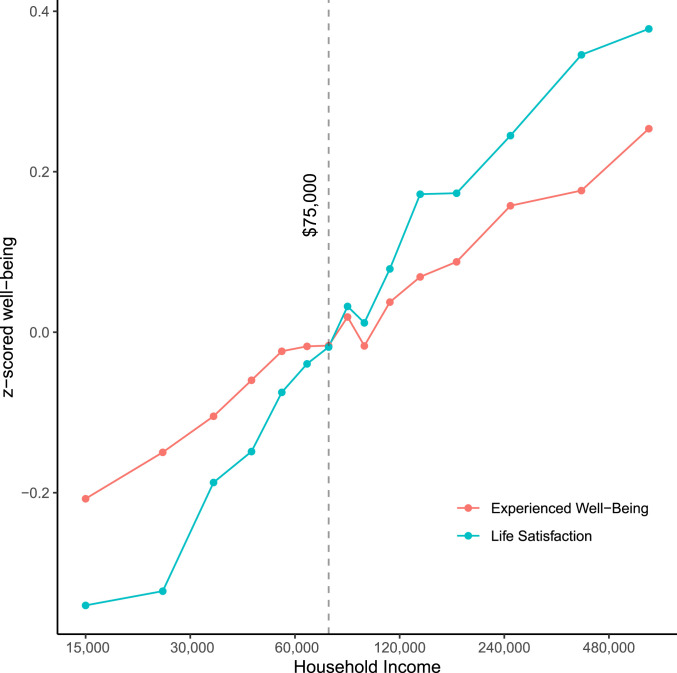
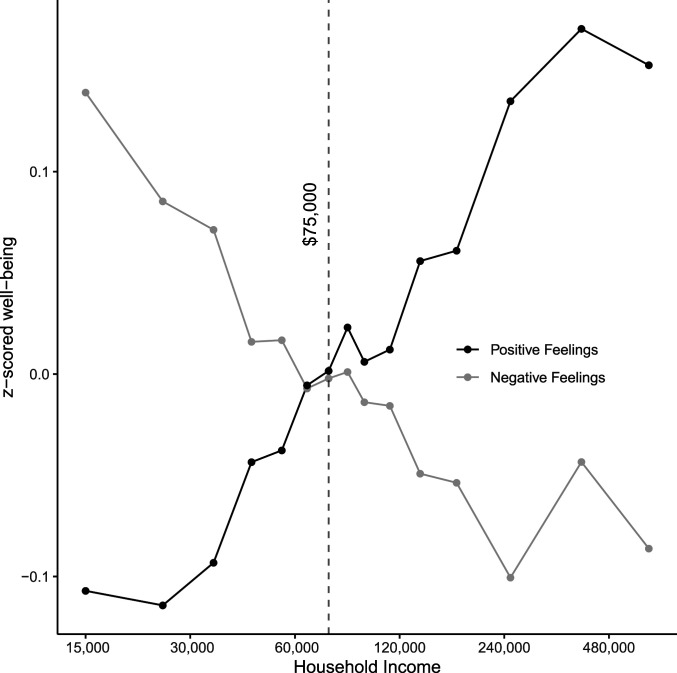
What is the relationship between money and well-being? Research distinguishes between two forms of well-being: people's feelings during the moments of life (experienced well-being) and people's evaluation of their lives when they pause and reflect (evaluative well-being). Drawing on 1,725,994 experience-sampling reports from 33,391 employed US adults, the present results show that both experienced and evaluative well-being increased linearly with log(income), with an equally steep slope for higher earners as for lower earners. There was no evidence for an experienced well-being plateau above $75,000/y, contrary to some influential past research. There was also no evidence of an income threshold at which experienced and evaluative well-being diverged, suggesting that higher incomes are associated with both feeling better day-to-day and being more satisfied with life overall.
Keywords: experience sampling; happiness; income; satiation; well-being.
Copyright © 2020 the Author(s). Published by PNAS.
Conflict of interest statement
The authors declare no competing interest.
Figures
References
-
- Diener E., Biswas-Diener R., Will money increase subjective well-being? Soc. Indic. Res. 57, 119–169 (2002).
-
- Gardner J., Oswald A. J., Money and mental wellbeing: A longitudinal study of medium-sized lottery wins. J. Health Econ. 26, 49–60 (2007). - PubMed
-
- Argyle M., “Causes and correlates of happiness” in Well-Being: The Foundations of Hedonic Psychology, Kahneman D., Diener E., Schwarz N., Eds. (Russell Sage Foundation, 1999), pp. 353–373.
-
- Stevenson B., Wolfers J., Economic growth and subjective well-being: Reassessing the Easterlin paradox. Brookings Pap. Econ. Act. 2008, 1–87 (2008).
-
- Veenhoven R., Hagerty M., Rising happiness in nations 1946–2004: A reply to Easterlin. Soc. Indic. Res. 79, 421–436 (2006).
LinkOut - more resources
Full Text Sources
Other Literature Sources
Miscellaneous
