. 2021 Jan 26;118(4):e2013730118.
doi: 10.1073/pnas.2013730118.

Synthetic protein conjugate vaccines provide protection against Mycobacterium tuberculosis in mice

Affiliations

Synthetic protein conjugate vaccines provide protection against Mycobacterium tuberculosis in mice

Cameron C Hanna et al. Proc Natl Acad Sci U S A. .

Abstract

The global incidence of tuberculosis remains unacceptably high, with new preventative strategies needed to reduce the burden of disease. We describe here a method for the generation of synthetic self-adjuvanted protein vaccines and demonstrate application in vaccination against Mycobacterium tuberculosis Two vaccine constructs were designed, consisting of full-length ESAT6 protein fused to the TLR2-targeting adjuvants Pam2Cys-SK4 or Pam3Cys-SK4 These were produced by chemical synthesis using a peptide ligation strategy. The synthetic self-adjuvanting vaccines generated powerful local CD4+ T cell responses against ESAT6 and provided significant protection in the lungs from virulent M. tuberculosis aerosol challenge when administered to the pulmonary mucosa of mice. The flexible synthetic platform we describe, which allows incorporation of adjuvants to multiantigenic vaccines, represents a general approach that can be applied to rapidly assess vaccination strategies in preclinical models for a range of diseases, including against novel pandemic pathogens such as SARS-CoV-2.

Keywords: chemical protein synthesis; mucosal vaccination; peptide ligation; self-adjuvanting; tuberculosis.


Conflict of interest statement

The authors declare no competing interest.

Figures

Fig. 1.
Fig. 1.
Proposed assembly of vaccine candidates 1 and 2 via a four-fragment peptide ligation strategy.
Fig. 2.
Fig. 2.
Synthesis of key ESAT617–95 protein fragment 5 via one-pot DSL–deselenization–Thz opening–NCL–Thz opening reaction sequence. Conditions: 1. DSL: 6 M Gn⋅HCl, 0.1 M Na2HPO4, pH = 6.8; 2. Deselenization: 0.25 M TCEP, 0.025 M DTT; 3. Thz opening: 0.2 M MeONH2, pH = 4.0; 4. NCL: 6 M Gn⋅HCl, 0.1 M Na2HPO4, 0.2 M MPAA, 0.25 M TCEP, pH = 7.1; 5. Thz opening: 0.2 M MeONH2, pH = 4.0.
Fig. 3.
Fig. 3.
Assembly of self-adjuvanting TB vaccine candidates 1 and 2 via a one-pot NCL–desulfurization protocol. Conditions: 1. NCL: 6 M Gn⋅HCl, 0.1 M Na2HPO4, 2 vol% TFET, 0.25 M TCEP, pH = 7.1; 2. Desulfurization: 6 M Gn⋅HCl, 0.1 M Na2HPO4, 0.5 M TCEP, 0.08 M reduced GSH, 0.04 M VA-044.
Fig. 4.
Fig. 4.
In vitro assessment of TLR2 agonism by self-adjuvanting vaccine candidates 1 and 2, determined by IL-8 release from HEK293-TLR2 reporter cells, measured by ELISA. Cells were stimulated for 16 h with PBS, ESAT6 synthetic protein, Pam2Cys-SK4-triethylene glycolate, or Pam3Cys-SK4-triethylene glycolate, in comparison to conjugate vaccines 1 and 2, using an equivalent molar concentration (7 µM = ∼10 µg/mL TLR2 ligand). Data are the means ± SEM (n = 3 technical replicates) and are representative of two independent biological replicates.
Fig. 5.
Fig. 5.
Mucosal immunization with vaccine candidates 1 and 2 induces local and circulating Th17-type ESAT6-specific CD4+ T cells and antibody responses. C57BL/6 mice (n = 3–4 animals per group) were immunized i.n. with 10 μg of Pam2Cys-ESAT6 vaccine 1 or Pam3Cys-ESAT6 vaccine 2, an equivalent molar amount of Pam2Cys-SK4-triethylene glycolate, or ESAT6 protein alone, three times at two-weekly intervals. At 1 wk following final immunization, (A) the frequency of antigen-specific cytokine-producing CD4+ T cells in the lungs or spleen were detected by ICS and flow cytometry following recall with ESAT61–20 in the presence of brefeldin A. Anti-ESAT6 IgG and IgA titers were determined in (B) serum and (C) BALF. Statistical significance was determined by Welch’s t test. (D) For protection studies, C57BL/6 mice (n = 6 animals per group) were immunized as per AC, and additional mice were immunized with 5 × 10⁵ CFU BCG once by subcutaneous injection at the time of first immunization. At 2 wk following final immunization, the frequency of antigen-specific cytokine-producing CD4+ PBMCs were detected by ICS. Data are the means ± SEM. Statistical significance was determined by two-way ANOVA with Dunnett’s multiple-comparison test to unvaccinated or Pam2Cys controls (*P < 0.05, **P < 0.01, ***P < 0.001, and ****P < 0.0001).
Fig. 6.
Fig. 6.
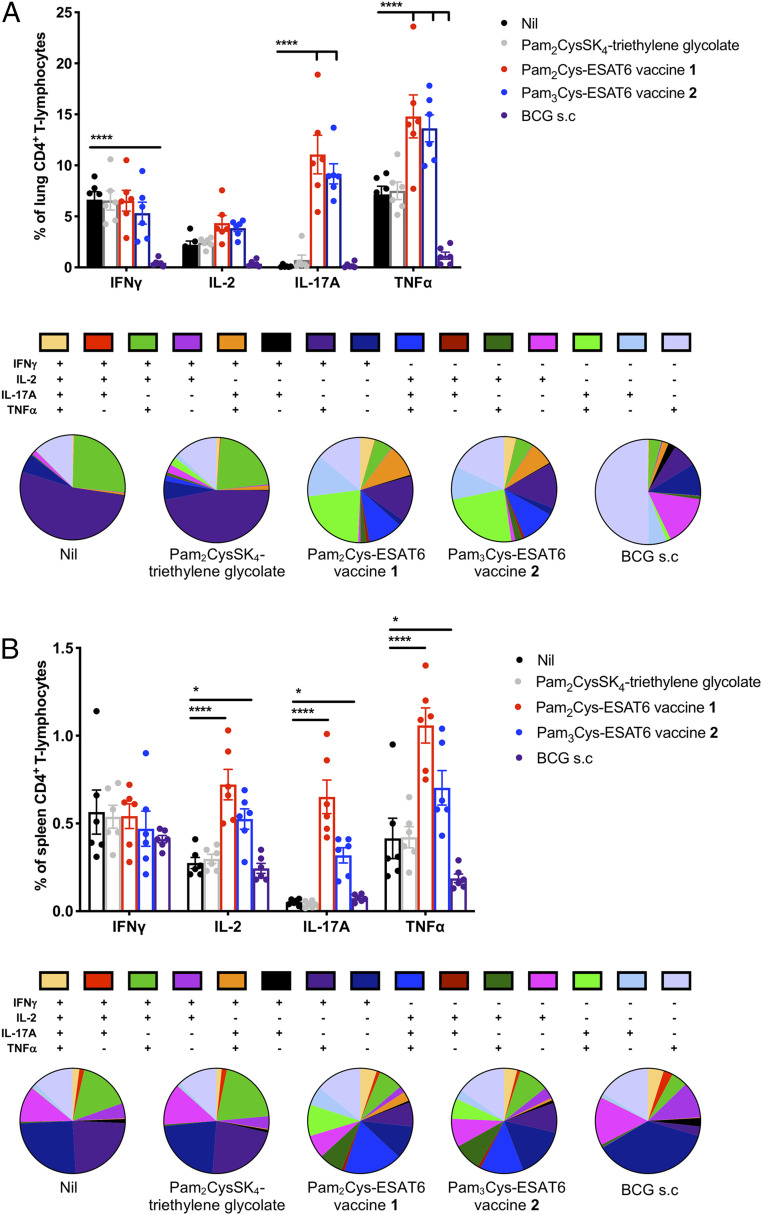
Mucosal immunization with vaccine candidates 1 and 2 induces strong local and systemic Th17-type responses that are maintained postchallenge with M. tuberculosis. C57BL/6 mice (n = 6 animals per group) were immunized i.n. with 10 μg of Pam2Cys-ESAT6 vaccine 1 or Pam3Cys-ESAT6 vaccine 2, or an equivalent molar amount of Pam2Cys-SK4-triethylene glycolate, three times at two-weekly intervals. Additional mice were immunized with 5 × 10⁵ CFU BCG once by subcutaneous injection at the time of first immunization. At 6 wk following final immunization, mice were challenged with a low-dose aerosol of M. tuberculosis H37Rv (100 CFU). Four weeks after infection, the frequency of ESAT6-specific cytokine-producing CD4+ T cells in the (A) lungs and (B) spleen were detected by ICS and flow cytometry following recall with ESAT61–20 (10 μg/mL) in the presence of brefeldin A (10 μg/mL). Data are the means ± SEM, representative of two independent experiments, shown as both the frequency of total CD4+ T lymphocytes and phenotype as a proportion of total cytokine-producing CD4+ T-cells. Statistical significance was determined by two-way ANOVA with Dunnett’s multiple-comparison test to unvaccinated control (*P < 0.05 and ****P < 0.0001).
Fig. 7.
Fig. 7.
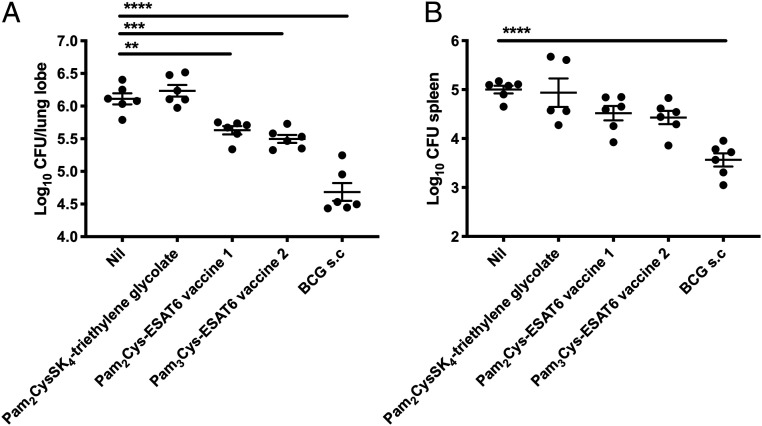
Protective efficacy against M. tuberculosis infection was induced by mucosal immunization with vaccine candidates 1 and 2. C57BL/6 mice (n = 6 animals per group) were immunized i.n. with 10 μg of Pam2Cys-ESAT6 vaccine 1 or Pam3Cys-ESAT6 vaccine 2, or an equivalent molar amount of Pam2Cys-SK4-triethylene glycolate, three times at two-weekly intervals. Six weeks following final vaccination, mice were challenged with a low-dose aerosol of M. tuberculosis H37Rv (100 CFU). Additional mice were immunized with 5 × 10⁵ CFU BCG once by subcutaneous injection 10 wk before challenge with M. tuberculosis H37Rv. After 28 d, mice were harvested and the bacterial loads in the lungs (A) and spleen (B) were enumerated following culture on Middlebrook 7H10 media. The data are the means ± SEM and are representative of two independent replicate experiments. Statistical significance was determined by one-way ANOVA with Dunnett’s multiple-comparison test to unvaccinated control (**P < 0.01, ***P < 0.001, and ****P < 0.0001).

References

    1. WHO , Global Tuberculosis Report 2019 (World Health Organization, 2019). https://www.who.int/teams/global-tuberculosis-programme/tb-reports/globa.... Accessed 24 December 2020.
    1. Pai M., et al. , Tuberculosis. Nat. Rev. Dis. Primers 2, 16076 (2016). - PubMed
    1. Andersen P., Doherty T. M., The success and failure of BCG—implications for a novel tuberculosis vaccine. Nat. Rev. Microbiol. 3, 656–662 (2005). - PubMed
    1. Foged C., Subunit vaccines of the future: The need for safe, customized and optimized particulate delivery systems. Ther. Deliv. 2, 1057–1077 (2011). - PubMed
    1. McDonald D. M., et al. , Synthesis of a self-adjuvanting MUC1 vaccine via diselenide-selenoester ligation-deselenization. ACS Chem. Biol. 13, 3279–3285 (2018). - PubMed

Publication types

MeSH terms