


The Development and Accuracy of the THIM Wearable Device for Estimating Sleep and Wakefulness
- PMID: 33469399
- PMCID: PMC7811468
- DOI: 10.2147/NSS.S287048
The Development and Accuracy of the THIM Wearable Device for Estimating Sleep and Wakefulness
Abstract
Introduction: THIM is a new wearable device worn on the finger that can passively monitor sleep and wakefulness overnight using actigraphy. This article showcases the development of the THIM sleep tracking algorithm (Study 1) and the testing of its accuracy against polysomnography (PSG) with an independent sample of good and poor sleepers (Study 2). The accuracy of THIM was compared to two popular wearables, Fitbit and Actiwatch devices.
Methods: Twenty-five (Study 1) and twenty (Study 2) healthy individuals with good or poor sleep (defined by scores on the Insomnia Severity Index) slept overnight in the sleep laboratory on one night. Participants slept from their typical bedtime to their typical wake up time with simultaneous recording from PSG, THIM, Fitbit and Actiwatch devices.
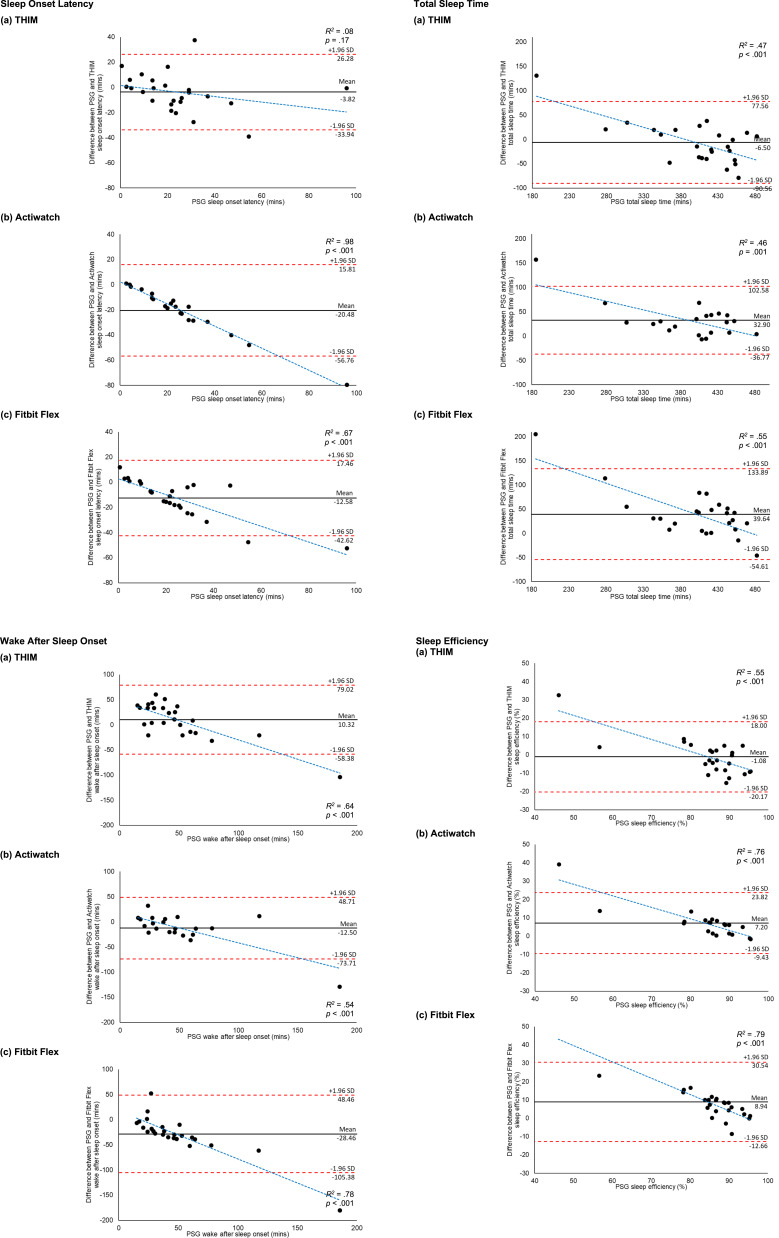
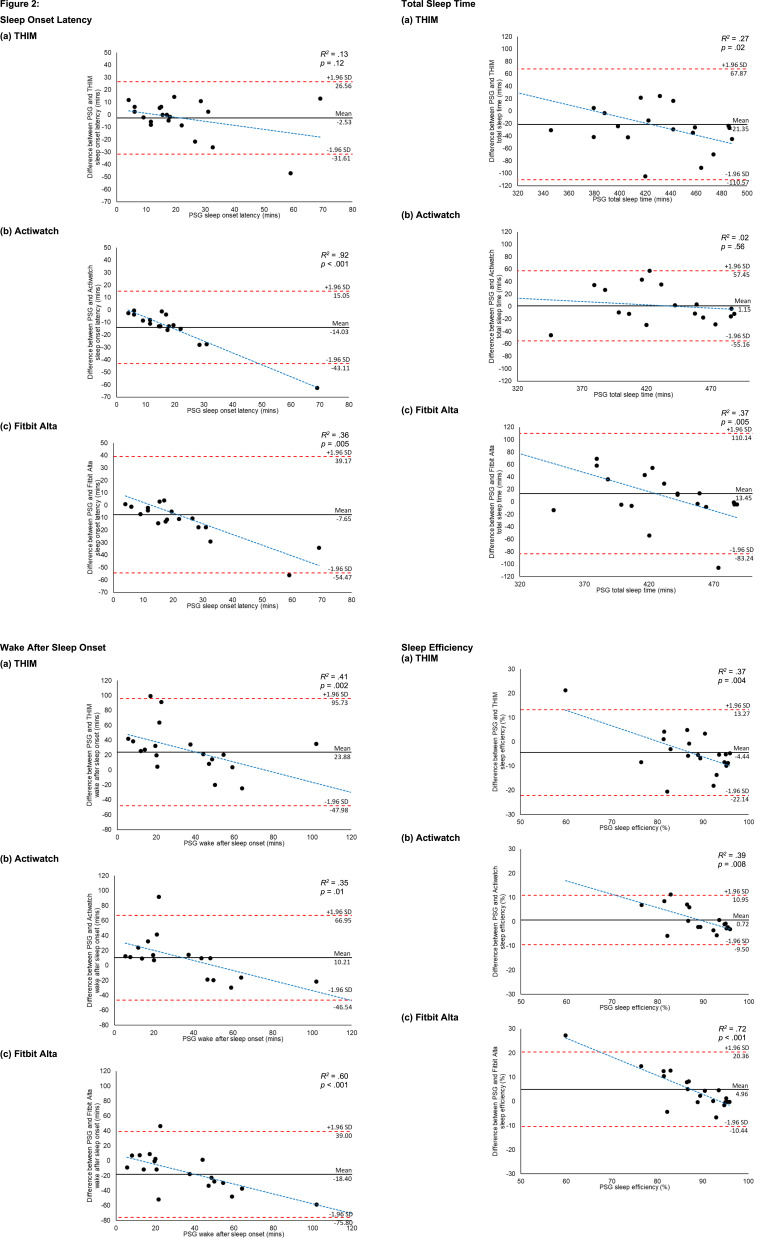
Results: In both studies, THIM had lower sensitivity (M = 0.89-0.91) compared to the Actiwatch (M = 0.95) and Fitbit devices (M = 0.96-0.98), yet higher specificity (M = 0.59 vs M = 0.32-0.59) in detecting sleep. There were no significant differences between PSG and THIM in either study for sleep onset latency, total sleep time, wake after sleep onset, or sleep efficiency, p > 0.06. Yet, there was high variability in the accuracy of all three actigraphy devices between individuals (evident on Bland-Altman plots) that was unexplained by sleep quality.
Discussion: Together, these studies suggest that THIM is capable of monitoring sleep and wake overnight in good and poor sleepers to a similar degree of accuracy as two of the most popular actigraphy devices available. Future research will examine the accuracy of THIM for monitoring sleep in people with insomnia.
Keywords: actigraphy; consumer sleep technology; polysomnography; sleep parameters; validation; wearable technology.
© 2021 Scott et al.
Conflict of interest statement
Research costs were partially funded by Re-Time Pty Ltd, the company that sell THIM. None of the study authors were financially supported by Re-Time Pty Ltd for this project. Hannah Scott reports grants from Re-Time Pty Ltd during the conduct of the study and has a patent pending: PCT/US2017/23240. Leon Lack reports grants from Re-Time Pty Ltd during the conduct of the study; is a shareholder of Re-Time Pty Ltd; and receives royalties for downloads of their book from the Re-Time website, outside the submitted work; in addition, Leon Lack has a US patent application pending to Re-Time Pty Ltd: 16/496360. The authors report no other potential conflicts of interest for this work.
Figures
References
-
- Re-Time PL. Thim - the First Wearable Device for Sleep, Which Will Improve Your Sleep. 2016. Available from http://thim.io/. Accessed December21, 2020.
LinkOut - more resources
Full Text Sources
Other Literature Sources
