


Socioeconomic and Racial Segregation and COVID-19: Concentrated Disadvantage and Black Concentration in Association with COVID-19 Deaths in the USA
- PMID: 33469872
- PMCID: PMC7815201
- DOI: 10.1007/s40615-021-00965-1
Socioeconomic and Racial Segregation and COVID-19: Concentrated Disadvantage and Black Concentration in Association with COVID-19 Deaths in the USA
Abstract
Introduction: This study's objective was to examine the association of the percentage of county population residing in concentrated disadvantage and Black-concentrated census tracts with county-level confirmed COVID-19 deaths in the USA, concentrated disadvantage and Black concentration at census tract-level measure socioeconomic segregation and racial segregation, respectively.
Methods: We performed secondary data analysis using tract (N = 73,056) and county (N = 3142) level data from the US Census Bureau and other sources for the USA. Confirmed COVID-19 deaths per 100,000 population was our outcome measure. We performed mixed-effect negative binomial regression to examine the association of county population's percentage residing in concentrated disadvantage and Black-concentrated tracts with COVID-19 deaths while controlling for several other characteristics.
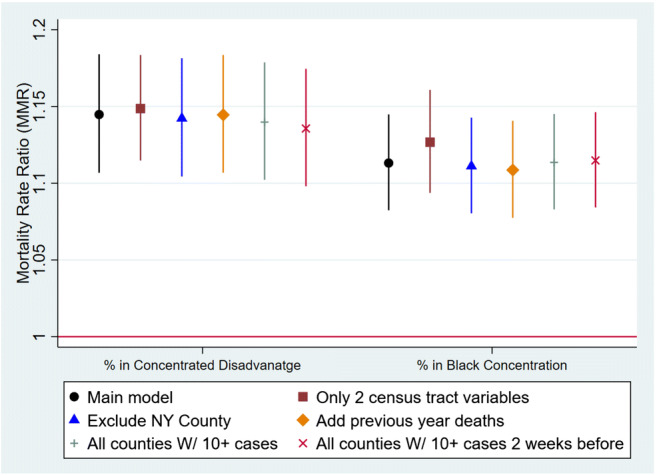
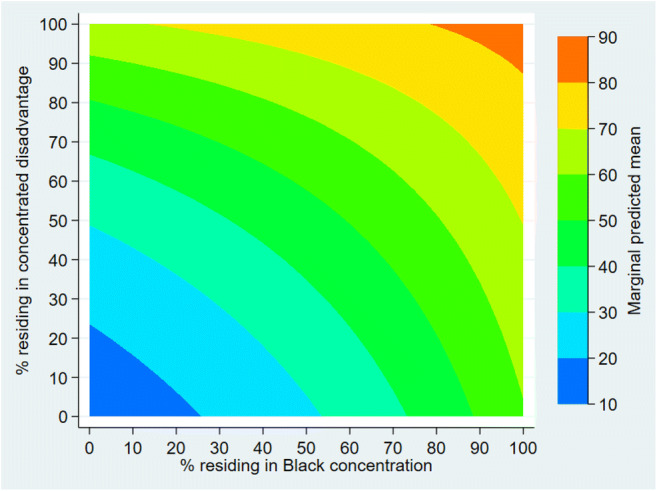
Results: For every 10% increase in the percentage of county population residing in concentrated disadvantage and Black-concentrated tracts, the rate for confirmed COVID-19 deaths per 100,000 population increases by a factor of 1.14 (mortality rate ratio [MMR] = 1.14; 95% confidence interval [CI]:1.11, 1.18) and 1.11 (MMR = 1.11; 95% CI:1.08, 1.14), respectively. These relations stayed significant in all models in further sensitivity analyses. Moreover, a joint increase in the percentage of county population residing in racial and socioeconomic segregation was associated with a much greater increase in COVID-19 deaths.
Conclusions: It appears that people living in socioeconomically and racially segregated neighborhoods may be disproportionately impacted by COVID-19 deaths. Future multilevel and longitudinal studies with data at both individual and aggregated tract level can help isolate the potential impacts of the individual-level characteristics and neighborhood-level socioeconomic and racial segregation with more precision and confidence.
Keywords: African Americans; COVID-19 (coronavirus disease 2019); Health disparities; Social segregation; Socioeconomic factors; Vulnerable populations.
© 2021. W. Montague Cobb-NMA Health Institute.
Conflict of interest statement
The authors declare that they have no conflict of interest.
Figures
References
-
- World Health Organization. Coronavirus disease (COVID-2019) situation reports Geneva: WHO; 2020 [Available from: https://www.who.int/emergencies/diseases/novel-coronavirus-2019/situatio.... Accessed 4 Jul 2020.
-
- McQuillan GM, Kruszon-Moran D, Kottiri BJ, Curtin LR, Lucas JW, Kington RS. Racial and ethnic differences in the seroprevalence of 6 infectious diseases in the United States: data from NHANES III, 1988–1994. Am J Public Health. 2004;94(11):1952–1958. doi: 10.2105/AJPH.94.11.1952. - DOI - PMC - PubMed
MeSH terms
LinkOut - more resources
Full Text Sources
Other Literature Sources
Medical