


Multimorbidity patterns and their relationship to mortality in the US older adult population
- PMID: 33471812
- PMCID: PMC7816983
- DOI: 10.1371/journal.pone.0245053
Multimorbidity patterns and their relationship to mortality in the US older adult population
Abstract
Background: Understanding patterns of multimorbidity in the US older adult population and their relationship with mortality is important for reducing healthcare utilization and improving health. Previous investigations measured multimorbidity as counts of conditions rather than specific combination of conditions.
Methods: This cross-sectional study with longitudinal mortality follow-up employed latent class analysis (LCA) to develop clinically meaningful subgroups of participants aged 50 and older with different combinations of 13 chronic conditions from the National Health Interview Survey 2002-2014. Mortality linkage with National Death Index was performed through December 2015 for 166,126 participants. Survival analyses were conducted to assess the relationships between LCA classes and all-cause mortality and cause specific mortalities.
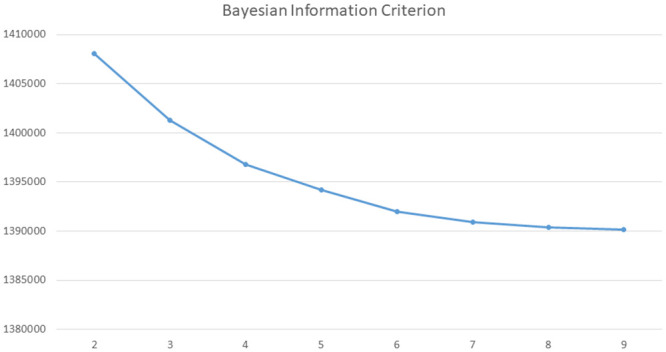
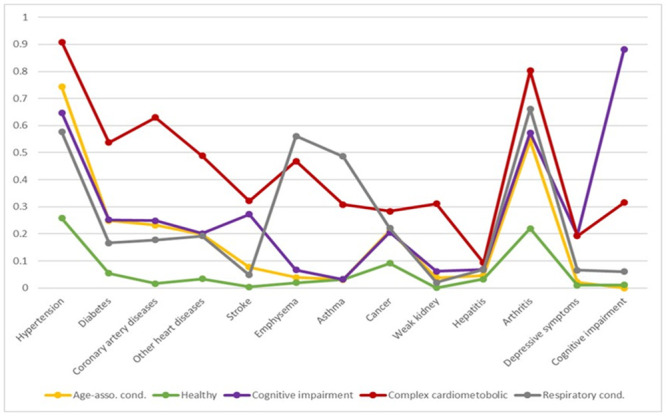
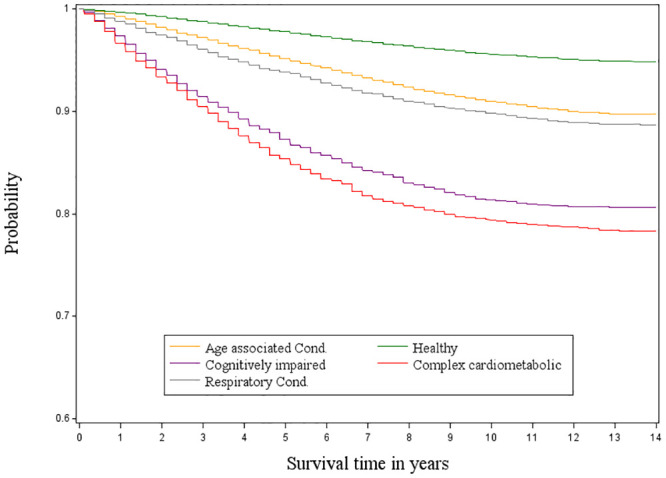
Results: LCA identified five multimorbidity groups with primary characteristics: "healthy" (51.5%), "age-associated chronic conditions" (33.6%), "respiratory conditions" (7.3%), "cognitively impaired" (4.3%) and "complex cardiometabolic" (3.2%). Covariate-adjusted survival analysis indicated "complex cardiometabolic" class had the highest mortality with a Hazard Ratio (HR) of 5.30, 99.5% CI [4.52, 6.22]; followed by "cognitively impaired" class (3.34 [2.93, 3.81]); "respiratory condition" class (2.14 [1.87, 2.46]); and "age-associated chronic conditions" class (1.81 [1.66, 1.98]). Patterns of multimorbidity classes were strongly associated with the primary underlying cause of death. The "cognitively impaired" class reported similar number of conditions compared to the "respiratory condition" class but had significantly higher mortality (3.8 vs 3.7 conditions, HR = 1.56 [1.32, 1.85]).
Conclusion: We demonstrated that LCA method is effective in classifying clinically meaningful multimorbidity subgroup. Specific combinations of conditions including cognitive impairment and depressive symptoms have a substantial detrimental impact on the mortality of older adults. The numbers of chronic conditions experienced by older adults is not always proportional to mortality risk. Our findings provide valuable information for identifying high risk older adults with multimorbidity to facilitate early intervention to treat chronic conditions and reduce mortality.
Conflict of interest statement
The authors have declared that no competing interests exist.
Figures
References
-
- Anderson GF. Chronic care: making the case for ongoing care: Robert Wood Johnson Foundation; 2010.
-
- Barnett K, Mercer SW, Norbury M, Watt G, Wyke S, Guthrie B. Epidemiology of multimorbidity and implications for health care, research, and medical education: a cross-sectional study. The Lancet. 2012;380(9836):37–43. - PubMed
-
- Buttorff C, Ruder T, Bauman M. Multiple chronic conditions in the United States. Santa Monica (CA): RAND Corporation; 2017.
-
- United Nations DoE Social Affairs PD. World Population Ageing 2015 (ST/ESA/SER. A/390). United Nations New York, NY; 2015.
Publication types
MeSH terms
Grants and funding
LinkOut - more resources
Full Text Sources
Other Literature Sources
Medical
Research Materials
