Review
. 2021 Feb;70(2):338-346.
doi: 10.2337/dbi20-0028.

A Journey in Diabetes: From Clinical Physiology to Novel Therapeutics: The 2020 Banting Medal for Scientific Achievement Lecture

Affiliations
Review

A Journey in Diabetes: From Clinical Physiology to Novel Therapeutics: The 2020 Banting Medal for Scientific Achievement Lecture

Ele Ferrannini. Diabetes. 2021 Feb.

Abstract

Insulin resistance and β-cell dysfunction are the core pathophysiological mechanisms of all hyperglycemic syndromes. Advances in in vivo investigative techniques have made it possible to quantify insulin resistance in multiple sites (skeletal and myocardial muscle, subcutaneous and visceral fat depots, liver, kidney, vascular tissues, brain and intestine), to clarify its consequences for tissue substrate selection, and to establish its relation to tissue perfusion. Physiological modeling of β-cell function has provided a uniform tool to measure β-cell glucose sensitivity and potentiation in response to a variety of secretory stimuli, thereby allowing us to establish feedbacks with insulin resistance, to delineate the biphasic time course of conversion to diabetes, to gauge incretin effects, and to identify primary insulin hypersecretion. As insulin resistance also characterizes several of the comorbidities of diabetes (e.g., obesity, hypertension, dyslipidemia), with shared genetic and acquired influences, the concept is put forward that diabetes is a systemic disease from the outset, actually from the prediabetic stage. In fact, early multifactorial therapy, particularly with newer antihyperglycemic agents, has shown that the burden of micro- and macrovascular complications can be favorably modified despite the rising pressure imposed by protracted obesity.


Figures

Figure 1
Figure 1
Reciprocal relation of whole-body lipid oxidation to glucose oxidation (red line) and direct relation of lipid oxidation to ketone body production (indexed as plasma β-hydroxybutyrate levels [green line]) during 5 h following a mixed meal. Plotted are mean data in subjects with type 2 diabetes (redrawn from Ferrannini et al. Shift to fatty substrate utilization in response to sodium–glucose cotransporter 2 inhibition in subjects without diabetes and patients with type 2 diabetes. Diabetes 2016;65:1190–1195). T2D, type 2 diabetes.
Figure 2
Figure 2
A: Glucose uptake by visceral and subcutaneous (SubQ) adipose tissue and skeletal muscle in insulin-sensitive and insulin-resistant individuals reconstructed from PET of [18F]FDG uptake. Bars indicate mean ± SEM. Stars indicate between-group statistical significance (P < 0.001 for all). Redrawn from Virtanen et al. (8). B: Fractional glucose uptake (= uptake rate / blood flow rate) by visceral and subcutaneous adipose tissue and skeletal muscle in insulin-sensitive and insulin-resistant individuals (by [18F]FDG and [15O]H2O PET). Bars indicate median and interquartile range. Redrawn from Ferrannini et al. (10). ns, not significant.
Figure 3
Figure 3
Contrasting relation of absolute oral glucose–induced insulin secretion and β-cell glucose sensitivity to the 2-h plasma glucose concentration across stages of glucose tolerance. Redrawn from data in Ferrannini et al. (35). IGT, impaired glucose tolerance; NGT, normal glucose tolerance; T2D, type 2 diabetes.
Figure 4
Figure 4
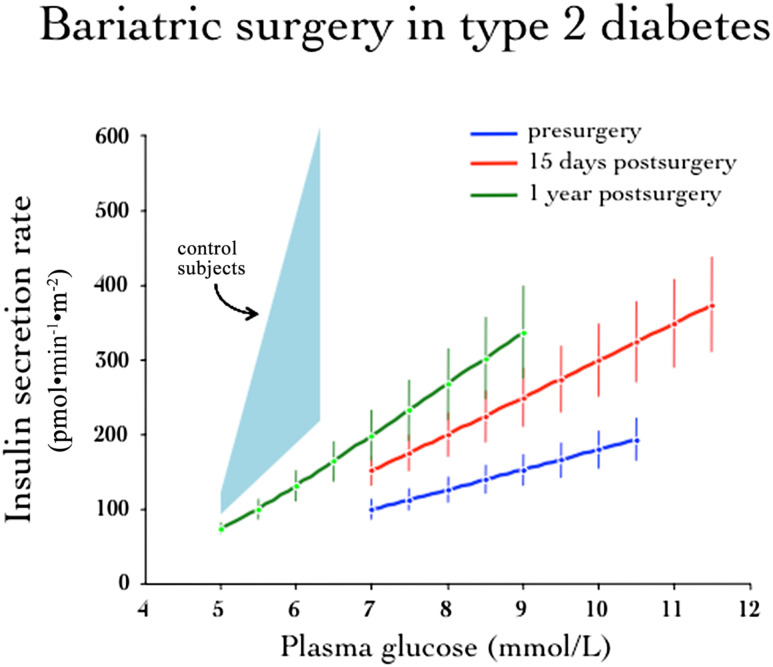
β-Cell sensitivity in morbidly obese patients with type 2 diabetes before, 14 days after, and 1 year after bariatric surgery (Roux-en-Y gastric bypass) as measured during a mixed-meal test. Plots are mean ± SEM over the observed plasma glucose ranges in the different groups. Redrawn from Nannipieri et al. (38).
Figure 5
Figure 5
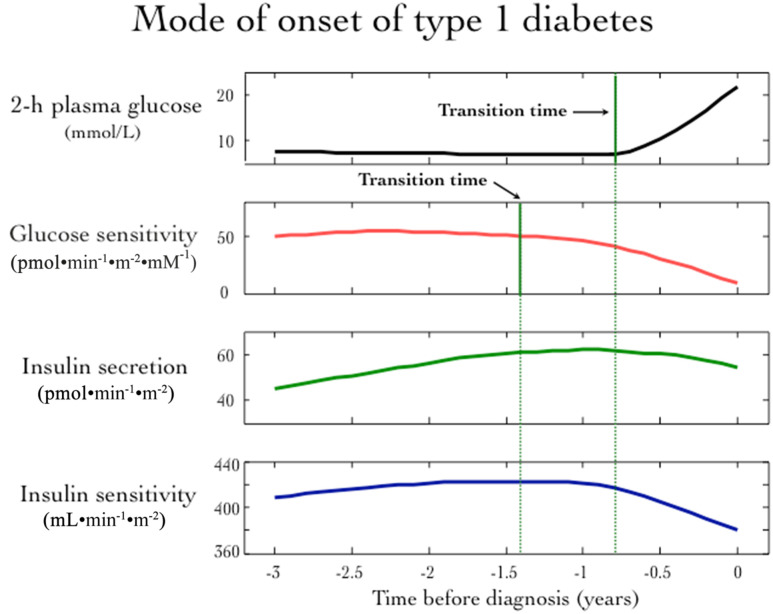
Time trajectories of 2-h plasma glucose concentrations, β-cell glucose sensitivity, postglucose insulin secretion, and insulin sensitivity in high-risk relatives of subjects with type 1 diabetes. Data synchronized on the time of diabetes diagnosis (time 0). Redrawn from Ferrannini et al. (39).
Figure 6
Figure 6
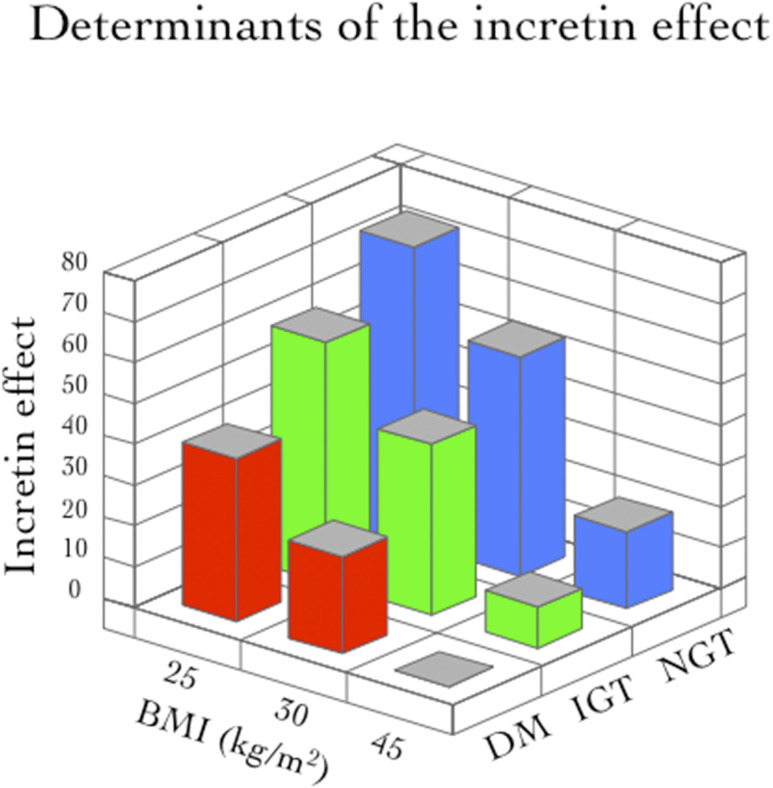
Dual impact of glucose tolerance and obesity, as the BMI, on the incretin effect. Redrawn from Muscelli et al. (44). DM, diabetes mellitus; IGT, impaired glucose tolerance; NGT, normal glucose tolerance.
Figure 7
Figure 7
Insulin hypersecretion with normal insulin sensitivity is associated with increased rather than decreased plasma glucose concentrations due to increased endogenous (hepatic) glucose production. Neural influences to islets and liver are postulated. Modified from Reaven et al. (47).
Figure 8
Figure 8
Main pathophysiological paths and influences in type 2 diabetes. Red lines and numbers refer to feedback cycles; associations are in green and paths to end-organ damage in blue. See text for further explanation.

References

    1. Cho NH, Shaw JE, Karuranga S, et al. IDF Diabetes Atlas: global estimates of diabetes prevalence for 2017 and projections for 2045. Diabetes Res Clin Pract 2018;138:271–281 - PubMed
    1. Williams R, Karuranga S, Malanda B, et al. Global and regional estimates and projections of diabetes-related health expenditure: results from the International Diabetes Federation Diabetes Atlas, 9th edition. Diabetes Res Clin Pract 2020;162:108072. - PubMed
    1. Chen L, Islam RM, Wang J, et al. A systematic review of trends in all-cause mortality among people with diabetes. Diabetologia 2020;63:1718–1735 - PMC - PubMed
    1. Ferrannini E, Mari A. How to measure insulin sensitivity. J Hypertens 1998;16:895–906 - PubMed
    1. Virtanen KA, Peltoniemi P, Marjamäki P, et al. Human adipose tissue glucose uptake determined using [(18)F]-fluoro-deoxy-glucose ([(18)F]FDG) and PET in combination with microdialysis. Diabetologia 2001;44:2171–2179 - PubMed

Substances