Corneal Keratocyte Density and Corneal Nerves Are Reduced in Patients With Severe Obesity and Improve After Bariatric Surgery
- PMID: 33475689
- PMCID: PMC7817877
- DOI: 10.1167/iovs.62.1.20
Corneal Keratocyte Density and Corneal Nerves Are Reduced in Patients With Severe Obesity and Improve After Bariatric Surgery
Abstract
Purpose: Obesity is associated with peripheral neuropathy, which bariatric surgery may ameliorate. The aim of this study was to assess whether corneal confocal microscopy can show a change in corneal nerve morphology and keratocyte density in subjects with severe obesity after bariatric surgery.
Methods: Twenty obese patients with diabetes (n = 13) and without diabetes (n = 7) underwent assessment of hemoglobin A1c (HbA1c), lipids, IL-6, highly sensitive C-reactive protein (hsCRP), and corneal confocal microscopy before and 12 months after bariatric surgery. Corneal nerve fiber density (CNFD), corneal nerve branch density (CNBD), corneal nerve fiber length (CNFL), and keratocyte density (KD) from the anterior, middle, and posterior stroma were quantified. Twenty-two controls underwent assessment at baseline only.
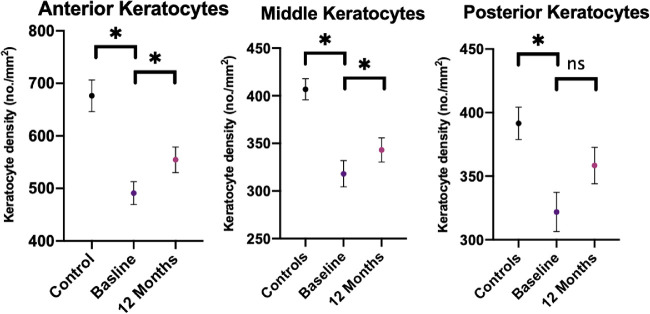
Results: CNFL (P < 0.001), CNBD (P < 0.05), and anterior (P < 0.001), middle (P < 0.001), and posterior (P < 0.001) keratocyte densities were significantly lower in obese patients compared to controls, and anterior keratocyte density (AKD) correlated with CNFL. Twelve months after bariatric surgery, there were significant improvements in body mass index (BMI; P < 0.001), HDL cholesterol (P < 0.05), hsCRP (P < 0.001), and IL-6 (P < 0.01). There were significant increases in CNFD (P < 0.05), CNBD (P < 0.05), CNFL (P < 0.05), and anterior (P < 0.05) and middle (P < 0.001) keratocyte densities. The increase in AKD correlated with a decrease in BMI (r = -0.55, P < 0.05) and triglycerides (r = -0.85, P < 0.001). There were no significant correlations between the change in keratocyte densities and corneal nerve fiber or other neuropathy measures.
Conclusions: Corneal confocal microscopy demonstrates early small fiber damage and reduced keratocyte density in obese patients. Bariatric surgery leads to weight reduction and improvement in lipids and inflammation and an improvement in keratocyte density and corneal nerve regeneration.
Conflict of interest statement
Disclosure:
Figures



References
-
- Adam S, Liu Y, Siahmansur T, et al.. Bariatric surgery as a model to explore the basis and consequences of the Reaven hypothesis: small, dense low-density lipoprotein and interleukin-6. Diab Vasc Dis Res. 2019; 16(2): 144–152. - PubMed
-
- Herman RM, Brower JB, Stoddard DG, et al.. Prevalence of somatic small fiber neuropathy in obesity. Int J Obes (Lond). 2007; 31(2): 226–235. - PubMed
Publication types
MeSH terms
Grants and funding
LinkOut - more resources
Full Text Sources
Other Literature Sources
Medical
Research Materials