Association of Metformin Use With Age-Related Macular Degeneration: A Case-Control Study
- PMID: 33475696
- PMCID: PMC7821082
- DOI: 10.1001/jamaophthalmol.2020.6331
Association of Metformin Use With Age-Related Macular Degeneration: A Case-Control Study
Abstract
Importance: Age-related macular degeneration (AMD), the leading cause of irreversible blindness in older adults, appears to have no effective preventive measures. The common antidiabetic drug metformin has been shown to have protective outcomes in multiple age-associated diseases and may have the potential to protect against the development of AMD.
Objective: To determine whether metformin use is associated with reduced odds of developing AMD.
Design, setting, and participants: This case-control study of patients from a nationwide health insurance claims database included a population-based sample of patients. Those aged 55 years and older with newly diagnosed AMD from January 2008 to December 2017 were defined as cases and matched with control participants. Data analyses were completed from June 2019 to February 2020.
Exposures: Dosage of metformin and exposure to other prescribed medications, as identified from outpatient drug claims.
Main outcomes and measures: Risk of developing AMD.
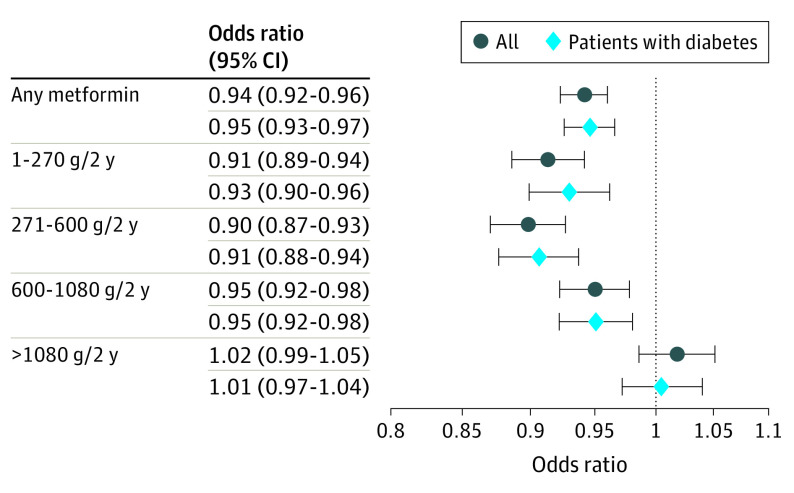
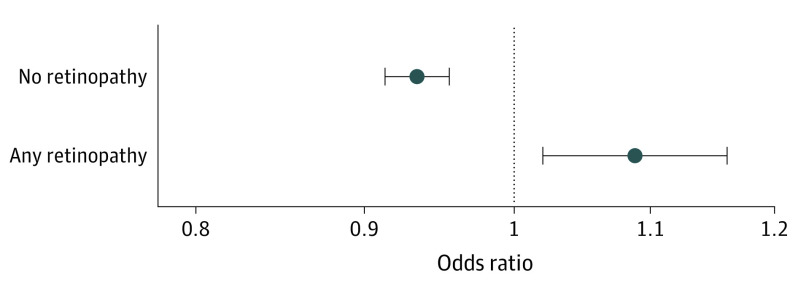
Results: A total of 312 404 affected individuals were included (181 817 women [58.2%]). After matching, 312 376 control participants were included (172 459 women [55.2%]; age range, 55 to 107 years). The case group had a slightly higher percentage of participants with diabetes (81 262 participants [26.0%]) compared with the control group (79 497 participants [25.5%]). Metformin use was associated with reduced odds of developing AMD (odds ratio [OR], 0.94 [95% CI, 0.92-0.96]). This association was dose dependent, with low to moderate doses of metformin showing the greatest potential benefit (dosages over 2 years: 1-270 g, OR, 0.91 [95% CI, 0.88-0.94]; 271-600 g, OR, 0.90 [95% CI, 0.87-0.93]; 601-1080 g, OR, 0.95 [95% CI, 0.92-0.98]). Doses of more than 1080 g of metformin over 2 years did not have reduced odds of developing AMD. Both the reduction in odds ratio and the dose-dependent response were preserved in a cohort consisting only of patients with diabetes. Metformin use was associated with a decreased OR of AMD in patients with diabetes without coexisting diabetic retinopathy (OR, 0.93 [95% CI, 0.91-0.95]) but was a risk factor in patients with diabetic retinopathy (OR, 1.07 [95% CI, 1.01-1.15]).
Conclusion and relevance: In this study, metformin use was associated with reduced odds of developing AMD. This association was dose dependent, with the greatest benefit at low to moderate doses. When looking only at patients with diabetes, we saw a preservation of the dose-dependent decrease in the odds of patients developing AMD. Metformin does not appear to be protective in patients with diabetes and coexisting diabetic retinopathy. This study suggests that metformin may be useful as a preventive therapy for AMD and provides the basis for potential prospective clinical trials.
Conflict of interest statement
Figures
Comment in
-
Is There a Case for Case-Control Studies in the Exploration of Retrospective Data Sets?JAMA Ophthalmol. 2021 Mar 1;139(3):309-310. doi: 10.1001/jamaophthalmol.2020.6328. JAMA Ophthalmol. 2021. PMID: 33475687 No abstract available.
-
Methodological Considerations for the Case-Control Study of Metformin and Age-Related Macular Degeneration.JAMA Ophthalmol. 2021 Aug 1;139(8):918-919. doi: 10.1001/jamaophthalmol.2021.2129. JAMA Ophthalmol. 2021. PMID: 34236407 No abstract available.
-
Methodological Considerations for the Case-Control Study of Metformin and Age-Related Macular Degeneration-Reply.JAMA Ophthalmol. 2021 Aug 1;139(8):919-920. doi: 10.1001/jamaophthalmol.2021.2132. JAMA Ophthalmol. 2021. PMID: 34236419 No abstract available.
References
Publication types
MeSH terms
Substances
Grants and funding
LinkOut - more resources
Full Text Sources
Other Literature Sources
Medical