


Duration of SARS-CoV-2 viral shedding in faeces as a parameter for wastewater-based epidemiology: Re-analysis of patient data using a shedding dynamics model
- PMID: 33477053
- PMCID: PMC7833251
- DOI: 10.1016/j.scitotenv.2020.144549
Duration of SARS-CoV-2 viral shedding in faeces as a parameter for wastewater-based epidemiology: Re-analysis of patient data using a shedding dynamics model
Abstract
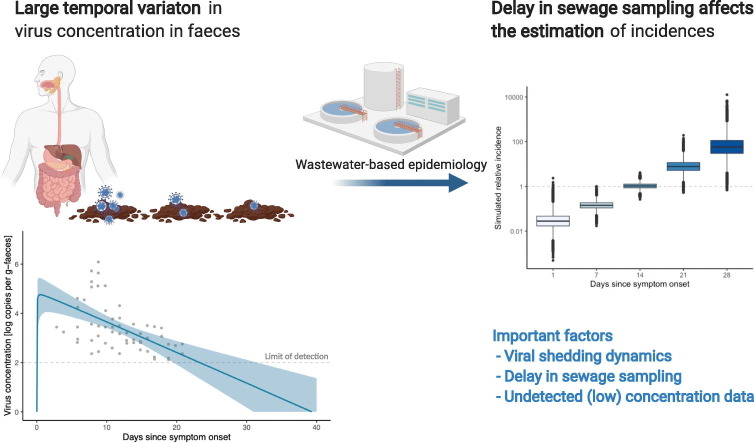
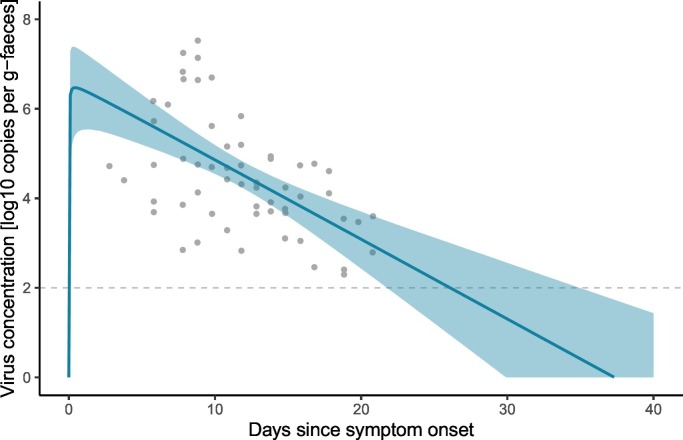
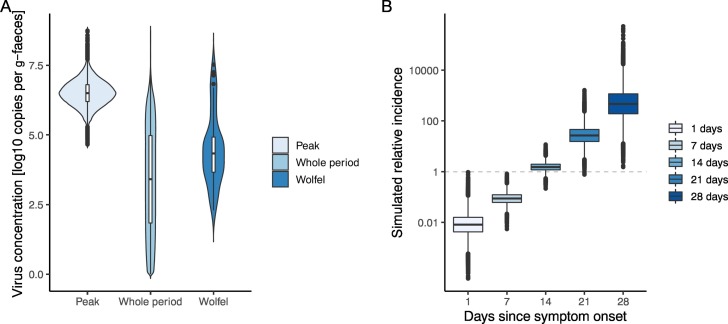
Wastewater-based epidemiology (WBE) is one of the most promising approaches to effectively monitor the spread of COVID-19. The virus concentration in faeces and its temporal variations are essential information for WBE. While some clinical studies have reported SARS-CoV-2 concentrations in faeces, the value varies amongst patients and changes over time. The present study aimed to examine how the temporal variations in the concentration of virus in faeces affect the monitoring of disease incidence. We reanalysed the experimental findings of clinical studies to estimate the duration of virus shedding and the faecal virus concentration. Available experimental data as of 23 October 2020 were collected. The viral shedding kinetics was modelled, and the dynamic model was fitted to the collected data by a Bayesian framework. Using posterior distributions, the duration of viral shedding and the concentration of virus copies in faeces over time were computed. We estimated the median concentration of SARS-CoV-2 in faeces as 3.4 (95% CrI: 0.24-6.5) log copies per gram-faeces over the shedding period, and our model implied that the duration of viral shedding was 26.0 days (95% CrI: 21.7-34.9), given the current standard quantification limit (Ct = 40). With simulated incidences, our results also indicated that a one-week delay between symptom onset and wastewater sampling increased the estimation of incidence by a factor of 17.2 (i.e., 101.24 times higher). Our results demonstrated that the temporal variation in virus concentration in faeces affects microbial monitoring systems such as WBE. The present study also implied the need for adjusting the estimates of virus concentration in faeces by incorporating the kinetics of unobserved concentrations. The method used in this study is easily implemented in further simulations; therefore, the results of this study might contribute to enhancing disease surveillance and risk assessments that require quantities of virus to be excreted into the environment.
Keywords: COVID-19; Faeces; Mathematical modelling; SARS-CoV-2; Viral shedding; Wastewater-based epidemiology (WBE).
Copyright © 2021 The Authors. Published by Elsevier B.V. All rights reserved.
Conflict of interest statement
Declaration of competing interest The authors declare that they have no conflict of interest.
Figures
References
-
- Ahmed W., Angel N., Edson J., Bibby K., Bivins A., O’Brien J.W., Choi P.M., Kitajima M., Simpson S.L., Li J., Tscharke B., Verhagen R., Smith W.J.M., Zaugg J., Dierens L., Hugenholtz P., Thomas K.V., Mueller J.F. First confirmed detection of SARS-CoV-2 in untreated wastewater in Australia: a proof of concept for the wastewater surveillance of COVID-19 in the community. Sci. Total Environ. 2020;728:138764. doi: 10.1016/j.scitotenv.2020.138764. - DOI - PMC - PubMed
-
- Bustin S.A., Benes V., Garson J.A., Hellemans J., Huggett J., Kubista M., Mueller R., Nolan T., Pfaffl M.W., Shipley G.L., Vandesompele J., Wittwer C.T. The MIQE guidelines: minimum information for publication of quantitative real-time PCR experiments. Clin. Chem. 2009;55:611–622. doi: 10.1373/clinchem.2008.112797. - DOI - PubMed
-
- CDC National Wastewater Surveillance System (NWSS) 2020. https://www.cdc.gov/coronavirus/2019-ncov/cases-updates/wastewater-surve... URL. (WWW Document)
-
- Guan W.-J., Ni Z.-Y., Hu Y., Liang W.-H., Ou C.-Q., He J.-X., Liu L., Shan H., Lei C.-L., Hui D.S.C., Du B., Li L.-J., Zeng G., Yuen K.-Y., Chen R.-C., Tang C.-L., Wang T., Chen P.-Y., Xiang J., Li S.-Y., Wang J.-L., Liang Z.-J., Peng Y.-X., Wei L., Liu Y., Hu Y.-H., Peng P., Wang J.-M., Liu J.-Y., Chen Z., Li G., Zheng Z.-J., Qiu S.-Q., Luo J., Ye C.-J., Zhu S.-Y., Zhong N.-S., China Medical Treatment Expert Group for Covid-19 Clinical characteristics of coronavirus disease 2019 in China. N. Engl. J. Med. 2020;382:1708–1720. doi: 10.1056/NEJMoa2002032. - DOI - PMC - PubMed
MeSH terms
Substances
LinkOut - more resources
Full Text Sources
Other Literature Sources
Medical
Miscellaneous
