Review
. 2021 Jan 17;11(1):232.
doi: 10.3390/nano11010232.

Carbon Dots-Based Logic Gates

Affiliations
Review

Carbon Dots-Based Logic Gates

Shweta Pawar et al. Nanomaterials (Basel). .

Abstract

Carbon dots (CDs)-based logic gates are smart nanoprobes that can respond to various analytes such as metal cations, anions, amino acids, pesticides, antioxidants, etc. Most of these logic gates are based on fluorescence techniques because they are inexpensive, give an instant response, and highly sensitive. Computations based on molecular logic can lead to advancement in modern science. This review focuses on different logic functions based on the sensing abilities of CDs and their synthesis. We also discuss the sensing mechanism of these logic gates and bring different types of possible logic operations. This review envisions that CDs-based logic gates have a promising future in computing nanodevices. In addition, we cover the advancement in CDs-based logic gates with the focus of understanding the fundamentals of how CDs have the potential for performing various logic functions depending upon their different categories.

Keywords: FRET; IFE; PET; carbon dots (CDs), logic gates; molecular logic; nanodevices.


Conflict of interest statement

The authors declare no financial or commercial conflict of interest of data; in the writing of the manuscript, or in the decision to publish the results.

Figures
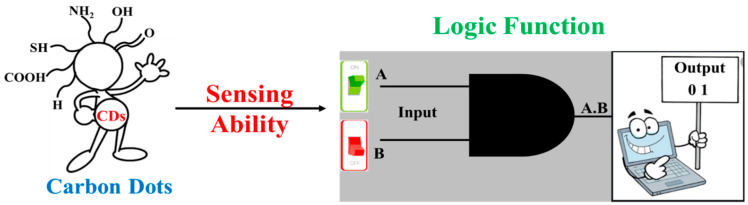
Figure 1
Figure 1
Carbon dots and their application in logic function based on their sensing ability.
Figure 2
Figure 2
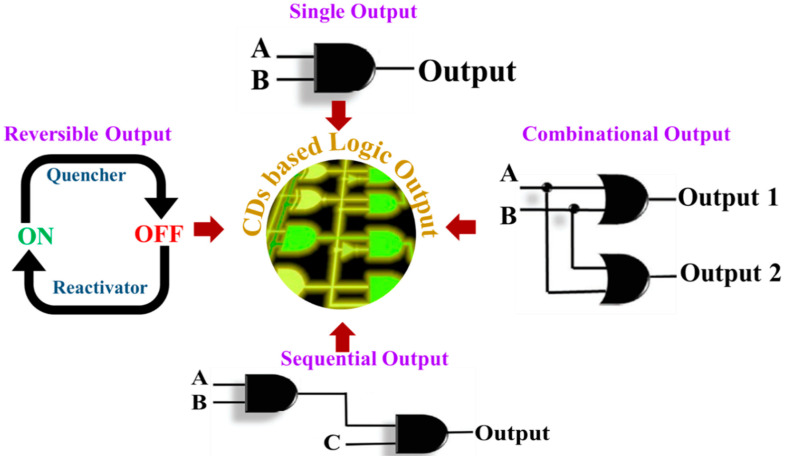
Different categories of carbon dots (CDs)-based logic gates according to their output. I. Single output, where only one output is generated. II. Combinational outputs are the integration of simple logic operations to obtain the complex combinational output. III. Sequential output, which responds to multiple inputs but with different stages of activation that should happen in a predestined order. IV. Reversible systems can switch between ON and OFF states depending upon the input added to the system.
Figure 3
Figure 3
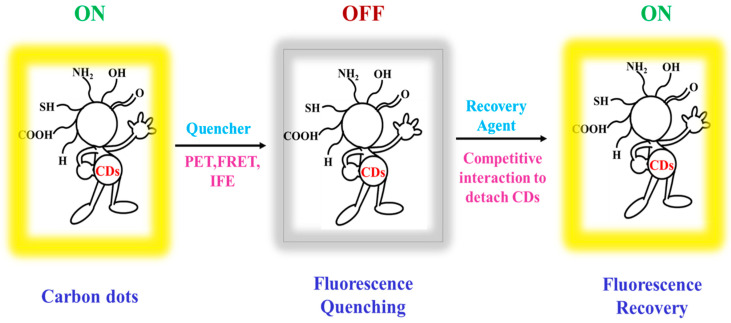
Mechanism of sensing CDs based logic systems with photoinduced electron transfer (PET), fluorescence resonance energy transfer (FRET), and inner filter effect (IFE) process for quenching and recovery by interactions with recovery agents.
Figure 4
Figure 4
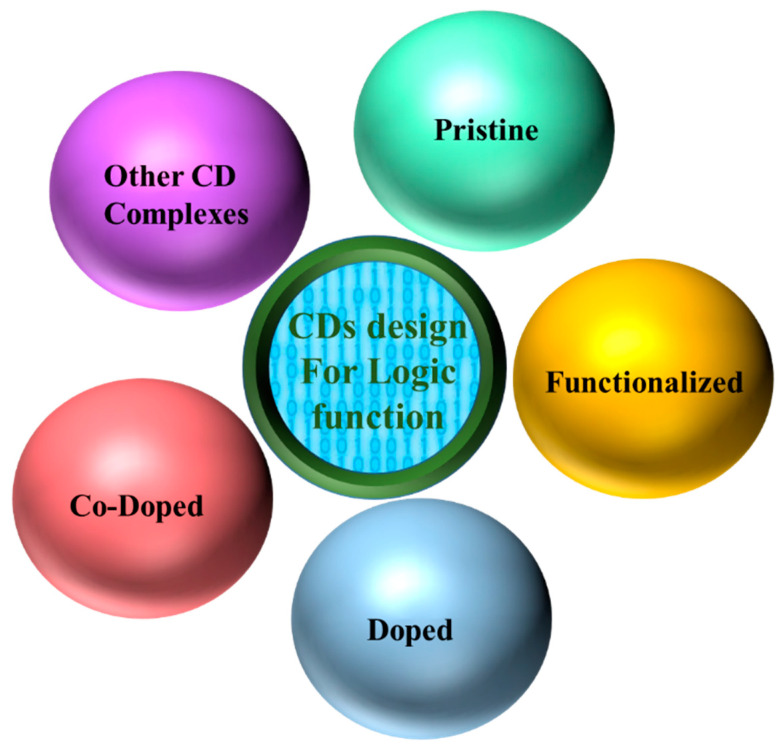
Five different categories of CDs design for logic function.
Figure 5
Figure 5
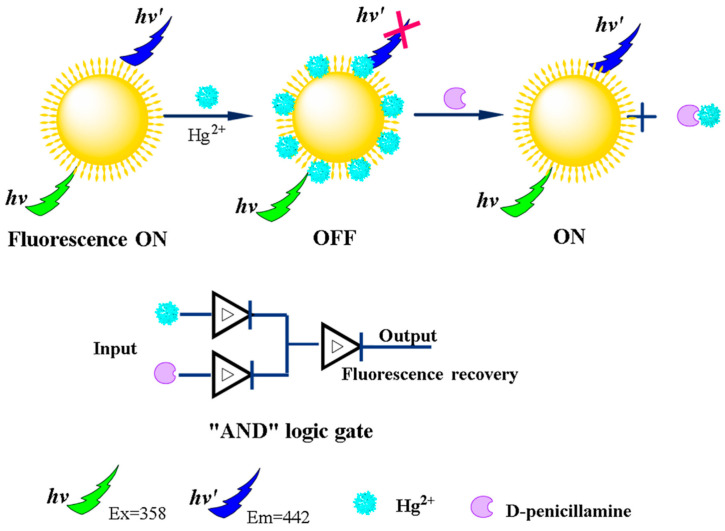
Schematic diagram of D-Penicillamine (D-PA) detection by pristine CDs and its AND logic gate function. Reproduced from ref [65] with permission of Sensors and Actuators, B: Chemical copyright 2016.
Figure 6
Figure 6
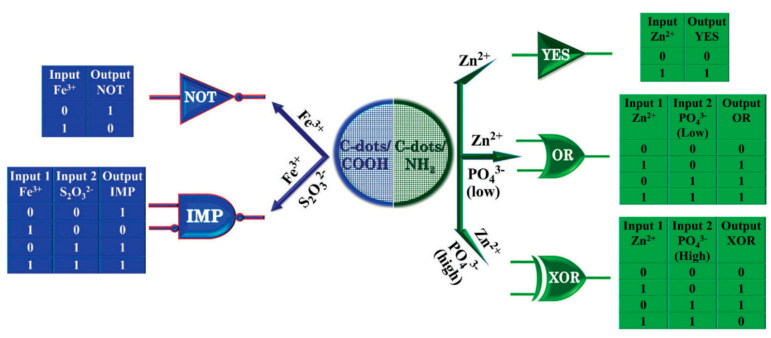
Functionalized CDs (COOH and amine functionalization) used for the detection of Fe3+, Zn2+ cations, and S2O32-, PO43- anions with its multiple logic operations. Reproduced from ref [35] with permission of Scientific Reports copyright 2015.
Figure 7
Figure 7
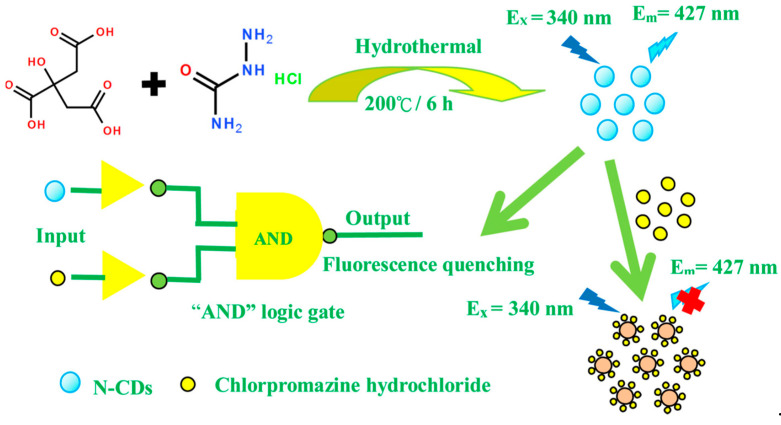
Schematic diagram of the formation process of N-CDs and detection for chlorpromazine hydrochloride (CPH). Reproduced from ref [70] with permission of the Journal of Photochemistry and Photobiology A: Chemistry copyright 2019.
Figure 8
Figure 8
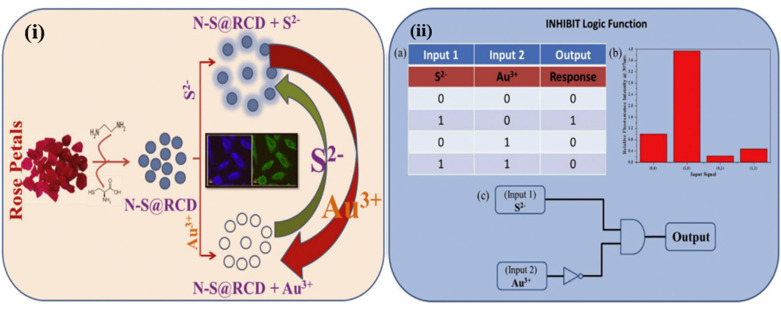
(i) Schematic illustration of multifunctional N-S@RCD. (ii) “INHIBIT” logic function using N-S@RCD. (a) Truth table, (b) fluorescence response of N-S@RCD under different inputs, and (c) Symbol of INHIBIT logic. Reproduced from ref [73] with permission of the Carbon copyright 2018.

References

    1. Ej O., Kozák K., Mária M., Sudolská S., Pramanik G., Cígler P., Otyepka M., Zbořil R. Photoluminescent Carbon Nanostructures. Chem. Mater. 2016;28:4085–4128.
    1. Wang Y., Hu A. Carbon quantum dots: Synthesis, properties and applications. J. Mater. Chem. C. 2014;2:6921–6939. doi: 10.1039/C4TC00988F. - DOI
    1. Xu X., Ray R., Gu Y., Ploehn H.J., Gearheart L., Raker K., Scrivens W.A. Electrophoretic Analysis and Purification of Fluorescent Single-Walled Carbon Nanotube Fragments. J. Am. Chem. Soc. 2004;126:12736–12737. doi: 10.1021/ja040082h. - DOI - PubMed
    1. Tuerhong M., XU Y., YIN X.B. Review on Carbon Dots and Their Applications. Chin. J. Anal. Chem. 2017;45:139–150. doi: 10.1016/S1872-2040(16)60990-8. - DOI
    1. Kailasa S.K., Mehta V.N., Hasan N., Wu H.F. Nanobiomaterials in Medical Imaging: Applications of Nanobiomaterials. William Andrew; Norwich, NY, USA: 2016. Applications of carbon dots in biosensing and cellular imaging; pp. 339–364.

LinkOut - more resources