


Update on the Transmission of Zika Virus Through Breast Milk and Breastfeeding: A Systematic Review of the Evidence
- PMID: 33477428
- PMCID: PMC7830280
- DOI: 10.3390/v13010123
Update on the Transmission of Zika Virus Through Breast Milk and Breastfeeding: A Systematic Review of the Evidence
Abstract
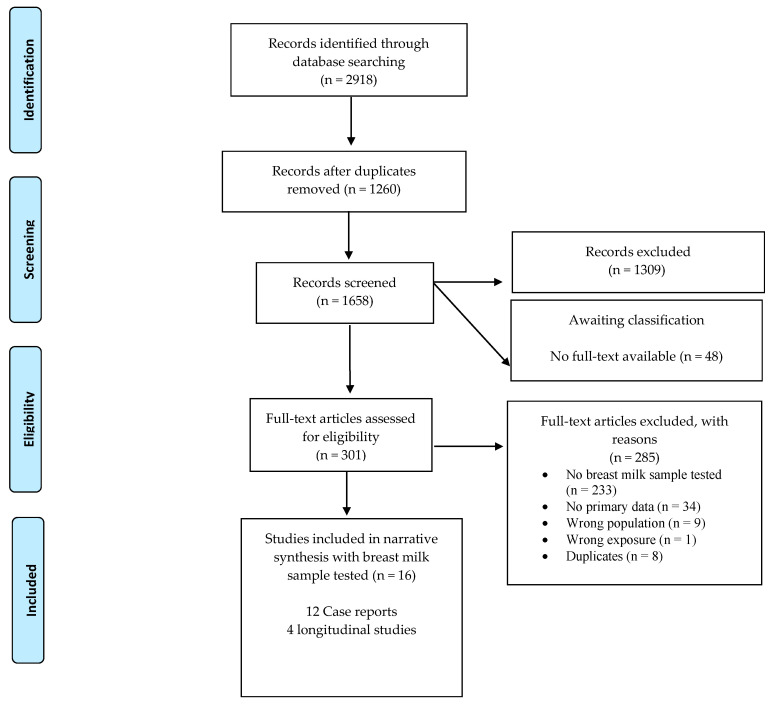
We systematically searched regional and international databases and screened 1658 non-duplicate records describing women with suspected or confirmed ZIKV infection, intending to breastfeed or give breast milk to an infant to examine the potential of mother-to-child transmission of Zika virus (ZIKV) through breast milk or breastfeeding-related practices. Fourteen studies met our inclusion criteria and inform this analysis. These studies reported on 97 mother-children pairs who provided breast milk for ZIKV assessment. Seventeen breast milk samples from different women were found positive for ZIKV via RT-PCR, and ZIKV replication was found in cell cultures from five out of seven breast milk samples from different women. Only three out of six infants who had ZIKV infection were breastfed, no evidence of clinical complications was found to be associated with ZIKV RNA in breast milk. This review updates our previous report by including 12 new articles, in which we found no evidence of ZIKV mother-to-child transmission through breast milk intake or breastfeeding. As the certainty of the present evidence is low, additional studies are still warranted to determine if ZIKV can be transmitted through breastfeeding.
Keywords: Zika virus; Zika virus infection; breast milk; breastfeeding; mother-to-child transmission; perinatal transmission.
Conflict of interest statement
The authors declare no competing interests relevant to this review. In the interest of full disclosure, S.M. has an equity interest in a startup commercializing some of his research focused on point-of-care assays for determining micronutrient status.
Figures
References
-
- WHO Zika Epidemiology Update 2019. [(accessed on 15 January 2021)]; Available online: https://www.who.int/emergencies/diseases/zika/zika-epidemiology-update-j....
-
- Besnard M., Eyrolle-Guignot D., Guillemette-Artur P., Lastère S., Bost-Bezeaud F., Marcelis L., Abadie V., Garel C., Moutard M.L., Jouannic J.M., et al. Congenital cerebral malformations and dysfunction in fetuses and newborns following the 2013 to 2014 Zika virus epidemic in French Polynesia. Eurosurveillance. 2016;21:30181. doi: 10.2807/1560-7917.ES.2016.21.13.30181. - DOI - PubMed
-
- Moore C.A., Staples J.E., Dobyns W.B., Pessoa A., Ventura C.V., Da Fonseca E.B., Ribeiro E.M., Ventura L.O., Neto N.N., Arena J.F., et al. Characterizing the Pattern of Anomalies in Congenital Zika Syndrome for Pediatric Clinicians. JAMA Pediatr. 2017;171:288–295. doi: 10.1001/jamapediatrics.2016.3982. - DOI - PMC - PubMed
-
- Pires P., Jungmann P., Galvão J.M., Hazin A., Menezes L., Ximenes R., Tonni G., Júnior E.A. Neuroimaging findings associated with congenital Zika virus syndrome: Case series at the time of first epidemic outbreak in Pernambuco State, Brazil. Child Nerv. Syst. 2018;34:957–963. doi: 10.1007/s00381-017-3682-9. - DOI - PubMed
Publication types
MeSH terms
Grants and funding
LinkOut - more resources
Full Text Sources
Other Literature Sources
Medical
Research Materials
Miscellaneous
