Review
. 2021 Jan 18;26(2):486.
doi: 10.3390/molecules26020486.

The Role of Bioactive Phenolic Compounds on the Impact of Beer on Health

Affiliations
Review

The Role of Bioactive Phenolic Compounds on the Impact of Beer on Health

Roberto Ambra et al. Molecules. .

Abstract

This review reports recent knowledge on the role of ingredients (barley, hop and yeasts), including genetic factors, on the final yield of phenolic compounds in beer, and how these molecules generally affect resulting beer attributes, focusing mainly on new attempts at the enrichment of beer phenols, with fruits or cereals other than barley. An entire section is dedicated to health-related effects, analyzing the degree up to which studies, investigating phenols-related health effects of beer, have appropriately considered the contribution of alcohol (pure or spirits) intake. For such purpose, we searched Scopus.com for any kind of experimental model (in vitro, animal, human observational or intervention) using beer and considering phenols. Overall, data reported so far support the existence of the somehow additive or synergistic effects of phenols and ethanol present in beer. However, findings are inconclusive and thus deserve further animal and human studies.

Keywords: alcohol; beer; health; phenols.


Conflict of interest statement

The authors declare no conflict of interest.

Figures
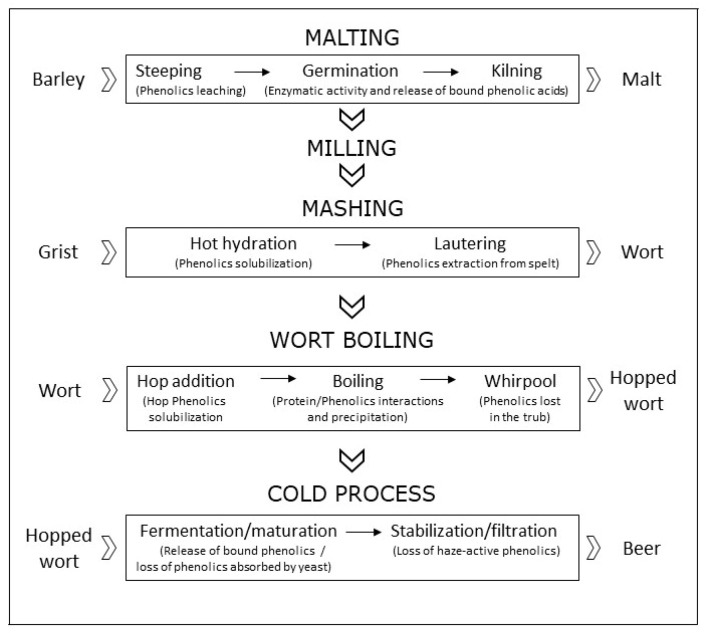
Figure 1
Figure 1
Phenolic compounds’ fate during the phases of malting and brewing processes: in the phase of mashing, after an initial decrease, total phenolics amount increases 3- to 5-fold; afterwards, phenolics continue to increase throughout mashing and during hop addition, but dramatically decrease during wort boiling, whirpool, fermentation, maturation, stabilization and filtration, so that, during the entire brewing process, about 60% of the malt phenolic content is lost.
Figure 2
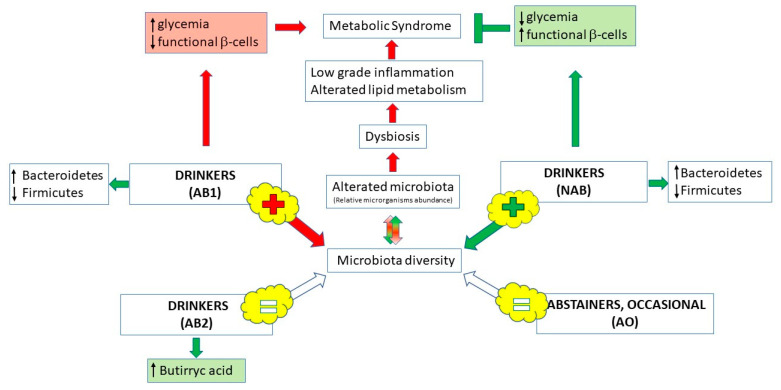
Figure 2
Schematic representation of relationship between beer, gut microbiota and metabolic syndrome. Phenolic compounds contained in non-alcoholic beer have a positive effect on the microbiota dysbiosis, one of the main causes of metabolic syndrome, but the effect is prevented by alcohol presence. Non-alcoholic beer consumption also determines a positive modification of some parameters typical of metabolic syndrome such as glycemia and the β-cells’ function (AB1, drinkers of 355 mL/day of alcoholic beer; NAB, drinkers of 355 mL/day of non-alcoholic beer [111]). On the other hand, moderate beer consumption can increase the production of butyric acid, a fundamental molecule produced by the microbiota and useful for its healthy implications (AB2, drinkers of 200–600 mL/day; AO, abstainers or occasional consumers of <1.5 alcohol g/day [122]).

Similar articles

Cited by

References

    1. Homan M.M. Beer and Its Drinkers: An Ancient Near Eastern Love Story. Near East. Archaeol. 2004;67:84–95. doi: 10.2307/4132364. - DOI
    1. Wang J., Liu L., Ball T., Yu L., Li Y., Xing F. Revealing a 5,000-y-old beer recipe in China. Proc. Natl. Acad. Sci. USA. 2016:201601465. doi: 10.1073/pnas.1601465113. - DOI - PMC - PubMed
    1. Brewers Contribution made by Beer to the European Economy. [(accessed on 1 October 2020)]; Available online: https://brewersofeurope.org/uploads/mycms-files/documents/publications/2....
    1. Osorio-Paz I., Brunauer R., Alavez S. Beer and its non-alcoholic compounds in health and disease. Crit. Rev. Food Sci. Nutr. 2019:1–14. doi: 10.1080/10408398.2019.1696278. - DOI - PubMed
    1. Cardona F., Andrés-Lacueva C., Tulipani S., Tinahones F.J., Queipo-Ortuño M.I. Benefits of polyphenols on gut microbiota and implications in human health. J. Nutr. Biochem. 2013;24:1415–1422. doi: 10.1016/j.jnutbio.2013.05.001. - DOI - PubMed

LinkOut - more resources