


S. pseudintermedius and S. aureus lineages with transmission ability circulate as causative agents of infections in pets for years
- PMID: 33478473
- PMCID: PMC7819200
- DOI: 10.1186/s12917-020-02726-4
S. pseudintermedius and S. aureus lineages with transmission ability circulate as causative agents of infections in pets for years
Abstract
Background: Staphylococcus pseudintermedius (SP) and Staphylococcus aureus (SA) are common colonizers of companion animals, but they are also considered opportunistic pathogens, causing diseases of diverse severity. This study focused on the identification and characterization of 33 coagulase-positive staphylococci isolated from diseased pets (28 dogs and five cats) during 2009-2011 in a veterinary hospital in Spain in order to stablish the circulating lineages and their antimicrobial resistance profile.
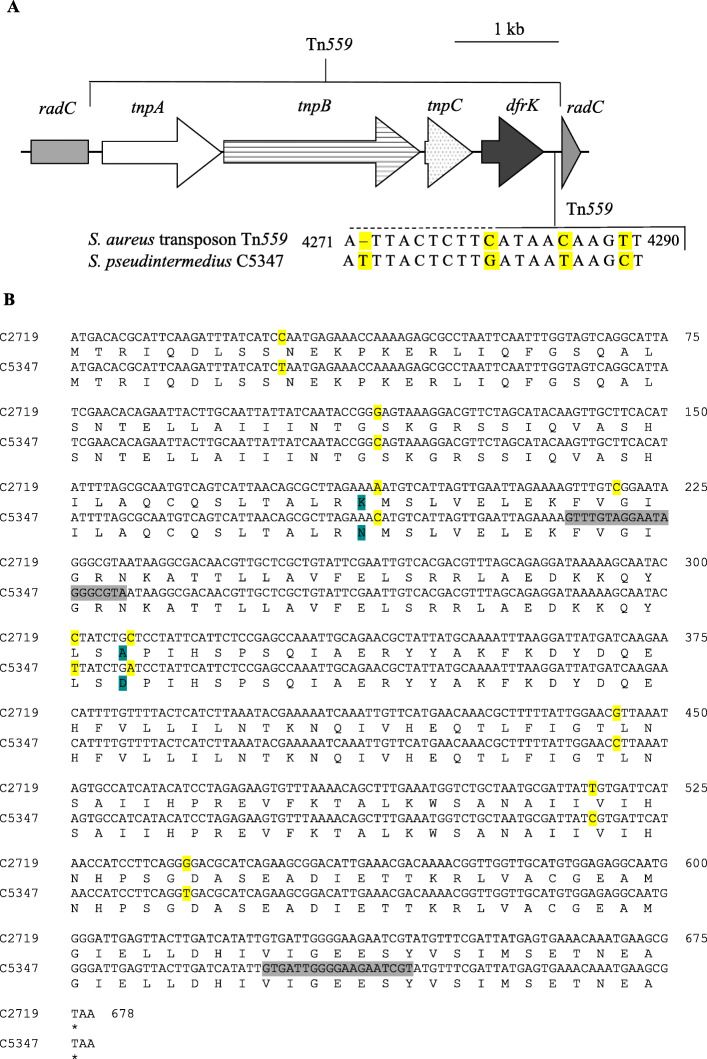
Results: Twenty-eight isolates were identified as SP and five as SA. Nine methicillin-resistant (MR) isolates (27%) carrying the mecA gene were detected (eight MRSP and one MRSA). The 55% of SP and SA isolates were multidrug-resistant (MDR). MRSP strains were typed as ST71-agrIII-SCCmecII/III-(PFGE) A (n=5), ST68-agrIV-SCCmecV-B1/B2 (n=2), and ST258-agrII-SCCmecIV-C (n=1). SP isolates showed resistance to the following antimicrobials [percentage of resistant isolates/resistance genes]: penicillin [82/blaZ], oxacillin [29/mecA] erythromycin/clindamycin [43/erm(B)], aminoglycosides [18-46/aacA-aphD, aphA3, aadE], tetracycline [71/tet(M), tet(K)], ciprofloxacin [29], chloramphenicol [29/catpC221], and trimethoprim-sulfamethoxazole [50/dfrG, dfrK]. The dfrK gene was revealed as part of the radC-integrated Tn559 in two SP isolates. Virulence genes detected among SP isolates were as follow [percentage of isolates]: siet [100], se-int [100], lukS/F-I [100], seccanine [7], and expB [7]. The single MRSA-mecA detected was typed as t011-ST398/CC398-agrI-SCCmecV and was MDR. The methicillin-susceptible SA isolates were typed as t045-ST5/CC5 (n=2), t10576-ST1660 (n=1), and t005-ST22/CC22 (n=1); the t005-ST22 feline isolate was PVL-positive and the two t045-ST45 isolates were ascribed to Immune Evasion Cluster (IEC) type F. Moreover, the t10576-ST1660 isolate, of potential equine origin, harbored the lukPQ and scneq genes. According to animal clinical history and data records, several strains seem to have been acquired from different sources of the hospital environment, while some SA strains appeared to have a human origin.
Conclusions: The frequent detection of MR and MDR isolates among clinical SP and SA strains with noticeable virulence traits is of veterinary concern, implying limited treatment options available. This is the first description of MRSA-ST398 and MRSP-ST68 in pets in Spain, as well the first report of the dfrK-carrying Tn559 in SP. This evidences that current transmissible lineages with mobilizable resistomes have been circulating as causative agents of infections among pets for years.
Keywords: Infection; MRSA; MRSA-CC398; MRSP; MRSP-ST71; Pets; Tn559.
Conflict of interest statement
The authors declare that they have no competing interests.
Figures

References
-
- Pires Dos Santos T, Damborg P, Moodley A, Guardabassi L. Systematic review on global epidemiology of methicillin-resistant Staphylococcus pseudintermedius: inference of population structure from Multilocus Sequence Typing Data. Front Microbiol. 2016;7:1599. doi: 10.3389/fmicb.2016.01599. - DOI - PMC - PubMed
MeSH terms
Substances
Supplementary concepts
Grants and funding
LinkOut - more resources
Full Text Sources
Other Literature Sources
Medical
Molecular Biology Databases
Miscellaneous
