Neurodevelopmental outcomes following neonatal late-onset sepsis and blood culture-negative conditions
- PMID: 33478957
- PMCID: PMC8292446
- DOI: 10.1136/archdischild-2020-320664
Neurodevelopmental outcomes following neonatal late-onset sepsis and blood culture-negative conditions
Abstract
Objective: Determine risk of death or neurodevelopmental impairment (NDI) in infants with late-onset sepsis (LOS) versus late-onset, antibiotic-treated, blood culture-negative conditions (LOCNC).
Design: Retrospective cohort study.
Setting: 24 neonatal centres.
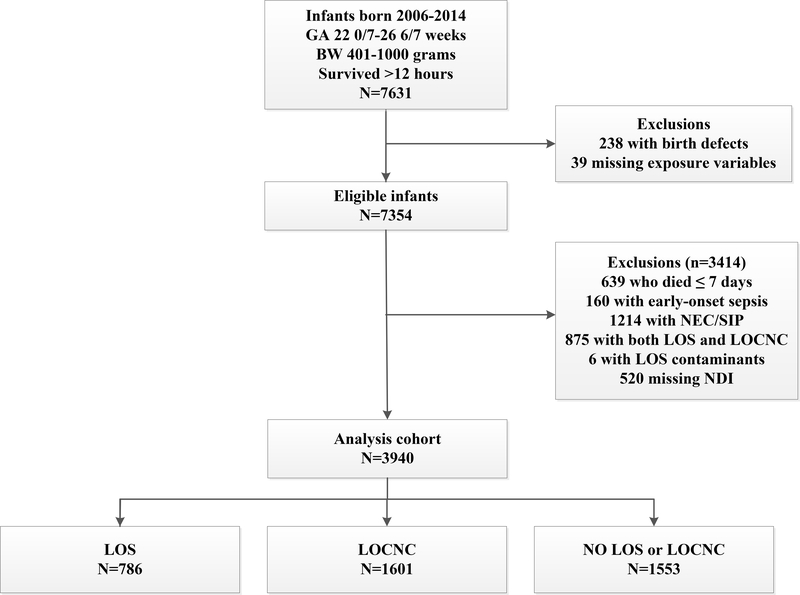
Patients: Infants born 1/1/2006-31/12/2014, at 22-26 weeks gestation, with birth weight 401-1000 g and surviving >7 days were included. Infants with early-onset sepsis, necrotising enterocolitis, intestinal perforation or both LOS and LOCNC were excluded.
Exposures: LOS and LOCNC were defined as antibiotic administration for ≥5 days with and without a positive blood/cerebrospinal fluid culture, respectively. Infants with these diagnoses were also compared with infants with neither condition.
Outcomes: Death or NDI was assessed at 18-26 months corrected age follow-up. Modified Poisson regression models were used to estimate relative risks adjusting for covariates occurring ≤7 days of age.
Results: Of 7354 eligible infants, 3940 met inclusion criteria: 786 (20%) with LOS, 1601 (41%) with LOCNC and 1553 (39%) with neither. Infants with LOS had higher adjusted relative risk (95% CI) for death/NDI (1.14 (1.05 to 1.25)) and death before follow-up (1.71 (1.44 to 2.03)) than those with LOCNC. Among survivors, risk for NDI did not differ between the two groups (0.99 (0.86 to 1.13)) but was higher for LOCNC infants (1.17 (1.04 to 1.31)) compared with unaffected infants.
Conclusions: Infants with LOS had higher risk of death, but not NDI, compared with infants with LOCNC. Surviving infants with LOCNC had higher risk of NDI compared with unaffected infants. Improving outcomes for infants with LOCNC requires study of the underlying conditions and the potential impact of antibiotic exposure.
Keywords: epidemiology; neonatology; neurology.
© Author(s) (or their employer(s)) 2021. No commercial re-use. See rights and permissions. Published by BMJ.
Conflict of interest statement
Competing interests: RG has received support from industry for research services (https://dcri.org/about-us/conflict-of-interest/). The other authors have no conflicts of interest relevant to this article to disclose.
Figures
References
-
- Horbar JD, Edwards EM, Greenberg LT, et al. Variation in Performance of Neonatal Intensive Care Units in the United States. JAMA pediatrics. 2017;171:e164396. - PubMed
-
- Glass TJA, Chau V, Grunau RE, et al. Multiple Postnatal Infections in Newborns Born Preterm Predict Delayed Maturation of Motor Pathways at Term-Equivalent Age with Poorer Motor Outcomes at 3 Years. The Journal of pediatrics. 2018;196:91–97.e1. - PubMed
-
- Shah DK, Doyle LW, Anderson PJ, et al. Adverse Neurodevelopment in Preterm Infants with Postnatal Sepsis or Necrotizing Enterocolitis is Mediated by White Matter Abnormalities on Magnetic Resonance Imaging at Term. The Journal of pediatrics. 2008;153:170–175.e1. - PubMed
Publication types
MeSH terms
Substances
Grants and funding
- UG1 HD068263/HD/NICHD NIH HHS/United States
- U10 HD021373/HD/NICHD NIH HHS/United States
- UL1 TR001111/TR/NCATS NIH HHS/United States
- UL1 RR025764/RR/NCRR NIH HHS/United States
- UG1 HD068270/HD/NICHD NIH HHS/United States
- M01 RR000030/RR/NCRR NIH HHS/United States
- UG1 HD034216/HD/NICHD NIH HHS/United States
- U10 HD027871/HD/NICHD NIH HHS/United States
- UG1 HD027880/HD/NICHD NIH HHS/United States
- UG1 HD027851/HD/NICHD NIH HHS/United States
- U10 HD036790/HD/NICHD NIH HHS/United States
- UG1 HD087226/HD/NICHD NIH HHS/United States
- U10 HD053124/HD/NICHD NIH HHS/United States
- U10 HD053119/HD/NICHD NIH HHS/United States
- UL1 TR001863/TR/NCATS NIH HHS/United States
- UG1 HD068244/HD/NICHD NIH HHS/United States
- UG1 HD027853/HD/NICHD NIH HHS/United States
- U10 HD040521/HD/NICHD NIH HHS/United States
- UL1 TR000042/TR/NCATS NIH HHS/United States
- UG1 HD040689/HD/NICHD NIH HHS/United States
- M01 RR000039/RR/NCRR NIH HHS/United States
- UG1 HD087229/HD/NICHD NIH HHS/United States
- M01 RR008084/RR/NCRR NIH HHS/United States
- UG1 HD053089/HD/NICHD NIH HHS/United States
- U10 HD040461/HD/NICHD NIH HHS/United States
- M01 RR000044/RR/NCRR NIH HHS/United States
- M01 RR016587/RR/NCRR NIH HHS/United States
- M01 RR000750/RR/NCRR NIH HHS/United States
- M01 RR000059/RR/NCRR NIH HHS/United States
- K23 HD088753/HD/NICHD NIH HHS/United States
- M01 RR000054/RR/NCRR NIH HHS/United States
- U10 HD021397/HD/NICHD NIH HHS/United States
- M01 RR000633/RR/NCRR NIH HHS/United States
- UG1 HD027856/HD/NICHD NIH HHS/United States
- UG1 HD027904/HD/NICHD NIH HHS/United States
- UL1 TR000142/TR/NCATS NIH HHS/United States
- UL1 TR002553/TR/NCATS NIH HHS/United States
- M01 RR007122/RR/NCRR NIH HHS/United States
- M01 RR000032/RR/NCRR NIH HHS/United States
- UG1 HD068284/HD/NICHD NIH HHS/United States
- UG1 HD021385/HD/NICHD NIH HHS/United States
- UG1 HD040492/HD/NICHD NIH HHS/United States
- UG1 HD021364/HD/NICHD NIH HHS/United States
- M01 RR000997/RR/NCRR NIH HHS/United States
- UL1 TR001117/TR/NCATS NIH HHS/United States
- UG1 HD053109/HD/NICHD NIH HHS/United States
- M01 RR000064/RR/NCRR NIH HHS/United States
- M01 RR000070/RR/NCRR NIH HHS/United States
- M01 RR000080/RR/NCRR NIH HHS/United States
- U10 HD040498/HD/NICHD NIH HHS/United States
- UG1 HD068278/HD/NICHD NIH HHS/United States
- U24 HD095254/HD/NICHD NIH HHS/United States
LinkOut - more resources
Full Text Sources
Other Literature Sources
Medical
Miscellaneous