


Demographic and public health characteristics explain large part of variability in COVID-19 mortality across countries
- PMID: 33479720
- PMCID: PMC7928985
- DOI: 10.1093/eurpub/ckaa226
Demographic and public health characteristics explain large part of variability in COVID-19 mortality across countries
Abstract
Background: The numbers of coronavirus disease 2019 (COVID-19) deaths per million people differ widely across countries. Often, the causal effects of interventions taken by authorities are unjustifiably concluded based on the comparison of pure mortalities in countries where interventions consisting different strategies have been taken. Moreover, the possible effects of other factors are only rarely considered.
Methods: We used data from open databases (European Centre for Disease Prevention and Control, World Bank Open Data, The BCG World Atlas) and publications to develop a model that could largely explain the differences in cumulative mortality between countries using non-interventional (mostly socio-demographic) factors.
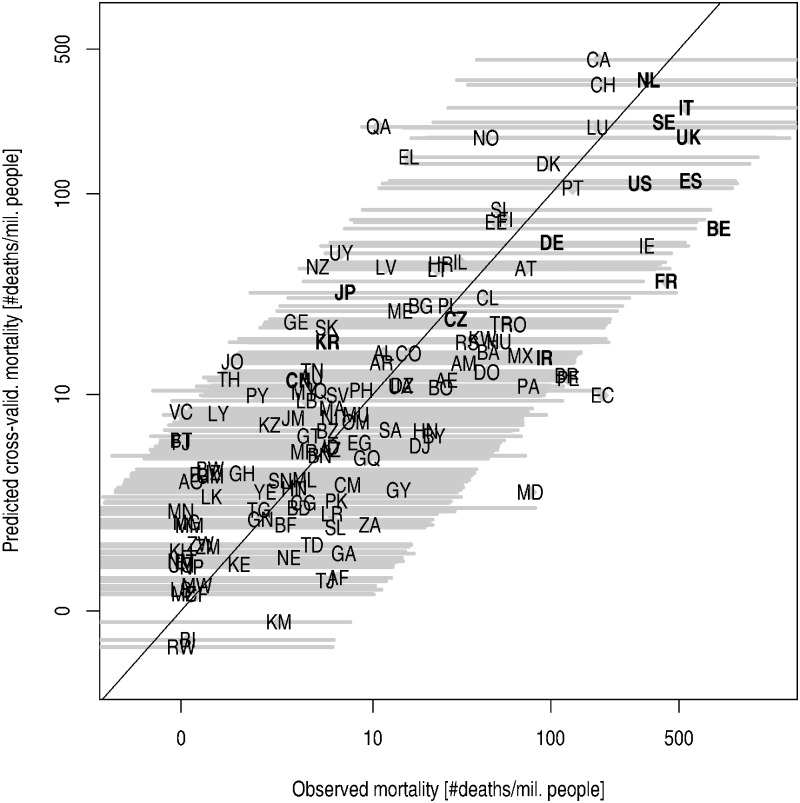
Results: Statistically significant associations with the logarithmic COVID-19 mortality were found with the following: proportion of people aged 80 years and above, population density, proportion of urban population, gross domestic product, number of hospital beds per population, average temperature in March and incidence of tuberculosis. The final model could explain 67% of the variability. This finding could also be interpreted as follows: less than a third of the variability in logarithmic mortality differences could be modified by diverse non-pharmaceutical interventions ranging from case isolation to comprehensive measures, constituting case isolation, social distancing of the entire population and closure of schools and borders.
Conclusions: In particular countries, the number of people who will die from COVID-19 is largely given by factors that cannot be drastically changed as an immediate reaction to the pandemic and authorities should focus on modifiable variables, e.g. the number of hospital beds.
© The Author(s) 2021. Published by Oxford University Press on behalf of the European Public Health Association. All rights reserved.
Figures
References
-
- Weissman GE, Crane-Droesch A, Chivers C, et al. Locally informed simulation to predict hospital capacity needs during the COVID-19 pandemic. Ann Intern Med 2020. - PubMed
MeSH terms
LinkOut - more resources
Full Text Sources
Other Literature Sources
Medical
