


Antigen-Based Testing but Not Real-Time Polymerase Chain Reaction Correlates With Severe Acute Respiratory Syndrome Coronavirus 2 Viral Culture
- PMID: 33479756
- PMCID: PMC7929138
- DOI: 10.1093/cid/ciaa1706
Antigen-Based Testing but Not Real-Time Polymerase Chain Reaction Correlates With Severe Acute Respiratory Syndrome Coronavirus 2 Viral Culture
Abstract
Background: Individuals can test positive for severe acute respiratory syndrome coronavirus 2 (SARS-CoV-2) by molecular assays following the resolution of their clinical disease. Recent studies indicate that SARS-CoV-2 antigen-based tests are likely to be positive early in the disease course, when there is an increased likelihood of high levels of infectious virus.
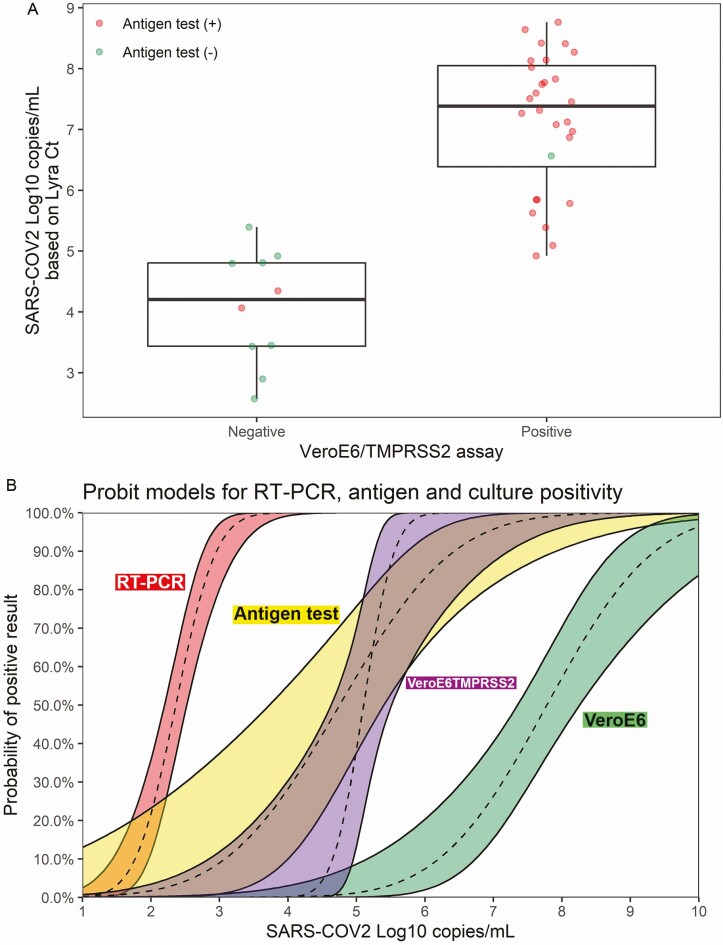
Methods: Upper respiratory specimens from 251 participants with coronavirus disease 2019 symptoms (≤7 days from symptom onset) were prospectively collected and tested with a lateral flow antigen test and a real-time polymerase chain reaction (rt-PCR) assay for detection of SARS-CoV-2. Specimens from a subset of the study specimens were utilized to determine the presence of infectious virus in the VeroE6TMPRSS2 cell culture model.
Results: The antigen test demonstrated a higher positive predictive value (90%) than rt-PCR (70%) when compared to culture-positive results. The positive percentage agreement for detection of infectious virus for the antigen test was similar to rt-PCR when compared to culture results.
Conclusions: The correlation between SARS-CoV-2 antigen and SARS-CoV-2 culture positivity represents a significant advancement in determining the risk for potential transmissibility beyond that which can be achieved by detection of SARS-CoV-2 genomic RNA. SARS-CoV-2 antigen testing can facilitate low-cost, scalable, and rapid time-to-result, while providing good risk determination of those who are likely harboring infectious virus, compared to rt-PCR.
Keywords: SARS-CoV-2; SARS-CoV-2 live culture; antigen testing; rt-PCR testing; viral load.
© The Author(s) 2021. Published by Oxford University Press for the Infectious Diseases Society of America. All rights reserved. For permissions, e-mail: journals.permissions@oup.com.
Figures
Comment in
-
A Practical and Economic Approach for Assessing Potential Severe Acute Respiratory Syndrome Coronavirus 2 (SARS-CoV-2) Transmission Risk in Coronavirus Disease 2019 (COVID-19) Patients.Clin Infect Dis. 2021 Nov 2;73(9):e2867-e2868. doi: 10.1093/cid/ciaa1789. Clin Infect Dis. 2021. PMID: 33258915 Free PMC article. No abstract available.
References
-
- He X, Lau EHY, Wu P, et al. Temporal dynamics in viral shedding and transmissibility of COVID-19. Nat Med 2020; 26:672–5. - PubMed
Publication types
MeSH terms
Substances
Grants and funding
LinkOut - more resources
Full Text Sources
Other Literature Sources
Medical
Miscellaneous
