


Purely Behavioral: A Scoping Review of Nonpharmacological Behavioral and Lifestyle Interventions to Prevent Cardiovascular Disease in Persons Living With HIV
- PMID: 33481464
- PMCID: PMC8289919
- DOI: 10.1097/JNC.0000000000000230
Purely Behavioral: A Scoping Review of Nonpharmacological Behavioral and Lifestyle Interventions to Prevent Cardiovascular Disease in Persons Living With HIV
Abstract
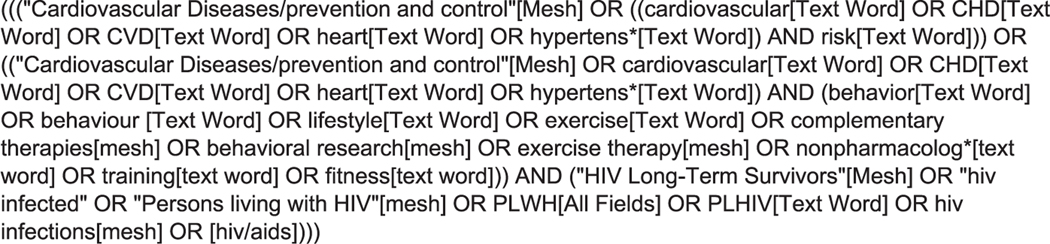
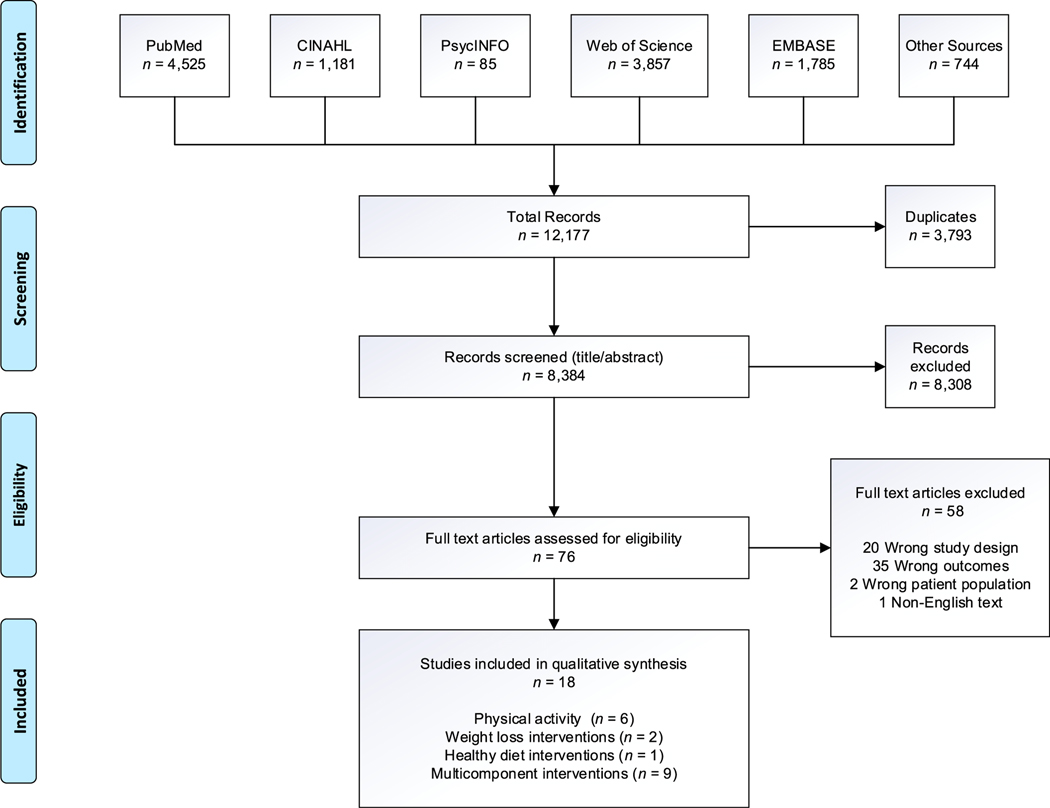
Cardiovascular disease (CVD) is the leading cause of death in the United States, accounting for 900,000 deaths annually. People living with HIV are at a higher risk of developing CVD. We conducted a scoping review guided by the Joanna Briggs Institute Manual for Evidence Synthesis. In July 2020, six databases were searched: PubMed, Cumulative Index to Nursing and Allied Health Literature, PsycINFO, Web of Science, Embase, and The Cochrane Central Register of Controlled Trials, as well as reference lists of relevant studies and key journals. Our review identified 18 studies that addressed nonpharmacological behavioral interventions into the following: physical activity (n = 6), weight loss (n = 2), dietary interventions (n = 1), and multicomponent interventions (n = 9). In the past 10 years, there has been an increased emphasis on nonpharmacological behavioral approaches, including the incorporation of multicomponent interventions, to reduce cardiovascular risk in people living with HIV. The extant literature is limited by underrepresentation of geographic regions and populations that disproportionately experience CVD.
Copyright © 2021 Association of Nurses in AIDS Care.
Figures

References
-
- Anderson NB, Bulatao RA, Cohen B, & National Research Council (US) Panel on Race, Ethnicity, and Health in Later Life. (2004). Behavioral health interventions: What works and why? In Critical Perspectives on Racial and Ethnic Differences in Health in Late Life. National Academies Press (US). https://www.ncbi.nlm.nih.gov/books/NBK25527/ - PubMed
-
- Arnett DK, Blumenthal RS, Albert MA, Buroker AB, Goldberger ZD, Hahn EJ, Himmelfar DC, Khera A, Llyod-Jones JD, McEvoy JW, Michos DE, Miedema DM, Munoz D, Smith CS Jr, Virani SS, Williams AK Sr, Yeboah J, & Ziaeian B (2019). 2019 ACC/AHA guideline on the primary prevention of cardiovascular disease: A report of the American College of Cardiology/American Heart Association Task Force on Clinical Practice Guidelines. Journal of the American College of Cardiology, 74(10), e177–e232. 10.1161/CIR.0000000000000678 - DOI - PMC - PubMed
-
- Ballocca F, Gili S, D’Ascenzo F, Marra WG, Cannillo M, Calcagno A, Bonora S, Flammer A, Coppola J, Moretti C, & Gaita F (2016). HIV infection and primary prevention of cardiovascular disease: Lights and shadows in the HAART era. Progress in Cardiovascular Diseases, 58(5), 565–576. 10.1016/j.pcad.2016.02.008 - DOI - PubMed
-
- Bibbins-Domingo K, Grossman DC, Curry SJ, Davidson KW, Epling JW, García FA, Gillman WM, Kemper RA, Krist HA, Kurth EA, Landefeld CS, Lefevre LM, Mangione MC, Phillips RW, Owens KD, Phipps GM, & Pignone P (2016). Statin use for the primary prevention of cardiovascular disease in adults:U.S. Preventive Services Task Force recommendation statement. JAMA, 316(19), 1997–2007. 10.1001/jama.2016.15450 - DOI - PubMed
Publication types
MeSH terms
Grants and funding
LinkOut - more resources
Full Text Sources
Other Literature Sources
Medical
Miscellaneous
