


The Transition to Adult Health Care in Youth With Spina Bifida: Theory, Measurement, and Interventions
- PMID: 33482054
- PMCID: PMC9676099
- DOI: 10.1111/jnu.12626
The Transition to Adult Health Care in Youth With Spina Bifida: Theory, Measurement, and Interventions
Abstract
Purpose: This article focuses on the transition to adult health care in youth with spina bifida (SB) from the perspective of theory, measurement, and interventions.
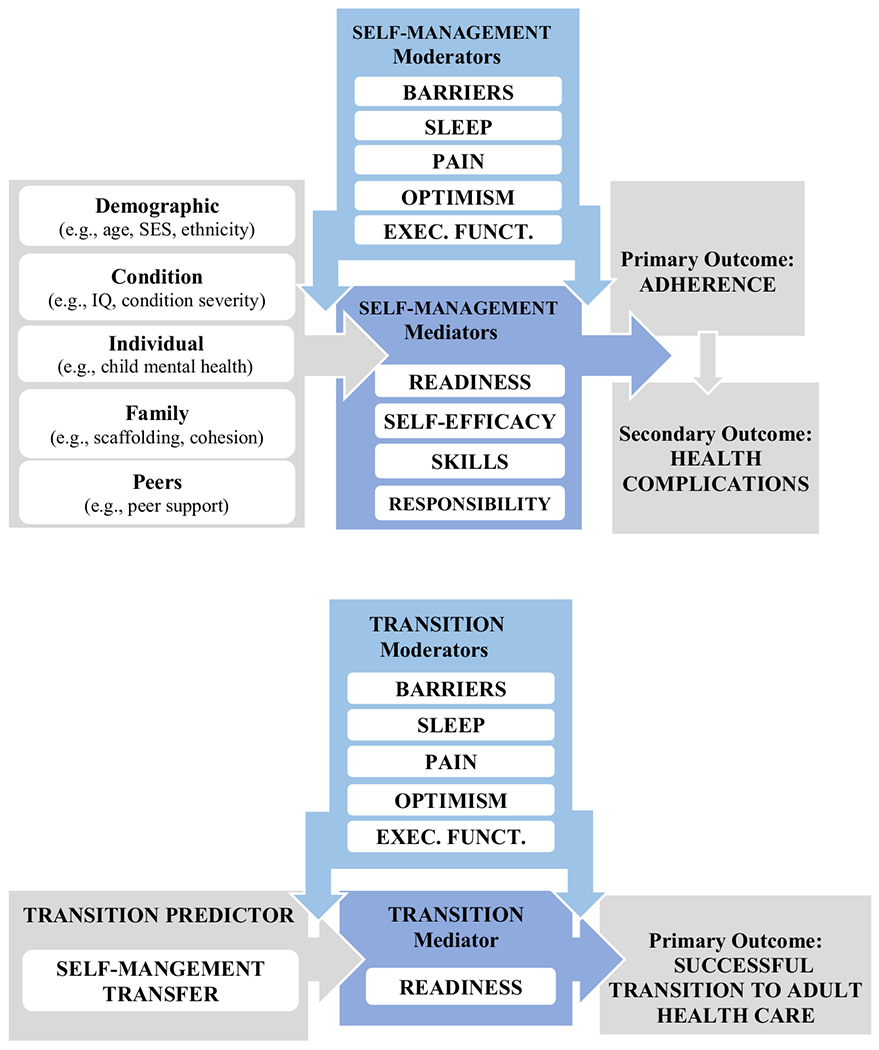
Methods: The purpose of this article is to discuss (a) a theory of linkages between the transfer of medical responsibility from parent to child and the transition from pediatric to adult health care, as mediated by transition readiness; (b) measurement issues in the study of self-management and the transition to adult health care; and (c) U.S.-based and international interventions focused on the transition to adult health care in young adults with SB.
Findings: Individuals with SB must adhere to a complex multicomponent treatment regimen while at the same time managing a unique array of cognitive and psychosocial challenges and comorbidities that hinder self-management, medical adherence, and the transition to adult health care. Moreover, such youth endure multiple transitions to adult health care (e.g., in the areas of urology, orthopedics, neurosurgery, and primary care) that may unfold across different time frames. Finally, three transition-related constructs need to be assessed, namely, transition readiness, transition completion, and transition success.
Conclusions: SB provides an important exemplar that highlights the complexities of conducting research on the transition to adult health care in youth with chronic health conditions. Many transition trajectories are possible, depending on the functioning level of the child and a host of other factors. Also, no single transition pathway is optimal for all patients with SB.
Clinical relevance: The success of the process by which a child with SB transitions from pediatric to adult health care can have life-sustaining implications for the patient.
Keywords: Adolescence; adult health care; chronic illness/chronic disease; quality improvement of care; symptom management.
© 2021 Sigma Theta Tau International.
Figures
References
-
- American Academy of Pediatrics, American Academy of Family Physicians, American College of Physicians-American Society of Internal Medicine. (2002). A consensus statement on health care transitions for young adults with special health care needs. Pediatrics, 10(6 Pt. 2), 1304–1306. - PubMed
-
- Betz CL (in press). Nursing’s influence on the evolution of the field of health care transition and future implications. Manuscript submitted for publication. - PubMed
-
- Betz CL, & Coyne IT (Eds.). (2020). Transition from pediatric to adult health care services for adolescents and young adults with long-term conditions: An international perspective on nurse’s roles and interventions. Cham, Switzerland: Springer Nature Switzerland AG.
Publication types
MeSH terms
Grants and funding
LinkOut - more resources
Full Text Sources
Other Literature Sources
Medical
