


Postoperative Outcomes after Index vs Interval Cholecystectomy for Perforated Cholecystitis
- PMID: 33482322
- PMCID: PMC8021230
- DOI: 10.1016/j.jamcollsurg.2020.11.034
Postoperative Outcomes after Index vs Interval Cholecystectomy for Perforated Cholecystitis
Abstract
Background: Gallbladder perforation is a known morbid sequela of acute cholecystitis, yet evidence for its optimal management remains conflicting. This study compares outcomes in patients with perforated cholecystitis who underwent cholecystectomy at the time of index hospital admission with those in patients who underwent interval cholecystectomy.
Study design: A retrospective analysis was conducted of 654 patients from the American College of Surgeons NSQIP database who underwent cholecystectomy for perforated cholecystitis (2006-2018). Primary outcomes were 30-day postoperative major and minor morbidity, 30-day mortality, and need for prolonged hospitalization. Patient and procedure characteristics and outcomes were compared using Mann-Whitney rank sum test for continuous variables and Pearson chi-square tests for categorical variables. A subset analysis was conducted of patients matched on propensity for undergoing interval cholecystectomy.
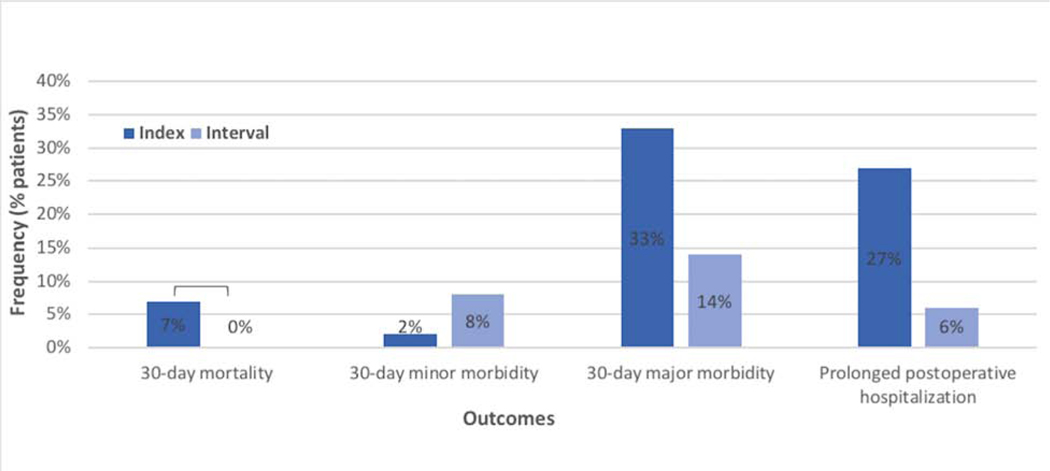
Results: The 30-day postoperative mortality rate of matched cohort patients undergoing index cholecystectomy was 7% vs 0% of patients undergoing interval cholecystectomy (p = 0.01). The 30-day minor morbidity rates were 2% for index and 8% for interval patients (p = 0.06), and the major morbidity rates were 33% for index and 14% for interval patients (p = 0.003). Of the index patients, 27% required prolonged hospitalization compared with 6% of interval patients (p < 0.001). Results showed similar trends in the unmatched analysis.
Conclusions: Patients who underwent index cholecystectomy had significantly longer postoperative hospitalizations and higher 30-day postoperative major morbidity and mortality. There were no differences in 30-day minor morbidity. Selected patients with perforated cholecystitis can benefit from operative management on an interval, rather than urgent, basis.
Copyright © 2021 American College of Surgeons. Published by Elsevier Inc. All rights reserved.
Figures
Comment in
-
Invited Commentary.J Am Coll Surg. 2021 Apr;232(4):349-350. doi: 10.1016/j.jamcollsurg.2020.12.041. J Am Coll Surg. 2021. PMID: 33771291 No abstract available.
-
When Operating on a Perforated Gallbladder, Some Aspects Should Be Reconsidered.J Am Coll Surg. 2022 May 1;234(5):973-974. doi: 10.1097/XCS.0000000000000075. J Am Coll Surg. 2022. PMID: 35426417 No abstract available.
-
In Support of Interval Cholecystectomy for Perforated Cholecystitis: In Reply to Toro and Di Carlo.J Am Coll Surg. 2022 May 1;234(5):974-975. doi: 10.1097/XCS.0000000000000076. J Am Coll Surg. 2022. PMID: 35426418 No abstract available.
References
Publication types
MeSH terms
Grants and funding
LinkOut - more resources
Full Text Sources
Other Literature Sources
Medical
