. 2021 Jan 22;16(1):45.
doi: 10.1186/s13023-021-01673-z.

Myopia-26, the female-limited form of early-onset high myopia, occurring in a European family

Affiliations

Myopia-26, the female-limited form of early-onset high myopia, occurring in a European family

Noémi Széll et al. Orphanet J Rare Dis. .

Abstract

Background: Female-limited early-onset high myopia, also called Myopia-26 is a rare monogenic disorder characterized by severe short sightedness starting in early childhood and progressing to blindness potentially by the middle ages. Despite the X-linked locus of the mutated ARR3 gene, the disease paradoxically affects females only, with males being asymptomatic carriers. Previously, this disease has only been observed in Asian families and has not gone through detailed investigation concerning collateral symptoms or pathogenesis.

Results: We found a large Hungarian family displaying female-limited early-onset high myopia. Whole exome sequencing of two individuals identified a novel nonsense mutation (c.214C>T, p.Arg72*) in the ARR3 gene. We carried out basic ophthalmological testing for 18 family members, as well as detailed ophthalmological examination (intraocular pressure, axial length, fundus appearance, optical coherence tomography, visual field- testing) as well as colour vision- and electrophysiology tests (standard and multifocal electroretinography, pattern electroretinography and visual evoked potentials) for eight individuals. Ophthalmological examinations did not reveal any signs of cone dystrophy as opposed to animal models. Electrophysiology and colour vision tests similarly did not evidence a general cone system alteration, rather a central macular dysfunction affecting both the inner and outer (postreceptoral and receptoral) retinal structures in all patients with ARR3 mutation.

Conclusions: This is the first description of a Caucasian family displaying Myopia-26. We present two hypotheses that could potentially explain the pathomechanism of this disease.

Keywords: ARR3; Early onset high myopia; G-protein coupled receptor; Intrinsically photosensitive retinal ganglion cell; Mendelian inheritance; Monogenic disorder; X-arrestin; X-linked female-limited high myopia.


Conflict of interest statement

DL and IN are employees of Seqomics Biotechnologies Ltd. IN is an investor of Seqomics Biotechnologies Ltd.

Figures
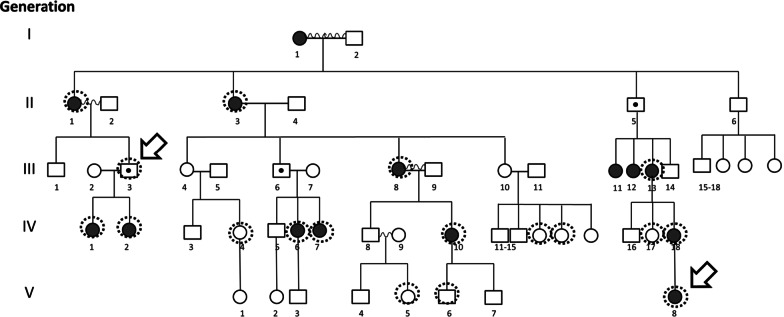
Fig. 1
Fig. 1
The pedigree of the investigated family. Dark shading indicates an eoHM phenotype. Dashed circles mark patients whose blood samples were obtained, the two arrows mark the two samples that went through whole exome sequencing
Fig. 2
Fig. 2
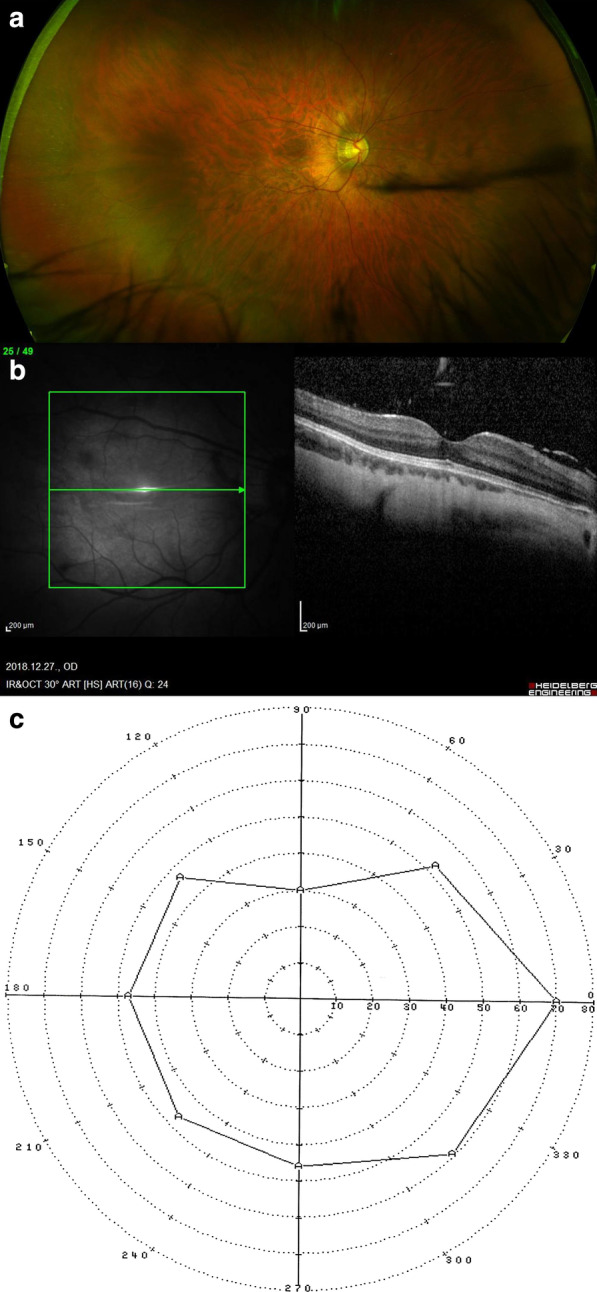
a Ultra widefield (Optos® California) fundus image of the right eye of affected female patient IV/6 displaying a META-PM2 stage myopic fundus. The tesselated appearence of the retina along with peripapillary and diffuse chorioretinal atrophy is observable. b Macular OCT image of the right eye affected female IV/6 displaying thinner (incipient atrophic) sensory retina and posterior vitreous detachment characteristic of higher degrees of myopia. c Visual field of the right eye of affected female IV/6 (nasal loss + superior artefact)
Fig. 3
Fig. 3
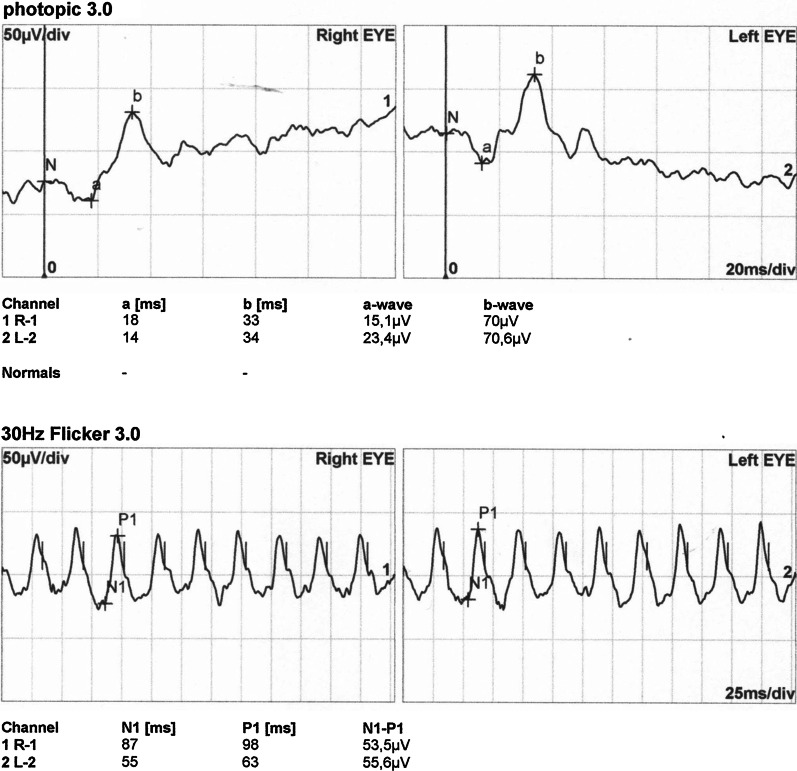
Normal photopic 3.0 ERGs in affected female IV/7. Despite prominent phenotypic signs of eoHM (SE: − 13.0/ − 9.0D, impaired BCVA, high myopic fundus alterations) in IV/7 individual, photopic 3.0 ERGs show no alterations, reflecting an overall normally functioning cone system
Fig. 4
Fig. 4
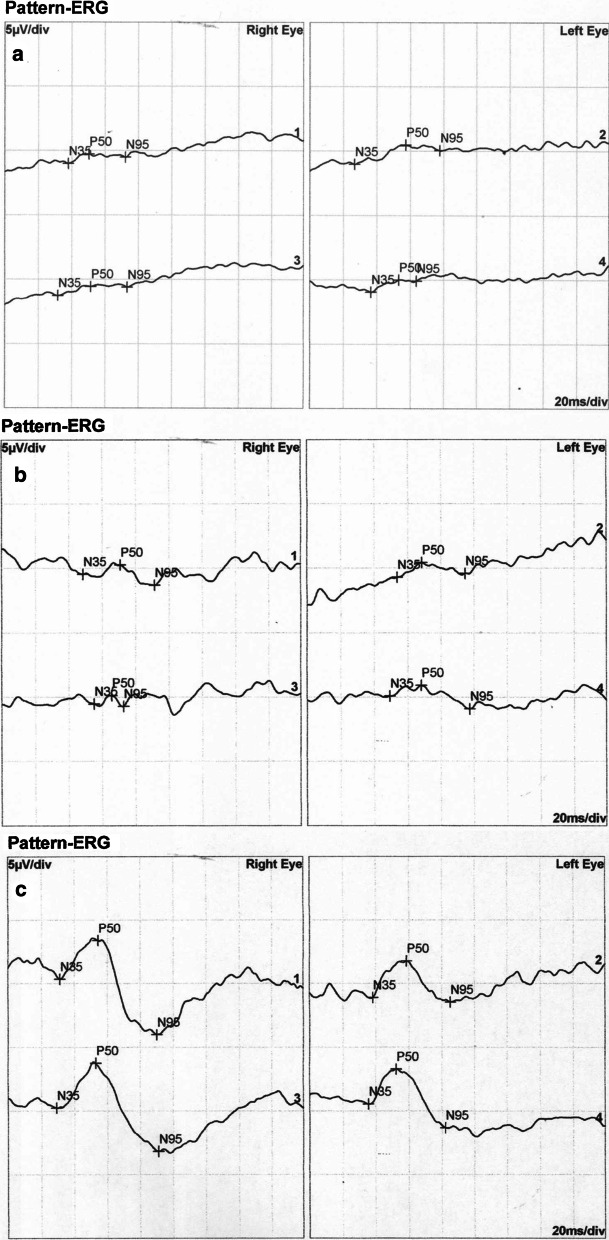
a Pattern ERG of carrier male III/3 is heavily affected. Despite no phenotypic sign of eoHM and visual impairment, pattern ERG of the carrier male patient is similarly subnormal as those of affected female patients. b Heavily affected PERG recordings of affected female IV/7. c Pattern ERG of unaffected male V/6. Physiological wave patterns are detected. In all sections, lines 1 and 3 and lines 2 and 4 represent pairs of replicate measurements
Fig. 5
Fig. 5
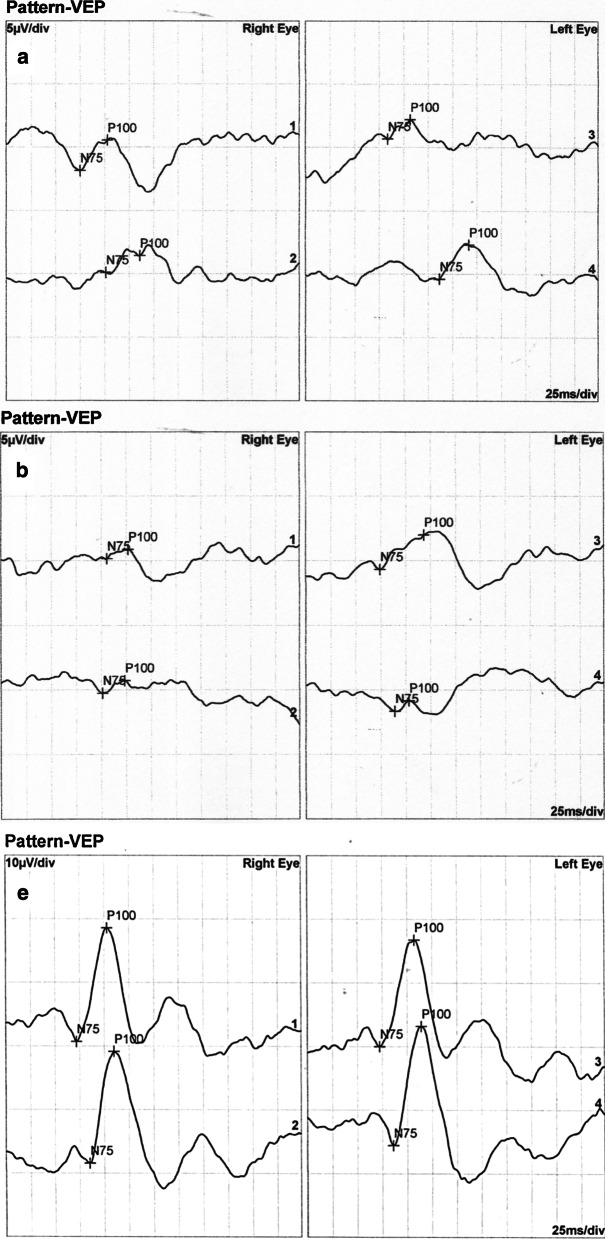
a Pattern VEP recordings of patient III/3 demonstrating increased implicit times and decreased amplitudes of P100 for 15′ (smaller checks) stimulation as compared to normal control. b Heavily affected pVEP recordings of affected female IV/7 demonstrating increased peak times and decreased amplitudes of P100. c Normal pattern VEP recordings of unaffected male V/6 (Note the change of the voltage scale). In all sections, lines 1 and 3 display responses to 60′ stimuli and lines 2 and 4 represent responses to 15′ stimuli
Fig. 6
Fig. 6
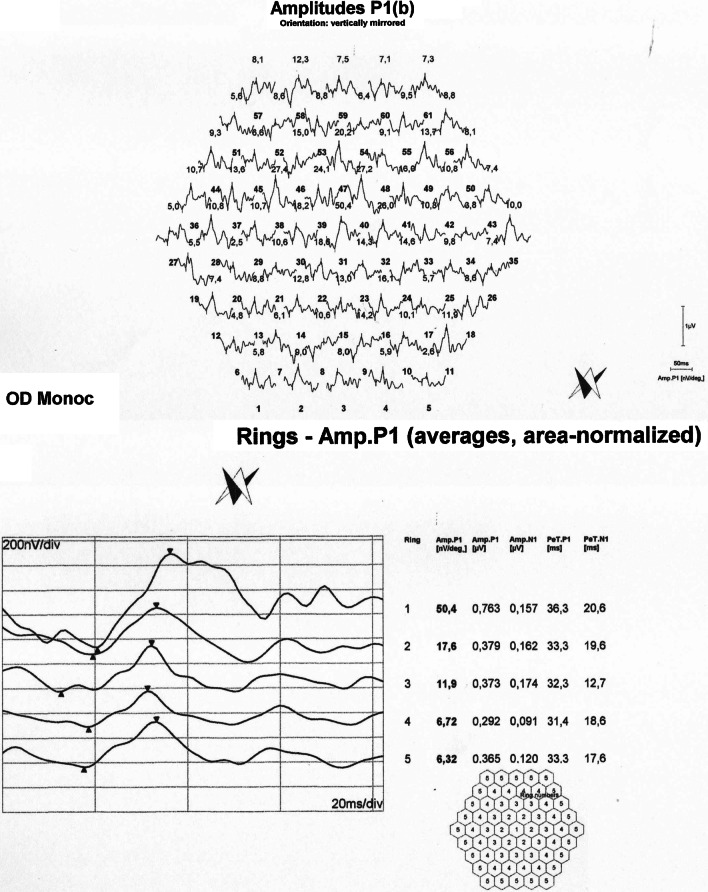
a MfERG recording of carrier male III/3, raw waveform. b MfERG recording and ring analysis of carrier male III/3

References

    1. Holden BA, Fricke TR, Wilson DA, Jong M, Naidoo KS, Sankaridurg P, et al. Global prevalence of myopia and high myopia and temporal trends from 2000 through 2050. Ophthalmology. 2016;123(5):1036–1042. doi: 10.1016/j.ophtha.2016.01.006. - DOI - PubMed
    1. McFadden SA. Understanding and treating myopia: what more we need to know and future research priorities. Optom Vis Sci. 2016;93(9):1061–1063. doi: 10.1097/OPX.0000000000000932. - DOI - PMC - PubMed
    1. Tedja MS, Haarman AEG, Meester-Smoor MA, Kaprio J, Mackey DA, Guggenheim JA, et al. IMI—myopia genetics report. Invest Ophthalmol Vis Sci. 2019;60(3):M89–M105. doi: 10.1167/iovs.18-25965. - DOI - PMC - PubMed
    1. Guggenheim JA, Kirov G, Hodson SA. The heritability of high myopia: a reanalysis of Goldschmidt's data. J Med Genet. 2000;37(3):227–231. doi: 10.1136/jmg.37.3.227. - DOI - PMC - PubMed
    1. Zhang Q. Genetics of refraction and myopia. In: Hejtmancik JF, Nickerson JM, editors. Molecular biology of eye disease. London: Academic Press; 2015. pp. 269–279.

Publication types