. 2021 Jan 22;12(1):519.
doi: 10.1038/s41467-020-20767-z.

Global patterns and climatic controls of forest structural complexity

Affiliations

Global patterns and climatic controls of forest structural complexity

Martin Ehbrecht et al. Nat Commun. .

Abstract

The complexity of forest structures plays a crucial role in regulating forest ecosystem functions and strongly influences biodiversity. Yet, knowledge of the global patterns and determinants of forest structural complexity remains scarce. Using a stand structural complexity index based on terrestrial laser scanning, we quantify the structural complexity of boreal, temperate, subtropical and tropical primary forests. We find that the global variation of forest structural complexity is largely explained by annual precipitation and precipitation seasonality (R² = 0.89). Using the structural complexity of primary forests as benchmark, we model the potential structural complexity across biomes and present a global map of the potential structural complexity of the earth´s forest ecoregions. Our analyses reveal distinct latitudinal patterns of forest structure and show that hotspots of high structural complexity coincide with hotspots of plant diversity. Considering the mechanistic underpinnings of forest structural complexity, our results suggest spatially contrasting changes of forest structure with climate change within and across biomes.


Conflict of interest statement

The authors declare no competing interests.

Figures
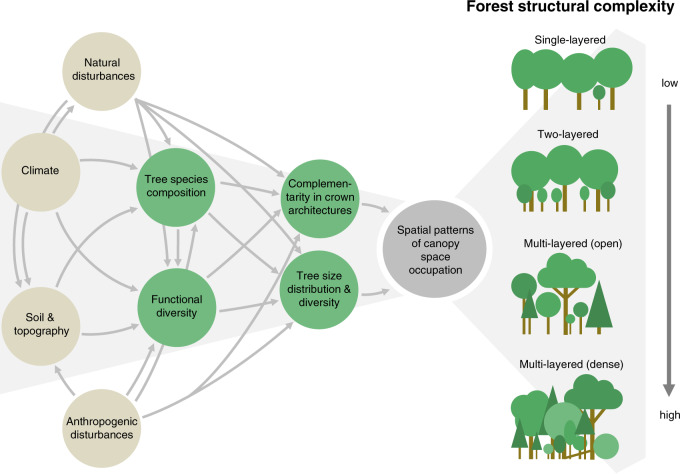
Fig. 1
Fig. 1. Conceptual figure outlining the abiotic and biotic controls on forest structural complexity.
Forest structural complexity increases with greater diversity of tree sizes and complementarity in crown architectures.
Fig. 2
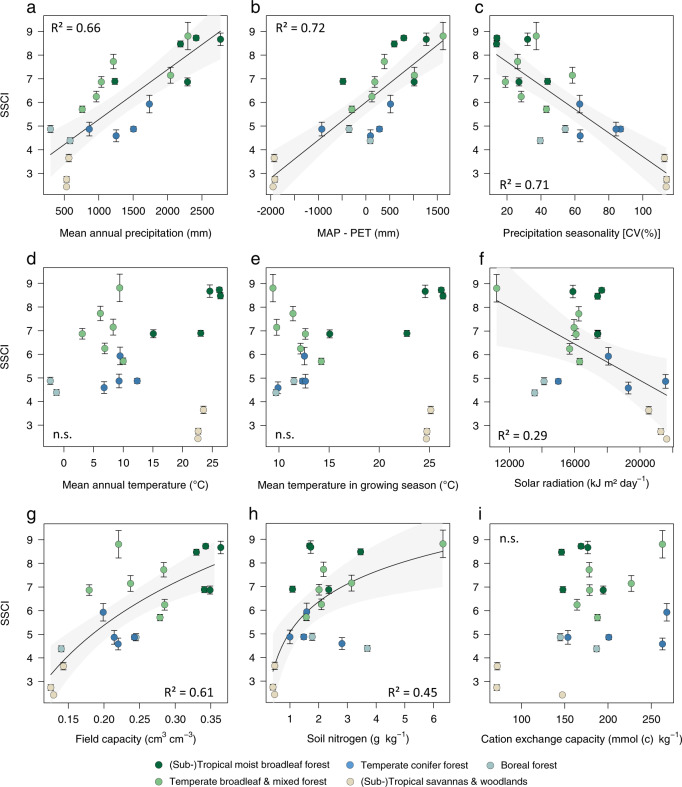
Fig. 2. Relationships of forest structural complexity (SSCI) with climatic and edaphic factors.
Linear regression was used to model relationships between primary forest structural complexity, as quantified by the stand structural complexity index (SSCI) and a mean annual precipitation (mm), b water balance (MAP–PET in mm), c precipitation seasonality (coefficient of variation in %), d mean annual temperature (°C), e mean temperature during growing season (°C), f solar radiation (kJ m² ha−1), g soil water holding capacity (field capacity in cm³ cm−3), h soil nitrogen (g kg−1), i cation exchange capacity (mmol (c) kg−1). Data points represent mean SSCI values for each site (n = 20 sites). Error bars indicate the standard error of the mean SSCI per site. Number of plots per site are shown in Table 3. Shaded envelopes represent the 95% confidence interval of the regression lines.
Fig. 3
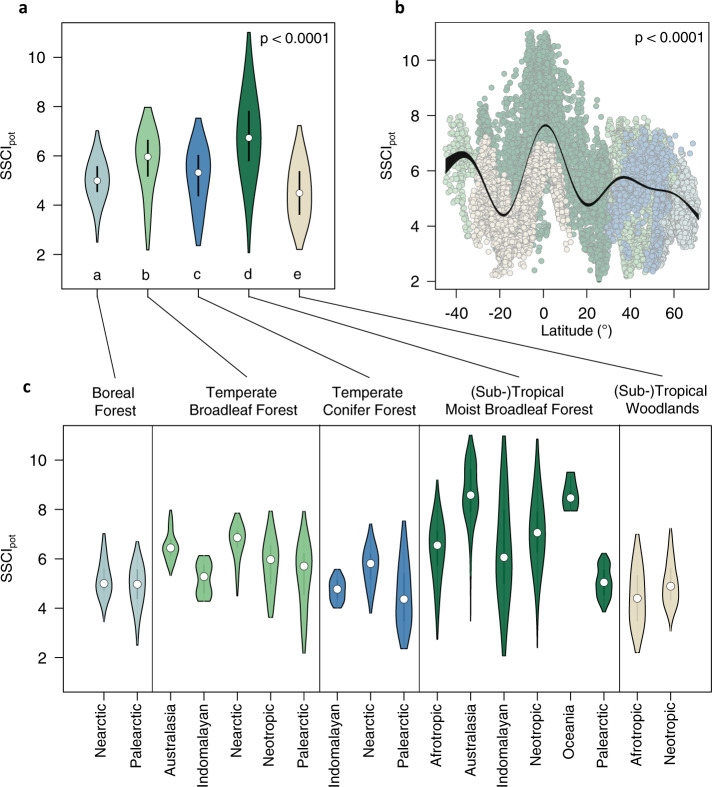
Fig. 3. Global variability and latitudinal patterns of the potential structural complexity.
Globally modeled forest structural complexity (SSCIpot), expressing the potential structural complexity across and within biomes (a), latitudes (b), and realms (c). Data points (n = 21,851) are samples based on a systematic global sampling grid with a distance of 50 km between points. Letters in a indicate significant differences in SSCIpot between biomes (one-way ANOVA, Tukey HSD post-hoc test, p < 0.0001). White dots mark the median, black lines the interquartile range and colored violins the probability density of the underlying distribution. The black band in b represents the 95% confidence interval of a thin-plate regression spline based on a generalized additive model (p < 0.0001).
Fig. 4
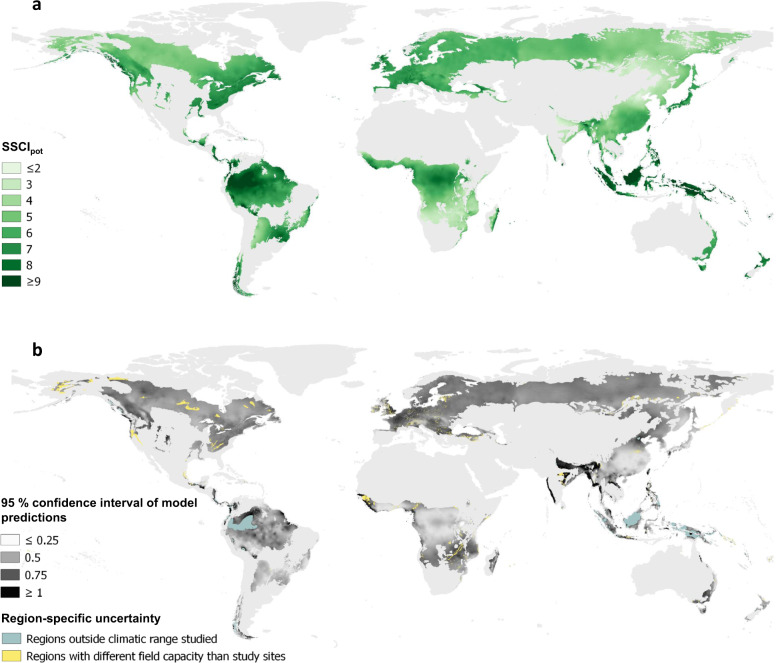
Fig. 4. Global patterns of potential structural complexity.
a Potential structural complexity (SSCIpot) in forest ecoregions across biomes. SSCIpot depiction was confined to biomes that were sampled within the frame of this study and are classified as forest or woodland ecoregion according to Olson et al. SSCIpot of Mediterranean Forests and Woodlands, Dry Broadleaf Forests, Tropical Conifer Forests and Mangroves is not shown here. Predictions are based on the WorldClim2 dataset for the years 1971–2000 and were made at 30 arcsecond resolution. b 95% confidence interval of SSCIpot model predictions. Regions outside the climatic range studied and regions with different soil conditions than our study sites are marked in light blue and yellow, respectively, because we cannot reliably quantify the uncertainty of model predictions for those areas.

References

    1. Ali A, et al. Impacts of climatic and edaphic factors on the diversity, structure and biomass of species-poor and structurally-complex forests. Sci. Total Environ. 2020;706:135719. doi: 10.1016/j.scitotenv.2019.135719. - DOI - PubMed
    1. Gauthier S, Bernier P, Kuuluvainen T, Shvidenko AZ, Schepaschenko DG. Boreal forest health and global change. Science. 2015;349:819–822. doi: 10.1126/science.aaa9092. - DOI - PubMed
    1. Seidl R, et al. Forest disturbances under climate change. Nat. Clim. Change. 2017;7:395–402. doi: 10.1038/nclimate3303. - DOI - PMC - PubMed
    1. Penone C, et al. Specialisation and diversity of multiple trophic groups are promoted by different forest features. Ecol. Lett. 2019;22:170–180. doi: 10.1111/ele.13182. - DOI - PubMed
    1. Stein A, Gerstner K, Kreft H. Environmental heterogeneity as a universal driver of species richness across taxa, biomes and spatial scales. Ecol. Lett. 2014;17:866–880. doi: 10.1111/ele.12277. - DOI - PubMed

Publication types