. 2021 Jan 22;12(1):539.
doi: 10.1038/s41467-020-20709-9.

Group-level cooperation in chimpanzees is shaped by strong social ties

Affiliations

Group-level cooperation in chimpanzees is shaped by strong social ties

Liran Samuni et al. Nat Commun. .

Abstract

Humans maintain extensive social ties of varying preferences, providing a range of opportunities for beneficial cooperative exchange that may promote collective action and our unique capacity for large-scale cooperation. Similarly, non-human animals maintain differentiated social relationships that promote dyadic cooperative exchange, but their link to cooperative collective action is little known. Here, we investigate the influence of social relationship properties on male and female chimpanzee participations in a costly form of group action, intergroup encounters. We find that intergroup encounter participation increases with a greater number of other participants as well as when participants are maternal kin or social bond partners, and that these effects are independent from one another and from the likelihood to associate with certain partners. Together, strong social relationships between kin and non-kin facilitate group-level cooperation in one of our closest living relatives, suggesting that social bonds may be integral to the evolution of cooperation in our own species.


Conflict of interest statement

The authors declare no competing interests.

Figures
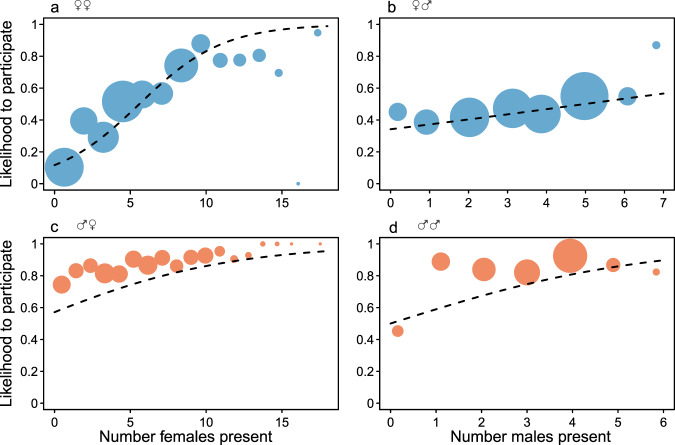
Fig. 1
Fig. 1. Does ‘strength in numbers’ influence participation?
The effects of the presence of number of other females (a and c) and males (b and d) on the likelihood to participate in intergroup encounters in females (blue, 75 individuals) and males (orange, 36 individuals). Larger point denotes larger number of observations and dashed lines represent the model lines. Source data are provided as a Source Data file.
Fig. 2
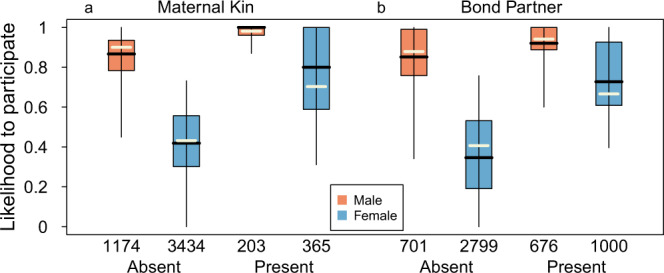
Fig. 2. Does predictability of reciprocity influence participation?
The effect of the presence of a adult maternal kin or b social bond partner on the likelihood to participate in intergroup encounters in males (orange, 36 individuals) and females (blue, 75 individuals). The black horizontal lines represent medians, the boxes represent quartiles, the vertical lines represent the 5th and 95th precentiles, and the white horizontal line represent the fitted model. Source data are provided as a Source Data file.
Fig. 3
Fig. 3. Does spatial proximity influence participation?
The effect of average dyadic association with all adult participants on the likelihood of a females (blue, 75 individuals) and b males (orange, 36 individuals) to participate in intergroup encounters. Larger point denotes larger number of observations and dashed lines represent the model lines. Source data are provided as a Source Data file.
Fig. 4
Fig. 4. Home range estimations of North, South, and East groups.
Presented are the 95% (dashed lines) and 99% (solid lines) kernel home range utilization areas of North group (blue), South group (yellow), and East group (red). The 95% and 99% kernel home range sizes were 19 and 30 km2 in North, 38 and 49 km2 in South, and 32 and 43 km2 in East, respectively. The home range overlap at 99% Kernel was 1.3 km2 between North and South, and 15 km2 between South and East. There was no home range overlap between North and East.

References

    1. House JS, Landis KR, Umberson D. Social relationships and health. Science. 1988;241:540–545. doi: 10.1126/science.3399889. - DOI - PubMed
    1. Holt-Lunstad J, Smith TB, Layton JB. Social relationships and mortality risk: a meta-analytic review. PLoS Med. 2010;7:e1000316. doi: 10.1371/journal.pmed.1000316. - DOI - PMC - PubMed
    1. Silk JB, Alberts SC, Altmann J. Social bonds of female baboons enhance infant survival. Science. 2003;302:1231–1234. doi: 10.1126/science.1088580. - DOI - PubMed
    1. Wittig RM, et al. Social support reduces stress hormone levels in wild chimpanzees across stressful events and everyday affiliations. Nat. Commun. 2016;7:13361. doi: 10.1038/ncomms13361. - DOI - PMC - PubMed
    1. Schülke O, Bhagavatula J, Vigilant L, Ostner J. Social bonds enhance reproductive success in male macaques. Curr. Biol. 2010;20:2207–2210. doi: 10.1016/j.cub.2010.10.058. - DOI - PubMed

Publication types

LinkOut - more resources